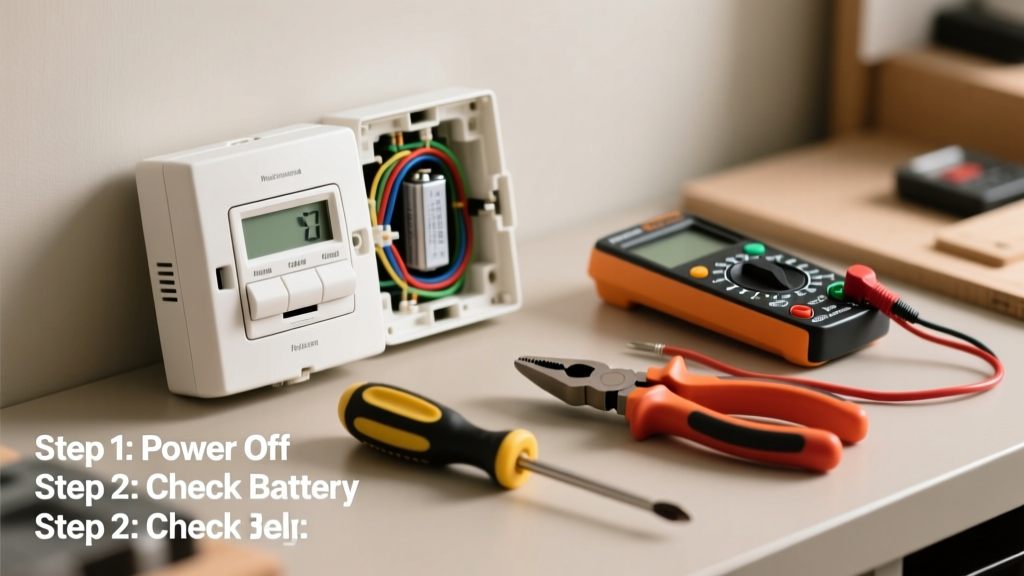
Your thermostat goes dark or ignores commands — and suddenly your furnace won’t kick on or your AC stays silent. This isn’t just inconvenient; it can lead to frozen pipes in winter or heat stress in summer. Most unresponsive thermostats stem from simple issues you can resolve in under 30 minutes.
Quick Diagnosis
Before grabbing tools, rule out the obvious causes:
- No power at the thermostat (dead batteries or tripped breaker)
- Loose or corroded wiring at the thermostat or HVAC control board
- Tripped safety switch on the furnace or air handler
- Blown low-voltage transformer (typically 24V AC)
- Firmware freeze or display failure in smart thermostats
Tools & Materials Needed
| Item | Purpose | Estimated Cost |
|---|---|---|
| Digital multimeter | Test voltage at terminals and verify 24V AC supply | $25–$65 |
| AA or AAA batteries (alkaline) | Replace dead or leaking batteries in battery-powered models | $3–$8 |
| Small Phillips screwdriver | Remove faceplate and mounting base safely | $4–$12 |
| Wire brush or contact cleaner | Clean corrosion off terminal screws and wire ends | $6–$15 |
| Labeling tape & pen | Mark wires before disconnecting to prevent miswiring | $2–$5 |
Step-by-Step Fix
- Check power source: For battery-operated thermostats, replace all batteries—even if one looks fine. For hardwired units, flip the HVAC circuit breaker off and back on, then verify power at the furnace’s low-voltage terminal block using a multimeter.
- Inspect wiring connections: Turn off power, remove the thermostat faceplate, and check for loose, frayed, or green-corroded wires at both the thermostat and furnace control board. Tighten terminals and clean contacts with a wire brush.
- Reset the thermostat: For smart models (Nest, Ecobee, Honeywell T9), hold the reset button for 10 seconds or perform a factory reset via app settings. For older mechanical units, toggle the system switch off/on three times rapidly.
- Test transformer output: At the furnace, locate the 24V transformer. With power on, measure voltage between R (hot) and C (common) terminals. If reading is below 22V AC or zero, the transformer likely needs replacement.
When to Call a Pro
Don’t risk electrical shock or HVAC damage in these scenarios:
- You measure 0V at the furnace transformer but the main breaker is on — indicates internal transformer or control board failure
- Wires show melted insulation, burn marks, or smell of ozone near the thermostat or furnace
- Your thermostat repeatedly loses calibration or reboots after successful reset — points to failing motherboard or firmware corruption
- You’re uncomfortable handling low-voltage wiring or lack a working multimeter
According to the U.S. EPA, 14% of household water usage is from leaks — but when it comes to HVAC,
"Over 60% of service calls for 'no heat' originate from thermostat-related issues that could be resolved without technician dispatch," says HVAC Technician Certification Board's 2023 Field Survey Report.
Prevention Tips
- Replace thermostat batteries every 12 months — even if the display stays lit
- Visually inspect wiring connections during seasonal HVAC maintenance (spring and fall)
- Keep thermostat away from direct sunlight, drafts, or heat sources like lamps or TVs
- Update smart thermostat firmware quarterly — enable auto-updates if available
Why does my thermostat go blank when I change the filter?
This usually signals a shorted blower motor or clogged condensate drain triggering a safety lockout — not a thermostat issue. Check for standing water in the drain pan and inspect the furnace’s limit switch.
Can I bypass the thermostat to test the HVAC system?
Yes — but only temporarily and with extreme caution. Jumping R to W (heat) or R to Y (cool) at the furnace control board will activate the system directly. Never jump more than two wires, and never do this with power on unless trained. Learn safe HVAC wiring basics first.
Is a buzzing sound from the thermostat dangerous?
A faint buzz may indicate a failing relay or transformer; a loud, persistent buzz often means arcing at a loose connection. Turn off power immediately and inspect wiring — review our home electrical safety checklist.
Will resetting my thermostat delete my schedule?
Yes — a full factory reset erases Wi-Fi credentials, custom schedules, and geofencing rules. Back up settings via app or photo before resetting. Some models (like Ecobee) allow cloud restore; others require manual re-entry.
How do I know if my thermostat is compatible with a new HVAC system?
Check the thermostat’s spec sheet for required wires (especially C-wire for power) and compatibility with variable-speed furnaces or heat pumps. Mismatched systems cause erratic behavior — see our compatibility guide for model-specific checks.
What’s the average lifespan of a programmable thermostat?
Most last 10–15 years. After 10 years, internal capacitors degrade, displays dim, and sensors drift. If your unit is older and fails multiple diagnostics, replacement is more reliable than repair.
Thermostat failures rarely mean your entire HVAC system is failing — but they’re your first warning sign. Address them promptly, methodically, and safely. A few minutes spent troubleshooting today keeps your home comfortable tomorrow — and avoids $150+ emergency service fees before sunrise.