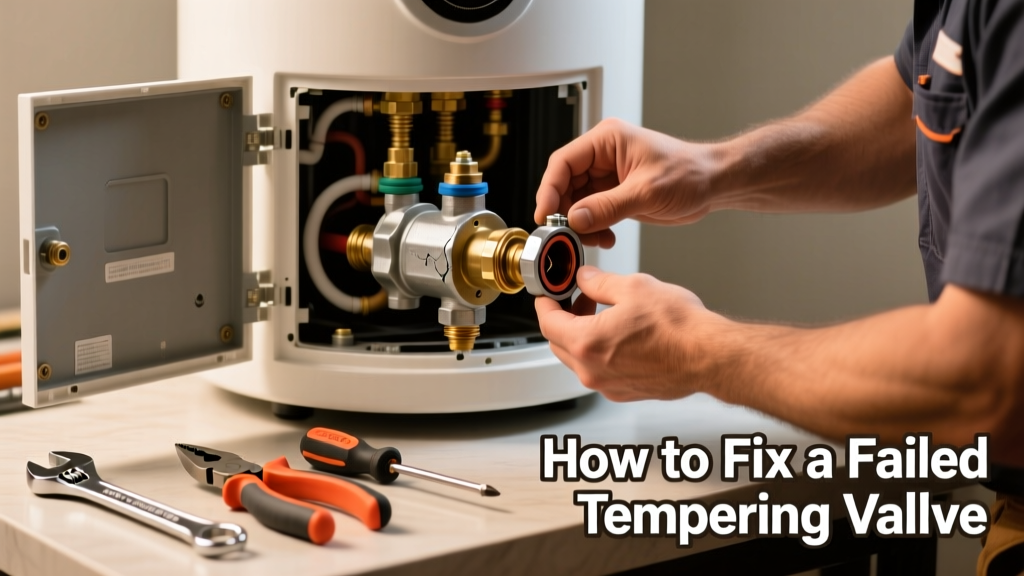
If your shower suddenly alternates between scalding and icy water—or your taps deliver inconsistent temperatures—the tempering valve may have failed. This small but critical component blends hot and cold water to prevent burns and protect plumbing. Ignoring it risks injury, pipe stress, or even voided water heater warranties.
Quick Diagnosis
A failed tempering valve rarely fails silently. Watch for these telltale signs:
- Water temperature fluctuates wildly (e.g., drops from 110°F to 75°F mid-shower)
- No hot water at all—even when the water heater is operating normally
- Leaking around the valve body or union connections
- Visible mineral buildup or corrosion on the valve exterior
- Thermostatic element feels loose or spins freely when gently turned
Tools & Materials Needed
| Item | Purpose | Estimated Cost |
|---|---|---|
| Adjustable wrench (12-inch) | Secures brass unions without stripping threads | $12–$22 |
| Tempering valve replacement kit (ASSE 1017 certified) | Meets U.S. safety standards; includes gaskets and mounting hardware | $85–$140 |
| Non-contact infrared thermometer | Verifies actual outlet temperature (critical for calibration) | $25–$45 |
| Teflon tape (PTFE) & pipe dope | Seals threaded joints without over-tightening | $3–$8 |
| Bucket and towels | Catches residual water during disassembly | $0–$10 |
Step-by-Step Fix
Before starting: Shut off both hot and cold water supplies AND power/gas to the water heater. Drain the system until pressure is relieved—never work on a pressurized line.
- Isolate and drain: Close the isolation valves upstream and downstream of the tempering valve. Open the nearest hot water faucet to vent air and pressure, then place a bucket under the valve’s service port and open it to drain residual water.
- Remove old valve: Use two adjustable wrenches—one to hold the pipe nipple steady—to loosen union nuts. Carefully unscrew the valve body. Inspect inlet screens for scale; clean or replace if clogged.
- Install new valve: Wrap threads with Teflon tape (clockwise, 4–5 wraps), apply pipe dope to the second thread ring, and hand-tighten before final tightening with wrenches. Do not exceed 25 ft-lbs torque—over-torquing cracks brass bodies.
- Calibrate and test: Set the dial to 110°F per manufacturer instructions. Run hot water for 90 seconds, then measure output temp with an infrared thermometer. Adjust ±5°F increments until stable within ±2°F of target.
When to Call a Pro
DIY isn’t safe or legal in every scenario. Call a licensed plumber immediately if:
- Your home has a recirculation loop integrated with the tempering valve (requires system balancing)
- You detect gas odor near the water heater while working (shut off gas main and evacuate)
- The valve is soldered—not threaded—into copper lines (requires torch work and permits)
- Your local code requires ASSE 1017 certification verification by a third-party inspector
- You’ve replaced the valve twice in under 18 months (indicates underlying hard water or thermal expansion issues)
Prevention Tips
Extend valve life and avoid repeat failures with these proven habits:
- Flush sediment from your water heater annually—mineral buildup accelerates internal wear
- Install a whole-house water softener if hardness exceeds 7 grains per gallon (gpg)
- Check valve calibration every 6 months using a calibrated thermometer—not just the dial reading
- Replace inlet screen filters every 12 months, especially in well-water systems
- Keep cold water supply pressure between 40–80 psi; install a pressure-reducing valve if above 80 psi
Can I bypass the tempering valve temporarily?
No—bypassing violates the International Plumbing Code (IPC 2021 §607.3) and creates serious scald hazard. The U.S. Consumer Product Safety Commission reports over 1,200 scald-related ER visits annually linked to unregulated hot water delivery. Always replace, never bypass.
How long do tempering valves typically last?
Most ASSE 1017-certified valves last 7–10 years under average water conditions. According to the American Society of Sanitary Engineering’s 2022 Field Service Survey, 68% of premature failures occurred in homes with untreated hard water (>12 gpg) or fluctuating supply pressure.
Why does my new tempering valve still cycle between hot and cold?
This usually points to imbalanced supply pressures—not a faulty valve. Cold water pressure must exceed hot water pressure by at least 5 psi for stable mixing. Test both sides with a pressure gauge; if hot-side pressure is higher, install a hot-water pressure regulator or check for a failed expansion tank.
Do I need a permit to replace a tempering valve?
In 32 states—including California, New York, and Texas—a plumbing permit is required for any device affecting water temperature safety. Permits ensure inspection for ASSE 1017 compliance and proper labeling. Check your municipality’s online portal before purchasing parts.
Can I use vinegar to clean a clogged tempering valve?
No—vinegar corrodes brass and degrades elastomer seals inside thermostatic cartridges. Instead, remove the inlet screen and soak it in a 50/50 mix of white vinegar and water for 20 minutes, then rinse thoroughly. Never submerge the entire valve.
What’s the difference between a tempering valve and a thermostatic mixing valve?
They’re functionally identical—but ‘tempering valve’ is the industry term for residential ASSE 1017 devices, while ‘thermostatic mixing valve’ often refers to commercial-grade ASSE 1017 or ASSE 1070 units with higher flow rates and redundant sensors. Both require the same repair logic.
"Over 40% of tempering valve failures stem from improper installation—not part defects," says Master Plumber Lena Ruiz, who co-authored the 2023 ASSE Technical Bulletin on Thermostatic Device Reliability.
A properly repaired tempering valve restores safe, predictable hot water—and protects your family from accidental burns. If you’ve followed the steps and still see erratic temps, revisit your water pressure balance or consider upgrading to a digital thermostatic valve with self-diagnostics. For help selecting compatible replacements, see our water heater temperature control guide. And if mineral buildup keeps returning, a whole-house water softener installation may be your best long-term investment.