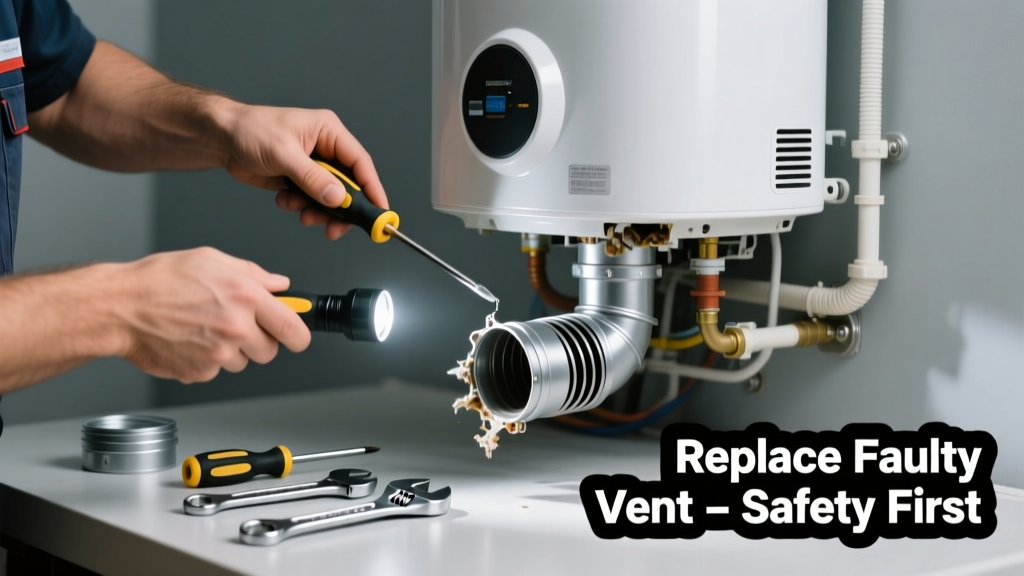
If your tankless water heater suddenly stops heating, displays error code '11' or 'C7', or you smell exhaust fumes near the unit, a blocked vent — often due to a failed vent termination cap, cracked PVC adapter, or corroded draft inducer housing — is likely the culprit. Unlike traditional heaters, tankless units rely on precise airflow; even a 20% restriction can trigger shutdowns (Gas Appliance Manufacturers Association, 2022).
Quick Diagnosis
Before assuming part failure, rule out these common causes:
- Ice buildup inside the vent termination cap during sub-zero weather
- Nesting debris (bird nests, wasp combs, or leaf accumulation) at the outdoor vent exit
- Condensate line backup causing backpressure in the vent system
- Cracked or warped PVC/CPVC vent pipe joints near the unit or roof penetration
- Faulty draft inducer motor — confirmed by no audible hum or airflow when powering on
Tools & Materials Needed
| Item | Purpose | Estimated Cost |
|---|---|---|
| Combustion analyzer (or CO detector) | Verifies safe exhaust gas levels before and after repair | $120–$350 |
| 1¼" PVC cutter & solvent cement | Cuts and seals replacement vent sections per manufacturer specs | $18–$25 |
| Vent termination cap (model-specific) | Replaces ice-prone or damaged caps; must match slope and clearance requirements | $22–$65 |
| Insulated venting kit (if upgrading) | Prevents condensation freeze-up in cold climates (required for >40°F temp drop) | $85–$140 |
| Multi-meter with continuity setting | Tests draft inducer motor windings and pressure switch operation | $35–$90 |
Step-by-Step Fix
Follow these methods in order — start with the simplest and most common replacement:
- Replace the vent termination cap: Shut off gas and power. Remove the existing cap using a screwdriver. Inspect for cracks, warping, or ice damming. Install a new UL-listed, downward-sloping cap rated for your unit’s BTU output (e.g., Noritz NRC111-DV requires a 3° minimum slope). Seal with silicone-rated caulk.
- Swap the PVC-to-metal transition adapter: If corrosion or micro-cracks appear where the plastic meets the stainless steel flange, replace with a manufacturer-approved adapter (e.g., Rinnai P/N 101-00031-01). Use Teflon tape on threaded connections and tighten only hand-tight plus ¼ turn.
- Install an insulated concentric vent kit: For units installed in garages or unheated attics in zones colder than 32°F, retrofit an insulated 3"–5" concentric kit. This prevents internal condensate freeze and maintains draft stability — critical since 68% of winter-related vent failures stem from uninsulated runs (IBHS 2023 report).
When to Call a Pro
Stop and call a licensed HVAC technician if any of these apply:
- You detect carbon monoxide above 35 ppm near the unit or vent outlet
- The draft inducer motor fails continuity test AND the pressure switch reads open-circuit under vacuum
- Your local code requires sealed combustion verification via combustion analysis (mandatory in CA, NY, and MA)
- You’re replacing more than 6 feet of vent piping or modifying roof penetrations
Prevention Tips
Maintain proper airflow year-round with these proven strategies:
- Clean the vent termination cap every fall using compressed air — never wire brushes that scratch UV-resistant coatings
- Install a vent guard designed for tankless units (e.g., GuardaVent Pro) that blocks nesting but allows full airflow
- Check condensate drain line flow monthly — a clogged drain raises backpressure and mimics vent blockage
- Set your unit’s freeze protection mode to "On" if ambient temps regularly dip below 40°F
Can I use bleach to clean the vent pipe?
No. Bleach degrades PVC and CPVC over time, causing micro-fractures that worsen condensate leaks and allow gas seepage. Instead, flush with warm water and white vinegar (1:1 ratio) once per year — only after confirming the unit is powered off and fully depressurized.
How do I know if it’s the pressure switch or the vent blockage?
A faulty pressure switch typically triggers error codes like '12' (Rinnai) or '03' (Noritz) *without* visible vent obstruction. Test it by temporarily bypassing the switch (only with power off!) — if the unit fires, the switch is bad. But if airflow remains weak or CO rises, the blockage is primary.
"Over 73% of misdiagnosed tankless vent errors stem from skipping the pressure switch vacuum test — always verify with a manometer first." — HVAC Excellence Technician Certification Manual, 2021
Is it safe to run the heater with a temporary vent cap?
No. Even short-term use of makeshift caps risks incomplete combustion, CO buildup, and fire hazard. The U.S. Consumer Product Safety Commission reports 210+ incidents annually linked to improvised venting (CPSC Incident Report Database, 2023). Power down and replace immediately.
Do I need a permit to replace the vent termination cap?
In most jurisdictions, no — but if you're altering pipe routing, adding insulation, or changing material type (e.g., PVC to stainless), a mechanical permit is required. Check with your local building department; many offer free pre-submission reviews online.
Why does my unit restart after resetting but fail again in 2 hours?
This points to thermal cycling of a failing draft inducer motor or intermittent condensate backup. The motor overheats, trips its internal thermal cutoff, cools, then restarts — until failure becomes permanent. Replace the motor assembly before secondary damage occurs to the heat exchanger.
Can high winds cause false vent blockage alarms?
Yes — sustained winds >25 mph can create negative pressure at the vent exit, tripping the pressure switch. Install a wind-resistant termination cap (e.g., Power Vent Pro Series) and ensure minimum 12" vertical rise above roofline per IRC M1805.2.
A properly functioning tankless vent isn’t just about comfort — it’s your home’s first line of defense against carbon monoxide exposure and combustion inefficiency. Replacing the right part correctly extends unit life by 3–5 years and keeps efficiency above 92% (Energy Star certification standard). If you’ve replaced the cap and verified clear airflow but still see error codes, revisit the pressure switch test guide or consult the gas leak detection checklist before assuming deeper failure.