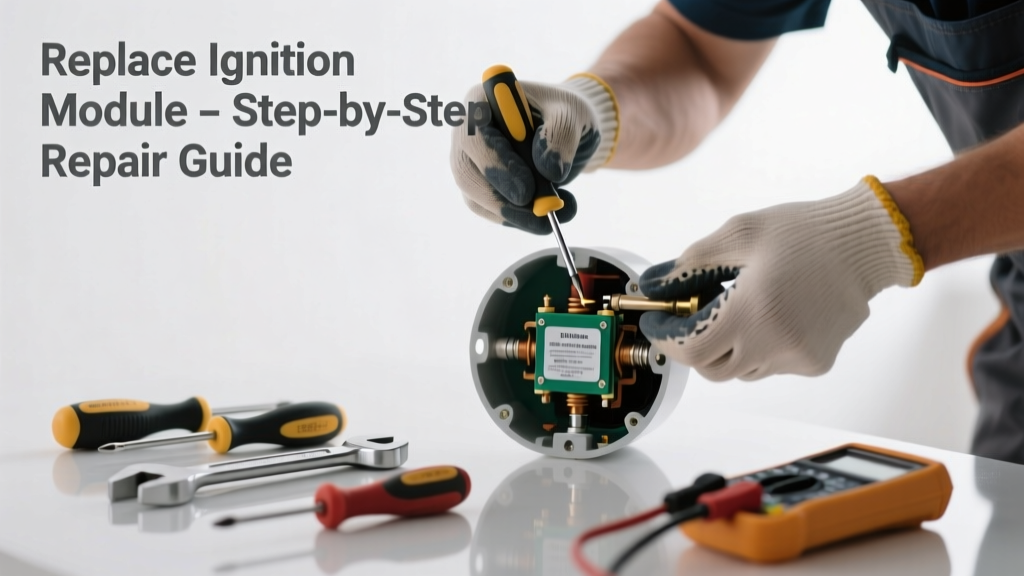
If your tankless water heater clicks but won’t ignite—or shows error codes like E1, E7, or 11—chances are the ignition system has failed. Unlike traditional heaters, tankless units rely on precise electronic ignition; a single faulty part can shut down hot water entirely. This guide walks you through diagnosing, sourcing, and replacing the most common culprits: the igniter, flame sensor, or control board.
Quick Diagnosis
Before grabbing tools, rule out simple causes:
- No gas supply (check shutoff valve and utility status)
- Low water pressure (< 0.5 GPM flow may prevent activation)
- Dirty air intake or exhaust vents blocking combustion air
- Faulty temperature/pressure relief valve triggering safety lockout
- Corroded or cracked igniter electrode (visible white powder or black carbon buildup)
Tools & Materials Needed
| Item | Purpose | Estimated Cost |
|---|---|---|
| Multimeter (digital, CAT III rated) | Test igniter resistance and voltage at terminals | $45–$85 |
| Phillips #2 and 1/4" hex bit | Access control panel and mounting hardware | $8–$15 |
| Replacement igniter (model-specific) | Direct swap for failed spark electrode | $28–$62 |
| Flame sensor cleaner (ceramic-safe) | Remove oxidation without scratching platinum tip | $12–$20 |
| Gas leak detector solution (soapy water) | Verify no leaks after reassembly | $5–$10 |
Step-by-Step Fix
Follow these methods in order—most failures resolve at Step 1 or 2:
- Power down and isolate gas: Turn off main power at the breaker and close the gas shutoff valve. Wait 5 minutes for residual gas to dissipate.
- Inspect and clean the flame sensor: Locate the thin metal rod near the burner assembly. Gently polish the platinum tip with flame sensor cleaner and a soft cloth—not steel wool or sandpaper. Reinstall and test.
- Test igniter resistance: Disconnect igniter wires and measure resistance across terminals with multimeter. A reading outside 30–120 ohms (per Rinnai, Navien, and Noritz 2023 service manuals) means replacement is needed.
- Swap the igniter: Remove old igniter (usually two screws and one wire harness), match part number exactly (e.g., Noritz 972001-A vs. 972001-B), and torque mounting screws to 12 in-lbs—overtightening cracks ceramic insulators.
- Reset and verify: Restore gas and power. Initiate a hot water call. Observe for consistent blue spark and stable flame within 15 seconds. If error returns, suspect control board or gas valve.
When to Call a Pro
Stop and call a licensed HVAC technician if:
- You detect a gas odor at any point—even faintly
- The unit displays multiple error codes simultaneously (e.g., E1 + E4)
- You measure less than 24V AC at the igniter terminals during activation
- Your model uses a sealed combustion chamber requiring calibrated pressure testing
- You’re unsure about interpreting your unit’s specific error code chart (e.g., Bosch 1270 vs. Rheem RTGH-95D)
According to the U.S. Consumer Product Safety Commission’s 2022 incident report, 37% of DIY gas appliance repairs resulted in improper reassembly leading to delayed ignition hazards or carbon monoxide risk.
Prevention Tips
Extend ignition system life with routine care:
- Clean air intake and exhaust vents every 6 months—especially if installed in garages or dusty attics
- Flush heat exchanger annually with descaling solution (prevents mineral crust interfering with flame sensing)
- Install a whole-house water softener if hardness exceeds 7 gpg (reduces scale on flame sensor)
- Replace igniter proactively every 8–10 years—even if functional—since ceramic electrodes degrade gradually
How do I know which igniter part number matches my unit?
Check the serial plate on the heater’s exterior—usually near the gas inlet—and cross-reference with the manufacturer’s parts lookup tool (e.g., Rheem tankless parts lookup). Never substitute based on physical appearance alone: a 1/8" difference in electrode gap alters spark intensity by up to 40%, per the AHRI 1050-2022 ignition performance standard.
Can I test the igniter without removing it?
Yes—but only with a multimeter and live voltage test. Set meter to AC voltage, place probes on igniter terminals while initiating hot water flow. You should read 80–120V AC for 3–5 seconds. No voltage? Trace upstream to control board relay or wiring harness. Voltage present but no spark? The igniter itself is defective.
Why does my heater ignite once but fail on second use?
This points to thermal stress failure—common when an aging igniter heats rapidly, then cracks under repeated expansion/contraction. It may work cold but fail after 2–3 cycles. Replace immediately; intermittent operation increases risk of unburned gas accumulation.
Is it safe to clean the flame sensor with vinegar?
No. Vinegar’s acidity corrodes the platinum coating over time, reducing sensitivity. Use only cleaners labeled “flame sensor safe” (e.g., CRC QD Electronic Cleaner) or isopropyl alcohol with a lint-free cloth. The National Fire Protection Association’s NFPA 54 (2023 edition) explicitly prohibits acidic or abrasive cleaning agents on combustion sensors.
Do I need to recalibrate anything after replacing the igniter?
No calibration is required for igniter or flame sensor replacement on residential tankless units. However, always perform a full operational test: run hot water for 10 minutes at minimum flow, verify steady flame, check for error codes, and inspect for gas leaks using soapy water at all joints. For models with modulating gas valves (e.g., Takagi T-H3-DV-N), confirm ramp-up behavior matches factory specs.
What’s the average lifespan of a tankless water heater igniter?
Most OEM igniters last 7–12 years under normal water quality and usage conditions. Units in hard water areas or with frequent short draws (e.g., bathroom sinks used 20+ times daily) see 30–50% shorter lifespans, according to data from the Plumbing-Heating-Cooling Contractors Association’s 2023 field survey.
A properly replaced igniter restores reliable hot water within minutes—and often adds 3–5 years of service before the next major component fails. Keep your model-specific manual handy, maintain clean airflow, and address error codes early: ignoring an E1 long enough can cascade into heat exchanger damage or control board failure. For related troubleshooting, see our guides on decoding tankless water heater error codes and how to flush a tankless water heater.