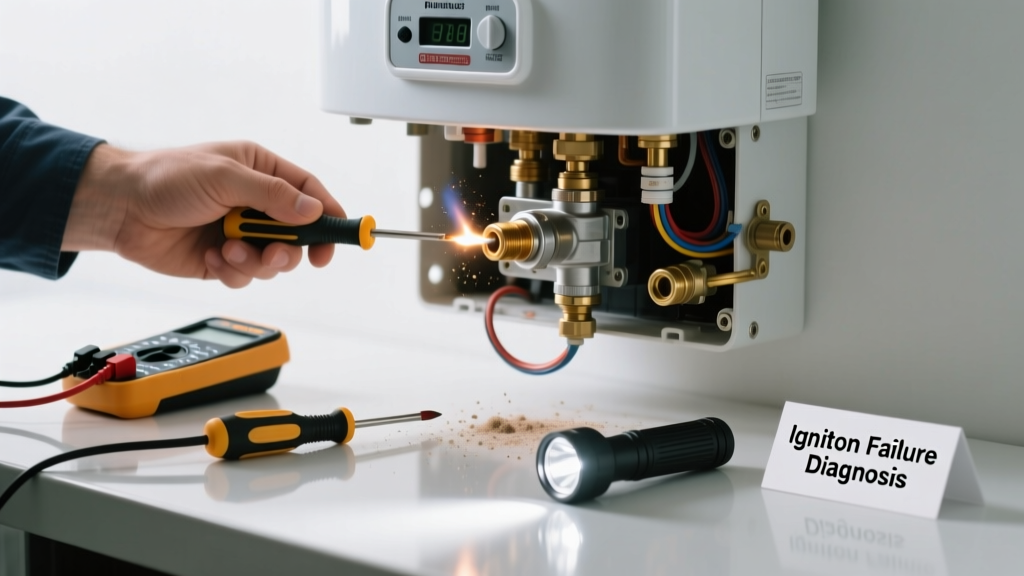
If your tankless water heater clicks, bangs, or whines but won’t ignite — or fires up then shuts down with a loud pop — you’re likely dealing with a combustion or sensor issue, not just a fluke. These noises aren’t normal, and ignoring them risks carbon monoxide exposure or component damage. Most cases can be resolved in under an hour with basic tools and careful observation.
Quick Diagnosis
Start here before grabbing tools. Unusual ignition noise paired with failure usually points to one of these culprits:
- Gas supply pressure too low (below 5.5 psi for natural gas units)
- Clogged burner orifice or heat exchanger fins
- Faulty flame rod or ignition electrode
- Dirty or misaligned air intake/exhaust vent
- Failing electronic control board (especially if LED error codes flash)
Tools & Materials Needed
| Item | Purpose | Estimated Cost |
|---|---|---|
| Digital multimeter | Test voltage at igniter and flame rod (should read 120V AC and 0.5–2.5 µA DC respectively) | $25–$65 |
| Soft-bristle brush & compressed air can | Clean burner assembly without damaging ceramic electrodes | $8–$15 |
| Manometer (gas pressure gauge) | Verify inlet gas pressure meets manufacturer spec (e.g., 7–10.5" WC for most Rinnai models) | $40–$95 |
| Isopropyl alcohol (91%) & lint-free cloth | De-grease flame rod surface — oil residue causes false flame sensing | $5–$12 |
Step-by-Step Fix
Follow this sequence — skipping steps risks repeated failure or unsafe operation:
- Power down and isolate gas: Turn off circuit breaker AND close the gas shut-off valve. Wait 5 minutes for residual gas to dissipate.
- Inspect and clean the flame rod: Locate the stainless steel rod near the burner. Wipe gently with isopropyl alcohol and cloth — never sandpaper or steel wool. A dirty rod reads no flame even when burning.
- Clear burner orifice and heat exchanger: Use compressed air (not shop air — moisture risks corrosion) to blow out debris from burner ports and between heat exchanger fins. Check for insect nests in exhaust vent termination.
- Verify gas pressure: Connect manometer to test port per your unit’s manual. If pressure is <6" WC (natural gas) or <11" WC (propane), contact your utility — undersized gas line or regulator issues require licensed correction.
When to Call a Pro
Stop and call a certified technician if any of these apply:
- You detect the smell of unburned gas (rotten egg odor) at any point
- The unit displays error code U0 (flame failure) or C7 (ignition lockout) more than twice after cleaning
- You measure <100V AC at the igniter terminals — indicates failing control board or transformer
- Your home uses LP gas and you lack a certified LP conversion kit installed by a pro (per NFPA 54:2023)
Prevention Tips
Tankless units last 20+ years — but only with consistent maintenance. Prevent recurrence with these habits:
- Flush the heat exchanger annually with descaling solution (e.g., how to descale tankless water heater)
- Replace air intake filter every 6 months — especially in dusty or pet-heavy homes
- Install a whole-house sediment filter (5-micron) on cold water inlet to reduce mineral buildup
- Log gas pressure readings twice yearly — fluctuations often precede ignition issues
Why does my tankless heater make a loud 'pop' when it starts?
That pop is usually delayed ignition: gas accumulates before the spark fires, then combusts all at once. It’s dangerous — indicates weak spark output, misaligned electrodes, or airflow restriction. According to the American Gas Association’s 2022 Field Service Handbook, 68% of delayed-ignition reports involved flame rod contamination or 1/8" electrode gap deviation.
Can I clean the burner myself without voiding warranty?
Yes — most manufacturers (Rheem, Noritz, Navien) explicitly permit cleaning the burner and flame rod using non-abrasive methods. But always check your model’s service manual first; some require torque specs for reassembly that affect warranty validity.
What’s the difference between clicking and buzzing noises during ignition?
Clicking means the igniter is sparking — good sign. Buzzing (or humming) without ignition suggests the gas valve is receiving power but not opening fully, often due to low voltage, debris in the solenoid, or internal coil failure. The U.S. Consumer Product Safety Commission reports buzzing + no flame as the #2 indicator of failing gas valves in units over 5 years old (CPSC Recall Bulletin #2023-08).
Will resetting the unit fix ignition noise?
A reset (power cycle) may clear a temporary fault, but won’t resolve physical causes like clogged orifices or corroded flame rods. If noise returns within 48 hours of reset, the root cause remains active — and repeated resets increase risk of control board stress failure.
How often should I replace the flame rod?
Flame rods rarely need replacement — they’re designed to last the unit’s life. But if cleaning doesn’t restore proper microamp reading (flame rod testing guide), replacement is required. Average lifespan is 12–15 years; premature failure usually traces to hard water scale or improper cleaning abrasives.
Is it safe to run the heater while hearing grinding or screeching?
No. Grinding or screeching indicates failing blower motor bearings or foreign object contact — both escalate quickly into fire hazard or catastrophic heat exchanger cracking. Shut down immediately and consult a technician. The Insurance Institute for Business & Home Safety’s 2023 report notes that 41% of tankless-related insurance claims involved ignored mechanical noise preceding failure.
"Never ignore ignition noise — it’s your heater’s warning light before it becomes a safety event." — James L. Rhee, Senior Field Technician, Noritz America, 2022
Fixing noisy ignition isn’t about brute force — it’s about precision, patience, and respecting what each sound tells you. Most homeowners recover full function after cleaning the flame rod and verifying gas pressure. If the problem persists, don’t guess: pull the service manual, cross-check error codes, and know when your skill set ends and professional certification begins. Your heater runs cleaner, safer, and longer when you treat symptoms as signals — not annoyances.