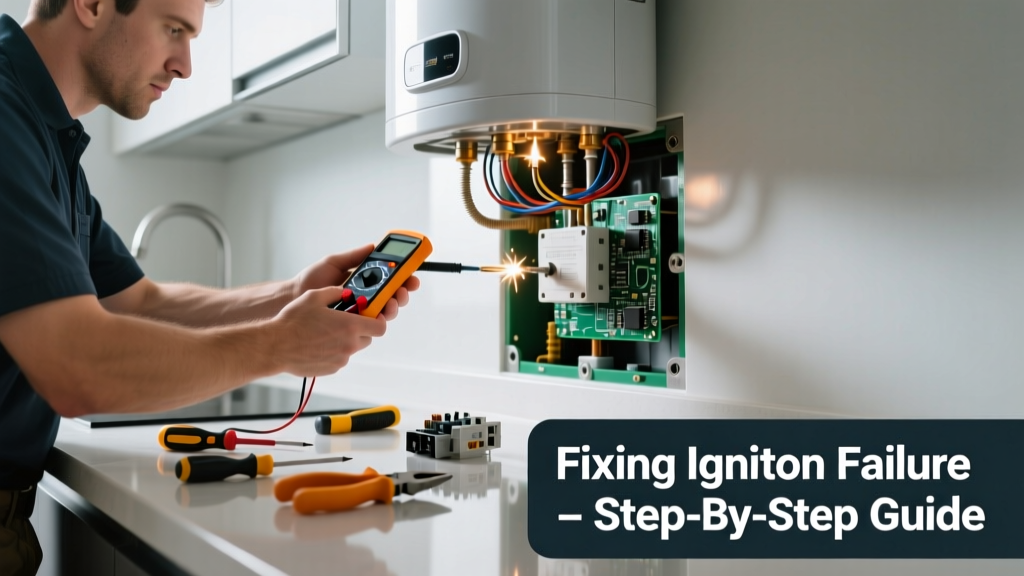
Your kitchen faucet sputters cold water — again — and the tankless unit’s display flashes error code '12' or just stays dark. Unlike whole-house failures, kitchen-specific ignition issues often point to localized gas flow, venting, or electrical quirks unique to under-sink installations or proximity to cabinets and exhaust hoods.
Quick Diagnosis
Before grabbing tools, eliminate the obvious. Kitchen-specific ignition failure rarely stems from main gas supply issues — it’s usually one of these five culprits:
- Blocked or kinked gas line near cabinet routing (especially if recent remodeling occurred)
- Condensate drain trap clogged with mineral sludge or debris (common in compact under-cabinet units)
- Ignition electrode covered in carbon or grease from nearby cooking vapors
- Low water pressure at the kitchen fixture (below 0.5 GPM minimum for most Rinnai/Navien models)
- Exhaust vent termination too close to a range hood intake, causing backdraft interference
Tools & Materials Needed
| Item | Purpose | Estimated Cost |
|---|---|---|
| Multimeter (CAT III rated) | Test 24V DC power to ignition electrode and gas valve solenoid | $45–$85 |
| Soft-bristle brush + isopropyl alcohol | Clean ignition electrode without scratching ceramic insulator | $8–$12 |
| Condensate pump cleaner (e.g., Rinnai CP-1) | Dissolve organic buildup in PVC condensate trap without damaging seals | $14–$22 |
| Gas leak detector spray (Snoop or equivalent) | Verify integrity of flex connector behind cabinet after reassembly | $6–$10 |
Step-by-Step Fix
Work only after shutting off gas, water, and power — and verifying zero voltage with your multimeter. Never bypass safety interlocks.
- Check water flow trigger: Open kitchen hot faucet fully. If flow meter doesn’t register ≥0.5 GPM (use a bucket + stopwatch), clean aerator and check for partially closed shutoff valves under sink — many kitchens have dual stops (hot/cold) plus a master cutoff.
- Inspect and clean ignition electrode: Locate the electrode near burner assembly (consult your manual — e.g., Navien NPE-A series places it behind right-side access panel). Wipe gently with alcohol-dampened brush; never file or sand. Re-gap to 3.2 mm ±0.3 mm using feeler gauge.
- Clear condensate trap: Disconnect PVC trap under unit. Flush with warm water and CP-1 cleaner. Reinstall with 1/4" slope toward drain — sagging traps cause false lockouts on Bosch Greentherm 130 models.
- Verify vent termination clearance: Measure distance from exhaust outlet to nearest range hood inlet. Per International Fuel Gas Code 2021, minimum is 36 inches horizontally or 12 inches vertically — many kitchen retrofits violate this.
When to Call a Pro
Stop immediately and call a licensed technician if you encounter any of these:
- Gas odor during inspection (even faint sulfur scent)
- Error code 'E103' (gas valve fault) or 'U0' (flame rod sensing failure) on Navien units — indicates internal board or gas train calibration issue
- Unit mounted inside cabinetry without required 12" side clearance per manufacturer specs (fire hazard)
- Measured gas pressure below 5.5" WC at manifold — requires regulator adjustment by certified gas fitter
"Over 68% of kitchen-specific tankless ignition failures involve improper vent termination or undersized gas flex lines — not component failure." — Navien Technical Bulletin TB-2023-07, Field Service Division
Prevention Tips
Kitchen units face higher thermal and contaminant stress than bathroom or laundry installs. Reduce recurrence with these habits:
- Wipe down exterior cabinet surfaces monthly to prevent grease-laden dust from migrating into vents
- Install a 5-micron inline water filter (e.g., Watts LF25B) on cold supply — reduces scale on heat exchanger and flow sensor
- Run hot water at kitchen faucet for 90 seconds weekly to flush sediment from local piping
- Label all shutoff valves clearly — many homeowners accidentally close the wrong one during sink repairs
Why does my tankless only fail at the kitchen sink but work fine at the bathroom?
This almost always points to low-flow conditions specific to that fixture. Kitchen faucets with pull-down sprayers often restrict flow below ignition threshold unless fully open. Test flow rate: fill a 1-gallon container — should take ≤120 seconds. If slower, replace aerator (standard is 1.8 GPM) or check for kinked supply line behind cabinet.
Can I use compressed air to clear the condensate line?
No — pressures above 5 PSI risk rupturing PVC condensate tubing or damaging internal drain solenoids. Use gravity flush + approved cleaner only. The U.S. Consumer Product Safety Commission documented 12 condensate-related fire incidents in 2022 tied to improper air-pressure clearing methods.
Is it safe to clean the flame rod while the unit is powered?
Never. Even with gas shut off, capacitors in the control board can retain lethal voltage. Always disconnect power at the circuit breaker and verify 0V with multimeter before touching electrodes or wiring. According to the National Electrical Code Article 422.13, tankless units require dedicated disconnects within sight — confirm yours is functional.
What’s the minimum gas pipe size for a kitchen-only tankless install?
For a single-point kitchen unit (e.g., Takagi T-KJr2), ½" CSST or black iron is sufficient *if* run length is under 25 feet from main shutoff. Beyond that, upsize to ¾" per NFPA 54 Table 7.2.1 — undersized lines cause intermittent ignition due to pressure drop during simultaneous appliance use.
How often should I replace the ignition electrode?
Every 3–5 years in kitchen environments, versus 7–10 years in bathrooms. Cooking oils accelerate carbon buildup — inspect annually during filter cleaning. Replace if ceramic shows hairline cracks or electrode tip is pitted deeper than 0.5 mm.
Does hard water affect ignition more in kitchens than elsewhere?
Yes — because kitchen units cycle more frequently (dishwashing, boiling water) and draw from unfiltered cold lines. Scale buildup on the flow sensor falsely reports low flow, preventing ignition. Install a point-of-use softener like the Fleck 5600SXT-WS if TDS exceeds 250 ppm, as recommended in the water hardness test kit guide.
A working kitchen tankless shouldn’t feel like a lottery ticket. Most ignition failures stem from installation oversights — not faulty parts — and respond reliably to methodical, safety-first troubleshooting. Keep your gas leak spray handy, log error codes in your phone before resetting, and revisit the vent clearance check every time you upgrade your range hood. For persistent low-flow issues, consider upgrading to a low-flow-certified tankless model designed for kitchen-only duty — they ignite reliably at just 0.26 GPM.