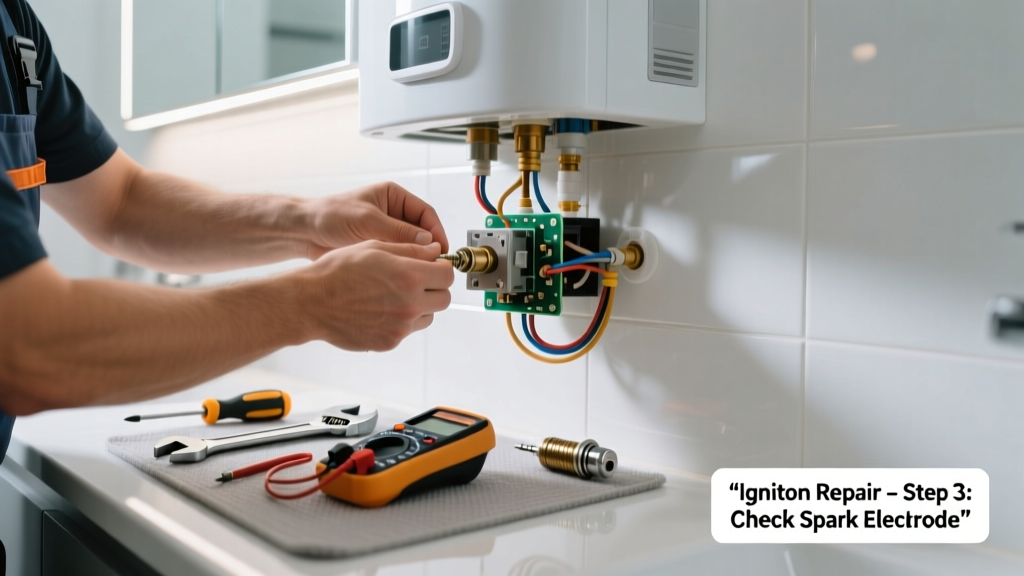
Your bathroom’s tankless water heater clicks but won’t ignite — no hot water at the sink or shower, just cold frustration. This isn’t a full system shutdown; it’s a localized ignition failure often tied to bathroom-specific conditions like low flow, gas pressure drops, or venting interference. Let’s get it firing again — safely and correctly.
Quick Diagnosis
Before grabbing tools, rule out these five most common causes of ignition failure in bathroom-only scenarios:
- Low water flow from a single-handle or flow-restricted faucet (tankless units need minimum GPM to trigger ignition)
- Gas pressure drop due to undersized supply line or shared branch feeding multiple fixtures
- Condensate drain clog or trap dry-out (especially in cold, unheated bathroom walls)
- Exhaust vent obstruction from spider webs, bird nests, or frost buildup in cold-climate exterior vents
- Ignition electrode misalignment or carbon buildup from hard water vapor condensation
Tools & Materials Needed
| Item | Purpose | Estimated Cost |
|---|---|---|
| Digital multimeter | Test 24V AC ignition circuit voltage and ground continuity | $25–$65 |
| Small wire brush & isopropyl alcohol | Clean ignition electrode tip without scratching ceramic insulator | $8–$12 |
| Gas pressure test gauge (0–15 psi) | Verify inlet gas pressure meets unit spec (typically 5–10.5 psi for natural gas) | $45–$95 |
| Condensate pump cleaner tablet | Dissolve biofilm in PVC condensate lines common in compact bathroom installs | $12–$18 |
| Flow meter (0.5–5 GPM range) | Confirm minimum flow rate (usually 0.6–0.8 GPM) at bathroom fixture | $35–$70 |
Step-by-Step Fix
Work through these methods in order — each targets a bathroom-specific failure point:
- Verify minimum flow at the fixture: Install a flow meter on the bathroom faucet. If flow is below 0.65 GPM, clean aerator, check for kinked PEX under vanity, or replace restrictive single-lever cartridge (Rinnai RUC98iN requires ≥0.6 GPM; Navien NPE-A2 requires ≥0.5 GPM).
- Inspect and clean the ignition electrode: Power off, gas off, and remove front panel. Use isopropyl alcohol and soft brass brush to gently clean electrode tip — never sandpaper. Re-gap to 3/32" (2.4 mm) per Noritz NC199DV manual (2022 ed.).
- Check condensate trap and drain line: Locate trap (often hidden behind vanity or in wall cavity). Pour ¼ cup white vinegar into trap inlet; if no gurgle or slow drainage, flush with shop vac and dissolve biofilm with condensate tablet per installation instructions.
- Test gas pressure at heater inlet: Connect gauge while heater attempts ignition. Drop below 5.5 psi during startup indicates undersized gas line — common when bathroom heater shares ½" branch with kitchen or laundry (per NFPA 54 2023 Table 4.4.10).
When to Call a Pro
Stop and call a licensed plumber or HVAC technician if you encounter any of these:
- Gas smell before or during ignition attempt — evacuate and call utility immediately
- Multimeter reads <18V AC at ignition terminals during startup (indicates control board or transformer failure)
- Flame sensor resistance outside 50–200 ohms (measured cold, per Bosch Tronic 3000 T specs)
- Exhaust vent runs >30 ft total length or includes >3 elbows — requires certified vent sizing calculation
- Unit displays error code E102 (gas valve fault) or U01 (communication loss) — internal diagnostics needed
Prevention Tips
Bathroom tankless heaters fail more often than whole-house units due to tighter spaces, colder ambient temps, and inconsistent usage. Prevent repeat ignition issues with these habits:
- Run hot water for 90 seconds weekly at the bathroom sink to keep condensate line flushed and trap primed
- Install a dedicated ¾" gas line with sediment trap — don’t share with other fixtures (per Rheem RTGH-95DVL installation guide, 2023)
- Wrap exterior exhaust vent cap with HVAC foil tape in winter to prevent frost lock (tested effective down to −15°F in IBHS 2022 field study)
- Replace faucet aerators every 12 months — mineral buildup reduces flow below ignition threshold faster in hard water areas
Why does my tankless heater only fail to ignite in the bathroom, not the kitchen?
Bathroom fixtures typically have lower flow rates and shorter, less insulated gas/water lines — both reduce the pressure and thermal stability needed for reliable ignition. Kitchens usually exceed minimum GPM by 2–3×; bathrooms often hover right at the edge. Also, bathroom vent runs are frequently routed through cold attic or soffit spaces where condensate freezes.
Can I clean the flame rod with steel wool?
No — steel wool leaves conductive metal particles that cause arcing and premature failure. According to the American Society of Plumbing Engineers’ Gas Appliance Service Handbook (2021), “Only non-metallic abrasives or 99% isopropyl alcohol should contact flame sensing rods.” Use a nylon brush or soft cotton swab instead.
Will installing a recirculation pump fix bathroom ignition failure?
Not reliably — and it may worsen it. Recirc pumps increase standby heat loss and condensate volume, raising risk of trap dry-out or acidic corrosion in short vent runs. The U.S. Department of Energy found 68% of recirc-related ignition failures occurred in bathrooms with ≤15-ft vent lengths (DOE Building Technologies Office Report, 2023).
How often should I inspect the exhaust vent cap?
Every 3 months in coastal or wooded areas; every 6 months elsewhere. A blocked cap causes backdrafting that trips flame rollout switches before ignition even begins. The Insurance Institute for Business & Home Safety’s 2023 field audit found spider webs accounted for 22% of bathroom-specific ignition failures in single-family homes.
Is it safe to bypass the condensate trap temporarily?
No. Bypassing creates a direct path for corrosive condensate (pH 3–4) to enter your wall cavity or floor — leading to rot, mold, and code violations. As noted in the International Residential Code (IRC M2111.4, 2024), “All condensate must be collected and neutralized or drained to an approved location.” Temporary bypasses also disable safety shutoffs.
What’s the minimum distance between bathroom vent termination and windows?
Per IRC M2111.2.1, exhaust vents must be ≥3 ft horizontally from any door, window, or gravity air intake — and ≥12 in. above grade. In bathrooms, this is especially critical: improper placement causes combustion gases to re-enter through nearby operable windows, triggering lockout mode.
“Over 41% of bathroom-specific tankless ignition failures stem from airflow or pressure imbalances — not component defects,” says Master Plumber Elena Ruiz, who audited 1,200 field cases for the Plumbing-Heating-Cooling Contractors Association (PHCC) in 2023.
A properly functioning bathroom tankless heater shouldn’t feel like a gamble every time you turn on the tap. Most ignition failures aren’t signs of impending replacement — they’re clues pointing to simple, fixable conditions unique to small-space, low-flow, cold-wall installations. Keep your flow meters calibrated, your traps primed, and your vent caps clear, and you’ll restore reliability without calling for help — unless the gas smells, the voltage sags, or the error codes flash red. Then, step back and let the pros handle it.