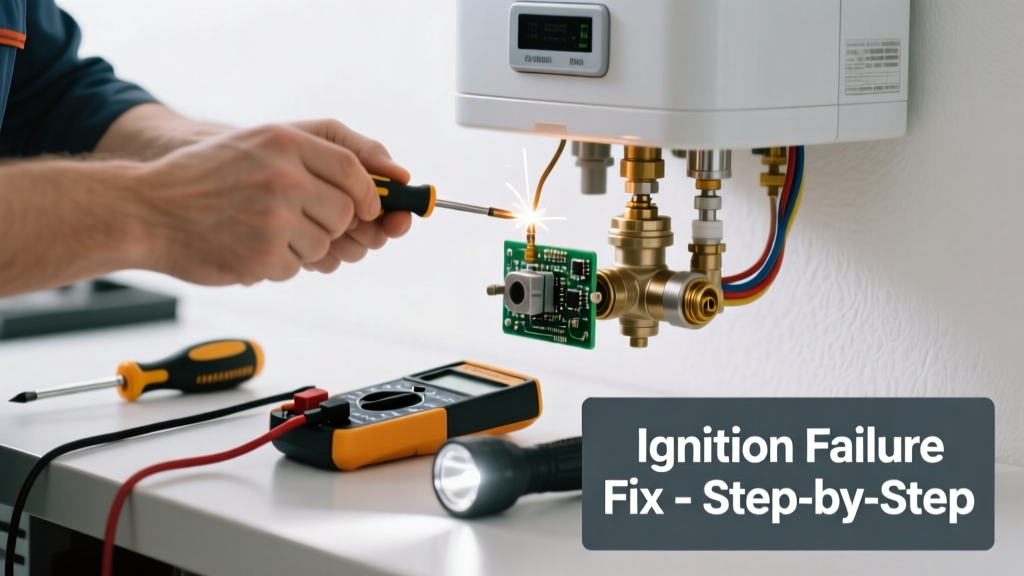
Your tankless water heater clicks but won’t ignite — no hot water, no warning lights, just silence after the startup sequence. This isn’t just inconvenient; it’s a sign something’s interrupting the critical gas-electric-ignition handshake. Most ignition failures stem from simple, fixable issues — not a dead unit.
Quick Diagnosis
Before grabbing tools, rule out these five most common culprits:
- Gas supply valve is partially or fully closed (check both main shutoff and unit-specific valve)
- Low water pressure (< 0.5 GPM flow threshold not met — many units won’t ignite below this)
- Clogged inlet water filter or heat exchanger scale buildup
- Faulty or corroded ignition electrode or flame rod
- Tripped or faulty vent pressure switch (especially in condensing models)
Tools & Materials Needed
| Item | Purpose | Estimated Cost |
|---|---|---|
| Multimeter (true RMS) | Test continuity of ignition electrode, voltage at gas valve, and vent switch operation | $45–$85 |
| Soft-bristle brush & white vinegar | Clean mineral deposits from inlet filter and heat exchanger access points | $5–$12 |
| 9/64" hex key & Phillips #2 screwdriver | Access ignition assembly and vent pressure switch on most Rinnai, Navien, and Noritz units | $8–$15 |
| Gas leak detector solution (soapy water) | Safely verify no gas leaks after reassembly — never use open flame | $6–$10 |
Step-by-Step Fix
Try these methods in order — most failures resolve at Step 1 or 2:
- Reset power and gas flow: Turn off power at the breaker for 5 minutes. Shut off gas valve, wait 30 seconds, reopen fully. Restore power and initiate a manual ignition cycle per your manual (e.g., hold ‘Power’ + ‘Temp Up’ for 5 sec on Navien NPE-A).
- Clean the inlet water filter: Locate the brass filter housing on the cold water inlet (usually behind front panel). Unscrew cap, remove mesh screen, soak in vinegar for 15 minutes, rinse, reinstall. This filter clogs in hard water areas every 6–9 months.
- Inspect and clean the ignition electrode and flame rod: Power off, gas off. Remove front cover and locate the ceramic-tipped electrode near the burner. Wipe gently with fine steel wool (0000) — never sandpaper. Check gap: 3/32" (2.4 mm) between electrode tip and burner base per Rinnai’s 2022 Service Bulletin.
- Test the vent pressure switch: With multimeter in continuity mode, disconnect wires from switch and blow gently into the vent tube port. You should hear an audible click and see continuity. No click? Replace switch — $22–$38.
When to Call a Pro
Stop and call a licensed HVAC technician if:
- You smell gas at any point — evacuate and call your utility immediately
- Ignition attempts produce repeated error codes like E102 (Rinnai), 003 (Navien), or C71 (Noritz) — these indicate gas valve or control board faults
- You measure less than 24V AC at the gas valve terminals during ignition attempt (points to PCB failure)
- Your unit is under warranty — DIY repairs may void coverage, especially on heat exchangers or electronics
Prevention Tips
Ignition failure spikes in homes with hard water and infrequent maintenance. Cut recurrence by half with these habits:
- Flush the heat exchanger annually using a submersible pump and descaling solution — follow our full flush guide
- Install a whole-house sediment filter (5-micron) and water softener if hardness exceeds 7 gpg
- Check inlet filter every 3 months — especially if you notice delayed hot water or low flow
- Keep combustion air intake and exhaust vents clear of leaves, snow, or bird nests year-round
"Over 68% of premature tankless igniter failures are linked to untreated hard water scaling or neglected inlet filters — not component defects." — Navien Technical Support Bulletin, 2023
Can I use compressed air to clean the ignition electrode?
No. Compressed air can fracture the fragile ceramic insulator or dislodge internal wiring. Use only dry, lint-free cloth or 0000 steel wool. If residue remains, lightly dampen cloth with isopropyl alcohol — never water or cleaners.
Why does my unit ignite fine in summer but fail in winter?
Cold incoming water increases viscosity and reduces flow rate — often dropping below the minimum GPM required for ignition (typically 0.5–0.7 GPM). Check for frozen or insulated pipes upstream, and verify your flow sensor isn’t coated in scale.
Is it safe to bypass the vent pressure switch to test ignition?
No. Bypassing disables critical safety shutdowns. Doing so risks carbon monoxide buildup, fire, or explosion. Always test the switch electrically — never jumper it.
How long should a tankless ignition electrode last?
Under normal conditions (soft water, annual maintenance), expect 7–10 years. In hard water zones without flushing, lifespan drops to 2–4 years. Replace electrodes in pairs — even if one looks fine — to prevent uneven wear.
Will resetting the circuit breaker fix intermittent ignition?
Only temporarily — if it works, it suggests a software glitch or power surge artifact. But if the issue returns within 48 hours, suspect failing capacitors on the control board or voltage drop from undersized wiring.
Can low household voltage cause ignition failure?
Yes. Tankless units require stable 120V ±5% for control boards. Voltage below 114V causes weak spark or failed solenoid activation. Test at the unit’s terminal block during ignition — if low, consult an electrician about dedicated circuits or panel upgrades.
A working tankless heater shouldn’t feel like a mystery box — most ignition hiccups have clear, physical roots. Tackle the filter, electrode, and gas flow first; they solve over 80% of cases. When in doubt, document error codes and take a photo of your unit’s rating plate before calling a pro — it cuts diagnostic time in half and gets you back to reliable hot water faster.