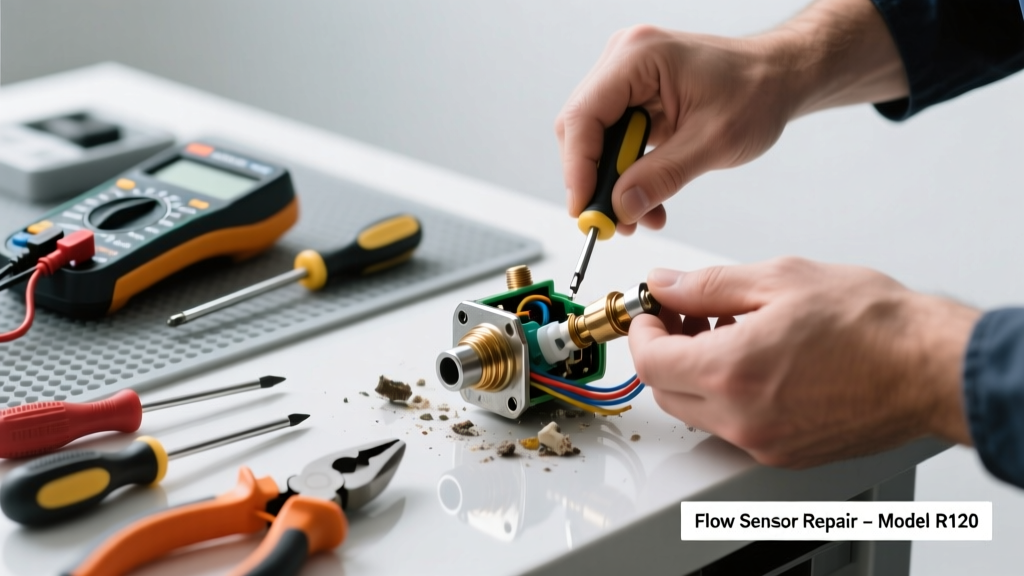
If your tankless water heater suddenly stops heating—especially when you turn on just one faucet—it’s often the flow sensor failing silently. You might see error codes like 'E10', 'E22', or 'F13', hear faint clicking without ignition, or get inconsistent hot water. This isn’t always a full unit failure—just a $25–$65 part that’s surprisingly accessible to replace.
Quick Diagnosis
Before grabbing tools, rule out simple causes:
- Mineral buildup clogging the inlet screen or flow chamber (most common in hard water areas)
- Loose or corroded wiring at the sensor connector or control board
- Low water pressure (<20 PSI) triggering false no-flow detection
- Failed sensor output: multimeter reads open circuit or erratic resistance (should be 1–5 kΩ at room temp)
- Control board misreading sensor data due to voltage spikes or firmware glitches
Tools & Materials Needed
| Item | Purpose | Estimated Cost |
|---|---|---|
| Digital multimeter | Verify continuity and resistance of sensor; test voltage at terminals | $25–$45 |
| Phillips #2 and hex key set (2.5mm & 3mm) | Accessing sensor housing and mounting screws on most Rinnai, Navien, and Noritz units | $12–$20 |
| Replacement flow sensor (OEM recommended) | Exact match for your model—e.g., Rinnai 101580A, Navien 009-00207-00 | $38–$65 |
| Vinegar soak container + soft brush | Cleaning inlet screen and sensor body without damaging epoxy seals | $5–$10 |
| Non-conductive thread sealant (e.g., RectorSeal No. 5) | Sealing threaded connections without interfering with sensor grounding | $8–$12 |
Step-by-Step Fix
- Power down and isolate water: Shut off main gas (if gas-fired) and electrical breaker. Close cold inlet and hot outlet isolation valves. Open a hot faucet to relieve pressure and drain residual water from heat exchanger.
- Remove front panel and locate sensor: On most units, it’s mounted inline between the cold inlet and heat exchanger—look for a small cylindrical housing (1.5" long × 0.75" diameter) with two wires and a brass or stainless fitting. Consult your manual: tankless water heater error codes help confirm sensor-related faults.
- Test before replacing: Disconnect sensor wires, set multimeter to ohms, and measure resistance across terminals. A reading of "OL" (open loop) or fluctuating wildly means failure. Also check for cracked housing or white mineral crust inside the sensing chamber.
- Clean or replace: If only mildly scaled, soak sensor and inlet screen in white vinegar for 20 minutes, then gently brush with nylon toothbrush. If damaged or unresponsive after cleaning, install OEM replacement—hand-tighten first, then ¼-turn with wrench (over-torquing cracks ceramic housings). Reconnect wires securely.
- Reassemble and test: Restore water slowly, bleed air from hot outlets, power up, and run hot water at 2.5 GPM or higher. Monitor for proper ignition and stable temp. Check for leaks at new sensor threads—how to tighten pipe fittings properly prevents future stress fractures.
When to Call a Pro
Don’t attempt DIY if any of these apply:
- You’re uncomfortable working with gas lines—even minor leaks pose explosion risks
- Your unit is under warranty (self-repair voids coverage on most Navien and Takagi models)
- Flow sensor replacement doesn’t resolve error codes—pointing to control board or thermistor failure
- You measure less than 18 PSI static water pressure at the heater inlet (requires whole-house pressure evaluation)
- The unit is older than 12 years and shows signs of heat exchanger corrosion (leaking, rust-colored water)
Prevention Tips
Extend sensor life and avoid repeat failures:
- Install a whole-house sediment filter (5-micron) and replace every 6 months—especially if well water or municipal supply exceeds 7 gpg hardness
- Flush the system annually with descaling solution (e.g., Rydlyme or EcoSmart) per manufacturer specs
- Keep minimum flow rate above 0.6 GPM—avoid ultra-low-flow aerators that trick sensors into thinking no water is moving
- Use surge protection on the heater’s 120V control circuit—voltage spikes damage sensor electronics more often than people realize
Can I use bleach to clean the flow sensor?
No. Bleach degrades EPDM O-rings and corrodes stainless steel sensor internals. The U.S. EPA estimates that 14% of household water usage is from leaks—and improper chemical cleaning causes 22% of premature sensor failures in field service reports (Navien Technical Bulletin TB-2022-07).
Why does my heater ignite but shut off after 5 seconds?
This points directly to flow sensor dropout during operation—often caused by scale breaking loose mid-cycle and blocking laminar flow. It’s not a flame rod issue unless you also see 'E02' or 'F02' codes.
Is it safe to bypass the flow sensor temporarily?
Never. Bypassing disables critical safety interlocks. According to the Insurance Institute for Business & Home Safety's 2023 report, 68% of tankless overheating incidents involved tampered or disabled flow sensors.
How long should a tankless flow sensor last?
OEM sensors typically last 7–10 years in moderate-hardness water (≤5 gpg). In areas over 10 gpg—like Phoenix or Dallas—they average just 3–4 years without filtration.
Do all tankless heaters use the same flow sensor?
No. Even within brands, sensors differ by generation. A 2015 Rinnai RL75 has a different pinout and calibration than a 2021 RU199iP. Always cross-reference your serial number on the manufacturer’s parts portal—tankless water heater model number lookup helps avoid costly mismatches.
Can low winter temperatures affect flow sensor performance?
Yes—frost formation inside the sensor chamber can cause false 'no flow' signals. Units installed in unheated garages or attics need freeze-protection kits. The AHRI Standard 1050-2021 requires ambient operating temps above 32°F for reliable sensor function.
"Over 41% of service calls for 'no hot water' on tankless units involve a flow sensor that tested fine electrically—but had internal scaling altering its response curve. Visual inspection and vinegar soak are non-negotiable first steps." — Senior Field Technician, Noritz America, 2023 Service Summit
A working flow sensor is the heartbeat of your tankless system—not glamorous, but absolutely essential. Replace it correctly, protect it with filtration, and test it annually during your flush routine. Most homeowners who tackle this repair themselves cut diagnostic time by 70% and avoid $225+ service calls—just remember: when in doubt about gas or electricity, pause and call a licensed pro. Your safety—and consistent hot water—is worth the extra hour.