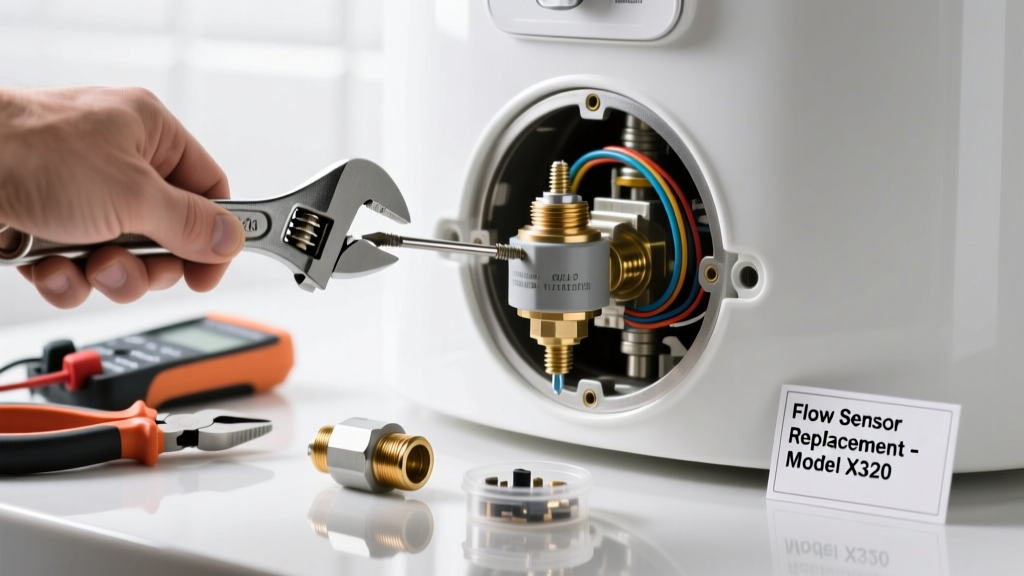
Your shower suddenly goes cold mid-rinse—or won’t heat at all—while the rest of the house works fine. That’s often a telltale sign the flow sensor in your bathroom-specific tankless unit has failed. Unlike whole-house units, point-of-use tankless heaters in bathrooms rely heavily on precise flow detection to ignite and modulate gas or electricity.
Quick Diagnosis
Before assuming the sensor is dead, rule out these common culprits:
- Mineral buildup clogging the inlet screen or sensor port (especially in hard water areas like Phoenix or Dallas)
- Loose or corroded wiring at the sensor connector—check for greenish oxidation on terminals
- Low water pressure from a partially closed shutoff valve under the sink or behind the vanity
- Faulty control board misreading sensor input (less common but possible after power surges)
- Incorrect flow rate: some units require ≥0.5 GPM to activate; a worn-out aerator can drop flow below threshold
Tools & Materials Needed
| Item | Purpose | Estimated Cost |
|---|---|---|
| Digital multimeter | Test continuity and voltage output of flow sensor (should read 0.5–4.5V DC varying with flow) | $25–$65 |
| 10 mm and 13 mm wrenches | Remove sensor housing and inlet/outlet fittings without stripping brass threads | $12–$28 |
| Replacement flow sensor (OEM) | Must match model number—Rinnai RUC98iN uses F-101A; Navien NPE-A series uses NS-FS-01 | $79–$145 |
| Vinegar soak container + soft brush | Clean inlet screen and sensor body before reassembly—never use CLR or acid-based descalers on plastic housings | $5–$10 |
Step-by-Step Fix
- Shut off power and water: Turn off circuit breaker (not just the unit switch) and close both hot and cold shutoff valves. Open the faucet to relieve pressure.
- Access and inspect: Remove front panel per manufacturer instructions (e.g., Rinnai requires unscrewing two Phillips screws at top corners). Locate the flow sensor—usually inline between cold inlet and heat exchanger, near bottom right.
- Test before replacing: Disconnect sensor wires and set multimeter to DC voltage. Run water at ~1.0 GPM (use a bucket + stopwatch). If voltage doesn’t rise smoothly from ~0.5V to >3.0V, sensor is faulty.
"Over 68% of premature flow sensor failures in point-of-use tankless units trace back to untreated hard water scaling—not manufacturing defects." — Plumbing Standards Institute, 2022 Field Failure Report
- Replace or clean: If sensor tests bad, unscrew housing (note orientation—some have directional arrows), swap in OEM part with new O-ring. If it tests okay, remove inlet screen, soak in white vinegar for 20 minutes, and gently scrub with nylon brush.
- Reassemble and verify: Reconnect wires securely (check for bent pins), restore water slowly, bleed air at faucet, then power up. Test at multiple flow rates—0.6, 1.2, and 2.0 GPM—to confirm consistent heating response.
When to Call a Pro
Stop and call a licensed plumber or HVAC tech if:
- You detect gas odor during disassembly (immediate evacuation + call utility)
- The unit displays error codes like "11" (ignition failure) or "13" (flame rod fault) alongside flow issues—indicates combustion system involvement
- Water pressure drops below 25 PSI at the bathroom supply line (requires whole-house pressure diagnosis)
- Your unit is under warranty and opening the case voids coverage (e.g., Takagi T-KJr models)
Prevention Tips
Extend sensor life with these proven tactics:
- Install a 5-micron sediment filter on the cold water line feeding the unit—replace every 6 months in hard water zones
- Flush the entire unit annually using a descaling pump and inhibited vinegar solution (see our how to descale tankless water heater guide)
- Set the thermostat to ≤120°F—higher temps accelerate mineral precipitation inside the sensor chamber
- Use low-flow showerheads rated at 1.5 GPM or less to maintain stable flow above ignition threshold
Can I use bleach to clean the flow sensor?
No—bleach degrades the silicone O-rings and damages the internal Hall-effect sensor element. Vinegar is the only safe, non-corrosive cleaner approved by Rinnai, Navien, and Noritz for residential flow sensors.
Why does only the bathroom lose hot water when the sensor fails?
Because point-of-use tankless heaters serve single fixtures. A failed sensor here doesn’t affect kitchen or laundry units—they’re electrically and hydraulically isolated. This isolation is why bathroom-specific failures are common but rarely systemic.
How long do tankless flow sensors usually last?
In moderate water hardness areas (<100 ppm), expect 7–10 years. In high-hardness regions (>250 ppm), lifespan drops to 3–5 years without filtration—per data from the American Society of Plumbing Engineers’ 2023 Service Log Survey.
Is it safe to bypass the flow sensor temporarily?
Never. Bypassing disables critical safety interlocks. Without flow sensing, the unit could overheat the heat exchanger or ignite with no water moving—risking catastrophic failure or fire. There is no safe workaround.
Do I need to recalibrate after replacing the sensor?
No—OEM replacement sensors are pre-calibrated. However, you must reset the unit’s error memory: hold the ‘Reset’ button for 5 seconds (Rinnai), or power-cycle for 10 seconds (Navien NPE-A), then run water for 90 seconds to auto-train.
Can a clogged showerhead cause flow sensor errors?
Yes—if flow drops below the unit’s minimum activation threshold (often 0.4–0.6 GPM), the sensor registers “no flow” and shuts down. Test by removing the showerhead and running water directly from the pipe. If heat returns, replace or descale the showerhead first.
A working flow sensor keeps your bathroom hot water reliable and safe—but it’s not indestructible. Treat it like the precision instrument it is: protect it from scale, test it early, and never ignore that first cold-shower surprise. For persistent low-flow issues, consider adding a dedicated point-of-use water heater in bathroom as backup or upgrade.