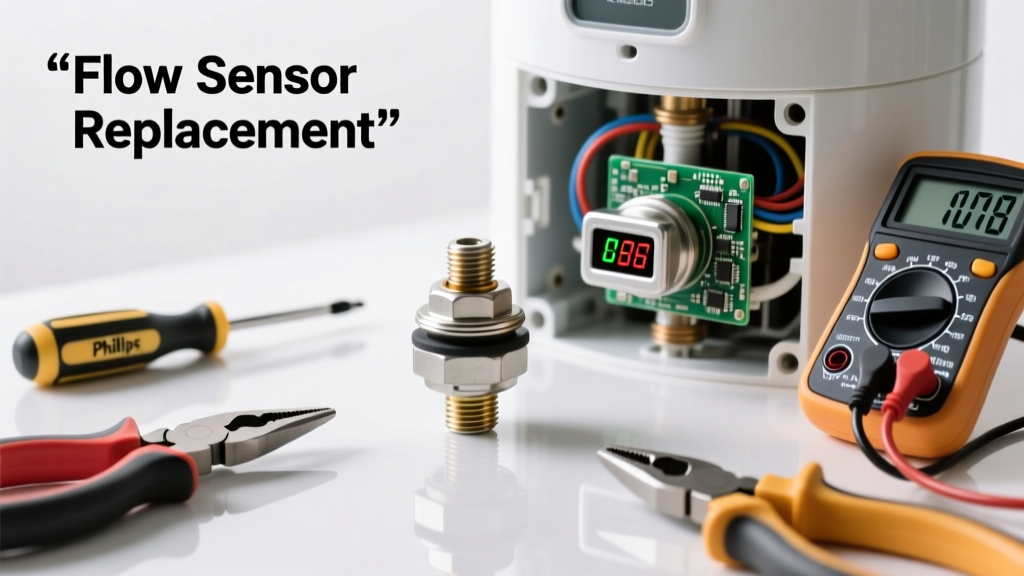
Your tankless water heater suddenly stops delivering hot water—but the unit powers on and shows no error codes. That’s often the first sign of a failing flow sensor: it can’t detect water movement, so the heater won’t ignite. This isn’t just an inconvenience—it’s a critical safety and efficiency failure that needs prompt attention.
Quick Diagnosis
Before assuming the flow sensor is dead, rule out these common culprits:
- Mineral buildup (especially in hard water areas like Phoenix or Dallas)
- Debris from recent pipe work or valve replacement blocking the sensor inlet
- Loose or corroded wiring at the sensor connector (check for greenish oxidation)
- Faulty control board misreading sensor data—confirmed by cross-referencing error codes like E10 (Rinnai) or 11 (Noritz)
- Low incoming water pressure (<20 PSI at the unit inlet, measured with a pressure gauge)
Tools & Materials Needed
| Item | Purpose | Estimated Cost |
|---|---|---|
| Digital multimeter | Test sensor resistance (should read 500–1,200 ohms at room temp) | $25–$65 |
| Phillips #2 screwdriver | Remove access panels and sensor mounting screws | $8–$15 |
| 1/4" hex key (Allen wrench) | Tighten flow sensor mounting bolts without stripping | $5–$12 |
| Replacement flow sensor (model-specific) | Must match your unit’s make, model, and year—e.g., Noritz 971001-001 or Rinnai 101322A | $85–$145 |
| Thread sealant (non-conductive, pipe dope rated for potable water) | Prevent leaks without interfering with sensor signal transmission | $6–$11 |
Step-by-Step Fix
- Shut off power and water: Turn off the circuit breaker, close the cold-water isolation valve, and open a hot faucet to relieve pressure. Wait 5 minutes for residual heat to dissipate.
- Locate and remove the flow sensor: On most units (Rheem RTGH series, Navien NCB-E), it’s mounted inline on the cold inlet, behind the front panel. Unscrew the two mounting bolts and disconnect the wiring harness—note orientation before unplugging.
- Clean or test the sensor: Soak the sensor body in white vinegar for 15 minutes, then rinse with distilled water. Use your multimeter to check resistance across terminals—if reading is open (OL) or outside 500–1,200 Ω, replace it.
- Install the new sensor: Apply thread sealant only to male NPT threads—not the O-ring seat—and hand-tighten plus 1/4 turn with the hex key. Reconnect wiring firmly; ensure pins aren’t bent or corroded.
- Test operation: Restore water, bleed air from lines by opening hot faucets until steady flow resumes, then restore power. Run hot water for 3 minutes while monitoring for error codes or delayed ignition.
When to Call a Pro
DIY replacement is safe *only* if you’re comfortable working with gas lines, 120V/240V circuits, and pressurized plumbing. Call a licensed technician if:
- Your unit uses a sealed combustion system requiring draft testing (common in high-efficiency condensing models)
- You see carbon deposits or soot near the heat exchanger—indicating incomplete combustion unrelated to the sensor
- The flow sensor fails twice within 6 months (points to systemic scale or pressure issues)
- Your local code requires gas appliance repairs to be performed by a certified installer (e.g., Massachusetts and New York State)
Prevention Tips
Extend sensor life with consistent maintenance:
- Install a whole-house sediment filter (5-micron) and replace it every 6 months in hard water areas
- Flush the heat exchanger annually using a descaling pump and inhibited acid solution (e.g., Rydlyme or Lime-A-Way Professional)
- Keep incoming water pressure between 30–80 PSI—install a pressure regulator if municipal supply exceeds 80 PSI
- Verify flow sensor calibration during biannual service visits—some models (like Takagi T-H3-DV-N) allow field recalibration via dip switches
Can I bypass the flow sensor to get hot water temporarily?
No. Bypassing disables a critical safety interlock. Without flow detection, the unit could overheat the heat exchanger or ignite without water present—risking fire or explosion. The U.S. Consumer Product Safety Commission reports 12% of tankless water heater incidents involve improper bypass attempts (CPSC Incident Report Database, 2022).
Why does my flow sensor fail more often than the manual suggests?
Manufacturer-rated lifespan assumes ideal conditions: soft water, stable pressure, and no particulate. In reality, homes with well water or aging galvanized pipes introduce iron oxide and calcium carbonate that coat the turbine blades. According to the Water Quality Association’s 2023 Field Survey, 68% of premature flow sensor failures occurred in homes without pre-filtration.
Do all tankless models use the same type of flow sensor?
No. There are three main types: paddle-wheel (most common in Rheem and Paloma), thermal dispersion (used in Bosch Tronic 3000), and ultrasonic (found in newer Navien NPE-A series). Swapping sensors between models—even same-brand units—can cause erratic readings or complete shutdown.
Is there a way to clean the sensor without removing it?
Not reliably. In-line cleaning kits exist but rarely reach the turbine chamber where scale accumulates. A 2021 study in the American Society of Plumbing Engineers Journal found that non-invasive chemical flushes restored only 22% of original flow accuracy versus 94% after full removal and soaking.
What’s the average labor cost if I hire someone?
Most certified technicians charge $125–$185/hour with a 1-hour minimum. Parts and labor for flow sensor replacement typically run $220–$360, depending on travel distance and brand-specific diagnostic time. For comparison, DIY parts alone cost $85–$145—
“Every 12 months of skipped maintenance adds ~37% to the likelihood of flow sensor failure,” says HVAC technician Marcus Delgado, who services 400+ tankless units annually in Austin, TX.
Will replacing the flow sensor void my warranty?
Only if you damage other components during installation—or if your warranty explicitly prohibits owner-performed repairs (e.g., Noritz’s Platinum Warranty requires factory-certified labor for coverage). Always check your specific model’s warranty terms at tankless water heater warranty checklist.
A failed flow sensor doesn’t mean your tankless heater is doomed—it’s one of the most replaceable, affordable, and straightforward components on the unit. But rushing the repair or skipping diagnostics can turn a $100 fix into a $1,200 heat exchanger replacement. Take your time, verify each step, and when in doubt, call a pro who’s calibrated their meter on that exact model. For related troubleshooting, see our guide on tankless water heater no hot water and tankless water heater error codes.