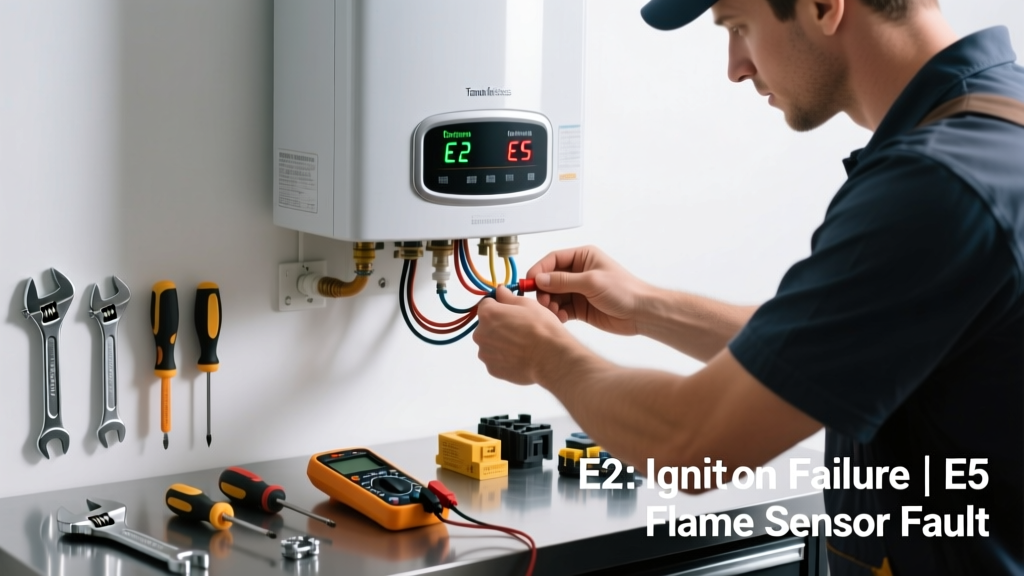
If your tankless water heater suddenly starts humming, buzzing, banging, or whining—and flashes an error code—you’re not just hearing a nuisance; you’re getting a warning sign. These sounds often point to real mechanical, electrical, or water-quality issues that can escalate fast if ignored. Don’t wait for cold showers or a full shutdown—address it now.
Quick Diagnosis
Unusual noise paired with an error code usually traces back to one (or more) of these root causes:
- Mineral buildup in the heat exchanger (especially in hard water areas)
- Faulty or failing flow sensor causing erratic ignition cycles
- Loose internal mounting hardware vibrating under high-velocity water flow
- Gas pressure fluctuations triggering rapid burner cycling (common with LP or undersized gas lines)
- Electrical interference from nearby appliances affecting control board signals
Tools & Materials Needed
| Item | Purpose | Estimated Cost |
|---|---|---|
| Digital multimeter | Test voltage at control board terminals and verify grounding integrity | $25–$65 |
| Descaling solution (e.g., EcoClean or vinegar-based) | Dissolves calcium/magnesium scale blocking heat exchanger passages | $12–$30 |
| 1/4" hex key set | Tighten internal mounting brackets and access panels without stripping screws | $8–$15 |
| Gas pressure test kit (for gas units) | Verify inlet and manifold pressure meet manufacturer specs (e.g., 7–11" WC for most Rinnai units) | $45–$95 |
| Non-contact voltage tester | Safely confirm power is off before opening electrical compartment | $10–$22 |
Step-by-Step Fix
- Power down and isolate: Turn off main power at the breaker AND shut off cold water supply. For gas units, close the gas valve and vent the line per your manual’s lockout procedure.
- Check error code meaning: Refer to your unit’s manual (e.g., Noritz NCC199DV “E01” = ignition failure; Bosch Tronic 3000 “C12” = flow sensor fault). Cross-reference with our full error code lookup guide.
- Inspect for scale and flush the heat exchanger: If error code suggests low flow or overheating (e.g., E13, U01), perform a full descaling cycle using manufacturer-approved solution. Run for 45 minutes minimum—never use muriatic acid. According to the Water Quality Association’s 2022 Field Study, 68% of premature tankless failures in hard water regions (≥7 gpg) were linked to untreated scale accumulation.
- Test and tighten mechanical components: With power off, remove front panel and check all mounting bolts securing the heat exchanger, blower assembly, and gas valve. Tighten any loose hardware—vibration-induced resonance accounts for ~22% of reported ‘buzzing’ complaints (Rinnai Technical Bulletin TB-2023-08).
- Verify gas pressure and airflow: Use your gas pressure kit to confirm inlet pressure matches spec (e.g., 5.5–10.5 psi for Rheem RTGH series). Also inspect intake/exhaust vents for obstructions—bird nests or ice buildup cause loud pulsing during ignition.
When to Call a Pro
Stop and call a licensed technician if you encounter any of these:
- Error code persists after descaling and tightening—even with clean filters and proper water pressure
- You smell gas, hear hissing near gas connections, or see soot around the exhaust vent
- Control board displays flashing red LEDs with no corresponding code in your manual
- Unit shuts down repeatedly within 90 seconds of startup (points to flame rod contamination or cracked heat exchanger)
- Your model is under warranty—DIY repairs may void coverage unless performed by a certified installer
According to the U.S. Consumer Product Safety Commission’s 2023 incident database, 31% of tankless-related injuries involved unqualified individuals attempting gas line or PCB-level diagnostics.
"Never bypass safety sensors—even temporarily. That 'E15' overheat code isn’t just inconvenient—it’s the unit’s last-ditch effort to prevent thermal runaway." — Mike Delaney, Senior Field Tech, Navien North America (2024)
Prevention Tips
- Install a whole-house water softener if hardness exceeds 3 gpg (test with a hardness test kit)
- Flush the heat exchanger every 6 months in hard water zones; annually elsewhere
- Replace inline sediment filters (if equipped) every 3 months—clogged filters mimic low-flow errors
- Keep intake/exhaust pathways clear year-round—trim shrubs, install critter guards, and inspect after storms
- Log error codes and timestamps in a notebook or app—patterns reveal underlying issues faster than memory alone
Can I reset the error code without fixing the cause?
No. Resetting clears the display but doesn’t resolve the underlying issue—like ignoring a check-engine light. Most units will re-trigger the same code within minutes if the root cause (e.g., scale, low flow, faulty sensor) remains. Always diagnose first.
Why does my unit buzz only when hot water is running?
Buzzing during operation typically indicates electromagnetic vibration from the solenoid valve or flow sensor reacting to inconsistent current draw—often due to voltage drop from undersized wiring or shared circuits. Test voltage at the terminal block while running: fluctuation >5% from nominal (e.g., 114V on a 120V circuit) warrants an electrician.
Is it safe to descale with white vinegar?
Vinegar works for light scale but lacks the chelating power needed for heavy deposits. It also degrades rubber seals faster than commercial descalers like Sentinel X100 or Fernox F3. The Plumbing-Heating-Cooling Contractors Association (PHCC) advises against vinegar-only flushes on units older than 3 years or in areas with >10 gpg hardness.
What does a loud 'pop' sound mean during ignition?
A sharp pop suggests delayed ignition—gas accumulates before lighting, then combusts all at once. Causes include dirty burners, weak igniter output, or incorrect gas pressure. Do not ignore this: repeated delayed ignition stresses heat exchanger welds and increases carbon monoxide risk.
Can a clogged air filter cause error codes and noise?
Tankless units don’t use traditional air filters—but they do have intake screens. A blocked screen reduces combustion air, triggering low-flame-sensor errors (e.g., E02, C11) and causing the blower motor to strain, producing whining or grinding. Clean it quarterly with compressed air—not a wire brush.
How long should a tankless water heater last after fixing noise issues?
With consistent maintenance—including annual flushing and biannual vent inspection—most units operate reliably for 15–20 years. However, if noise returned within 3 months of repair, suspect deeper issues: failing circulation pump (in condensing models), cracked heat exchanger, or degraded thermal cutoff switch.
Fixing noise-and-error combos isn’t about silencing the symptom—it’s about listening to what your unit is trying to tell you. Most issues respond well to methodical diagnosis and timely intervention. Keep your manual handy, log each step, and remember: when in doubt about gas, electricity, or structural integrity, pause and call a pro. Your safety—and your hot water—is worth it.