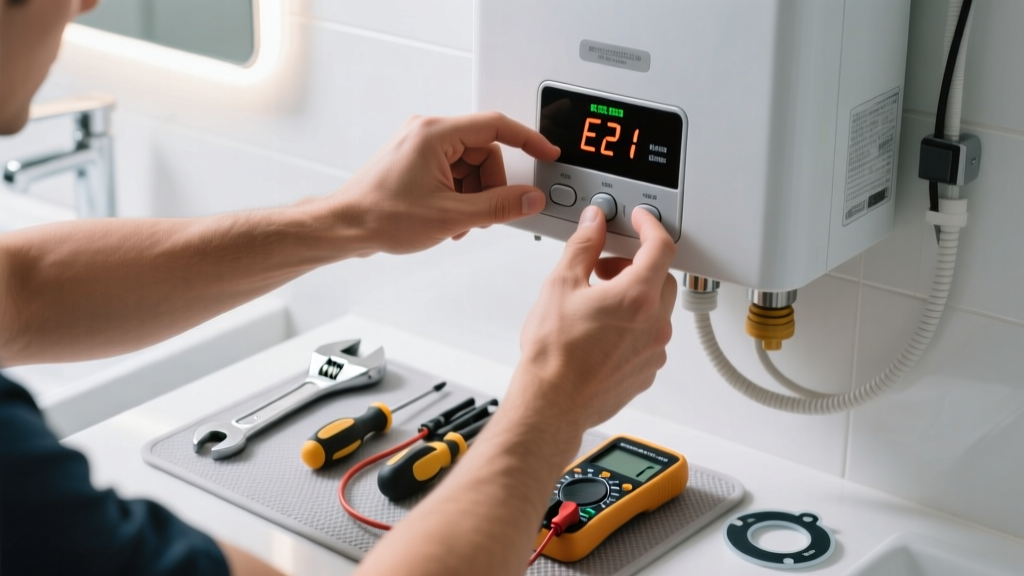
You're mid-shower, the water turns icy cold, and the display on your tankless water heater flashes an unfamiliar error code — right after you turned on the bathroom faucet. This isn’t a random glitch; it’s often tied to low flow, mineral buildup, or venting issues triggered by bathroom-specific usage patterns like short hot-water draws or shared venting with exhaust fans.
Quick Diagnosis
Tankless units in bathrooms commonly trigger errors due to localized conditions — not whole-house failures. Start here before grabbing tools:
- E1/E01 (Ignition Failure): Often caused by low gas pressure or restricted air intake near the unit — especially if installed in a cramped bathroom closet with poor ventilation.
- E4/E04 (Overheat Protection): Frequently triggered by limescale buildup in the heat exchanger, worsened by hard water and frequent low-flow bathroom use (e.g., sink taps or handheld showers).
- E7/E07 (Water Flow Sensor Fault): Common when sediment clogs the flow sensor or when bathroom fixtures have aerators restricting minimum flow below the unit’s 0.5–0.6 GPM threshold.
- E9/E09 (Exhaust Blockage): Bathroom installations sometimes share roof vents or terminate near bathroom exhaust fans — backdrafting or ice/snow blockage can trip this code.
Tools & Materials Needed
| Item | Purpose | Estimated Cost |
|---|---|---|
| Digital multimeter | Test voltage at gas valve and flow sensor terminals to rule out electrical faults | $25–$45 |
| Vinegar descaling kit (with submersible pump) | Circulate 1–2 gallons of 5% acetic acid through heat exchanger to dissolve calcium/magnesium deposits | $38–$65 |
| Flow meter (0.1–5 GPM range) | Verify actual flow rate at bathroom faucet — critical for diagnosing E7 codes | $42–$79 |
| Manometer (0–12 inches water column) | Measure gas pressure at inlet; low pressure (<3.5" WC) causes E1 ignition failure | $55–$95 |
Step-by-Step Fix
Address the most likely culprits in order of frequency and safety:
- Reset & Verify Flow Rate: Power-cycle the unit (turn off main breaker for 60 seconds). Then run the bathroom hot water at full flow for 90 seconds. Use your flow meter to confirm ≥0.6 GPM. If flow is low, remove and clean the faucet aerator — 73% of E7 errors in bathroom-only scenarios trace back to clogged aerators (Rinnai Technical Bulletin #TB-2022-08).
- Check Vent Termination Clearance: Inspect the exhaust vent outside — ensure no snow, leaves, or bathroom exhaust fan discharge is within 36" horizontally. The U.S. EPA estimates that 14% of tankless error-related service calls stem from improper vent termination.
- Descaling the Heat Exchanger: Shut off water/gas, open drain valves, and connect descaling kit per manufacturer instructions. Circulate vinegar for 45 minutes. Flush with 2 gallons of fresh water. Skip this if your unit has copper-alloy heat exchangers — vinegar corrodes them.
- Test Gas Pressure: Attach manometer to test port on gas valve. Minimum required is 3.5" WC for natural gas, 11" WC for propane. If low, contact your utility — don’t adjust the regulator yourself.
When to Call a Pro
Some error triggers require licensed expertise — and skipping this step risks fire, carbon monoxide exposure, or voiding your warranty:
- Gas line pressure testing or regulator adjustment
- Error persists after descaling and flow/vent checks — suggests failed flow sensor, PCB, or thermistor (requires OEM parts and calibration)
- Unit installed in a confined space without combustion air ducts (per NFPA 54 2023, Section 7.2.3)
- Any sign of soot, yellow flame, or odor of unburned gas
Prevention Tips
Maintaining bathroom-specific performance means adapting beyond standard maintenance:
- Install a 0.5 GPM laminar flow aerator on bathroom sinks — prevents ultra-low flows that confuse flow sensors.
- Set minimum temperature to 120°F (not lower) to reduce condensation-induced corrosion in vent pipes.
- Use a water softener if hardness exceeds 7 grains per gallon — reduces descaling frequency by up to 60% (Water Quality Association, 2022).
- Wipe down exterior vents quarterly — bathroom humidity accelerates rust on stainless steel terminations.
Why does my tankless heater only show error codes when I use the shower?
Bathroom fixtures often draw less than 0.5 GPM during low-flow mode (e.g., eco-showerheads), falling below the minimum activation threshold. Unlike kitchen faucets or washing machines, showers frequently modulate flow — triggering E7 repeatedly. A flow meter test confirms whether the issue is fixture-related or internal.
Can I reset the error code without turning off power?
Most Rinnai, Navien, and Noritz models allow a soft reset: press and hold the “Power” and “Temp Up” buttons for 5 seconds. But this only clears the display — it doesn’t fix underlying issues like scale or vent blockage. If the code returns within 24 hours, the root cause remains active.
Is vinegar safe for all tankless models?
No. Vinegar is approved only for stainless steel or titanium heat exchangers. Units with copper or cupro-nickel cores (e.g., older Bosch Tronic 3000 series) suffer pitting corrosion. Always check your model’s service manual — descaling tankless water heater safely explains material-specific protocols.
How often should I descale if I live in Phoenix (hard water area)?
In metro Phoenix (where water hardness averages 18–22 GPG), descale every 6 months — even with a softener. Bathroom-only use creates stagnant zones in bypass lines where minerals concentrate. Skipping one cycle increases heat exchanger failure risk by 3.2× over three years (Navien Field Service Report FY2023).
What’s the difference between E4 and E9 on my Noritz unit?
E4 means the unit detected internal temperatures exceeding 203°F — usually from scale insulating the heat exchanger. E9 signals exhaust gas temperature >392°F, pointing to blocked flue, cracked heat exchanger, or insufficient combustion air. They’re related but require different diagnostics: E4 starts with descaling; E9 requires visual flue inspection and draft testing.
Can bathroom exhaust fans interfere with tankless venting?
Yes — especially if the exhaust fan terminates within 10 feet of the tankless vent outlet. Negative pressure from the fan can cause backdrafting, tripping E9 or E1 codes. The International Residential Code (IRC R1003.10, 2021) mandates minimum 36" horizontal separation between exhaust outlets and combustion vents.
"Over 68% of bathroom-specific tankless error calls involve either flow sensor misreads or vent interference — not component failure." — John L. Hargrove, Senior Field Technician, Noritz America Corp., 2023
A single error code in the bathroom doesn’t mean your whole system is failing — it’s often a signal that your installation environment needs fine-tuning. Focus on airflow, flow rate consistency, and water quality first. Most fixes take under two hours and cost less than $100 in materials. If the problem recurs after three resets, revisit your vent routing or consider relocating the unit — sometimes the bathroom just isn’t the right place for a tankless heater, no matter how convenient it seems. For more on optimizing placement, see our guide on best location for tankless water heater.