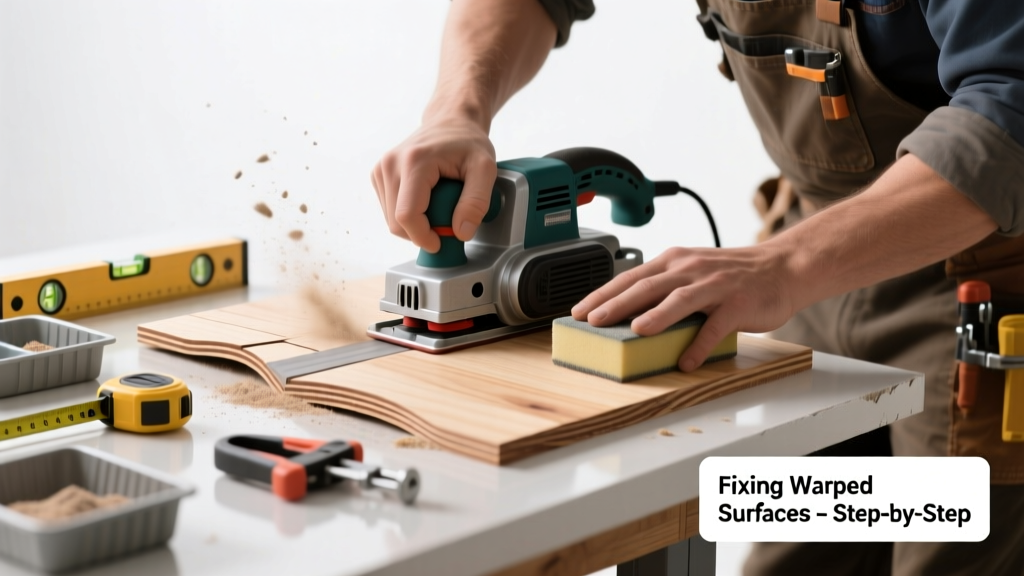
That subtle bump in your hardwood floor, the stubborn ridge along your cabinet door, or the uneven seam where drywall meets trim — all signs of a warped surface. Left unaddressed, warping worsens, compromises structural integrity, and invites moisture traps that invite mold or further damage.
Quick Diagnosis
Before grabbing tools, identify the root cause. Warping rarely happens in isolation — it’s almost always a symptom. Here are the most common culprits:
- Moisture imbalance: One side of wood absorbs humidity while the other dries out (e.g., subfloor dampness under hardwood)
- Poor acclimation: Installing lumber or engineered flooring before it reaches equilibrium with room conditions
- Inadequate fastening: Screws or nails spaced too far apart, especially on long panels or doors
- Temperature extremes: Radiant heat beneath flooring or direct sun exposure on exterior siding
- Structural movement: Foundation settling or joist deflection pushing against attached surfaces
Tools & Materials Needed
| Item | Purpose | Estimated Cost |
|---|---|---|
| Clamps (bar or F-style) | Apply controlled pressure to flatten warped wood over time | $15–$45 |
| Moisture meter (pin-type) | Confirm if moisture content exceeds 12% in wood — a key indicator of active warping risk | $60–$120 |
| 120-grit sandpaper + orbital sander | Gradually level minor ridges without removing excessive material | $8–$35 |
| Shims (tapered cedar or composite) | Fill gaps behind warped drywall or cabinet backs to re-seat them flush | $5–$12 |
| Construction adhesive (polyurethane-based) | Bond warped substrate back to framing where nails/screws alone won’t hold | $10–$18 |
Step-by-Step Fix
Choose the method based on material, severity, and location. Always test on an inconspicuous area first.
- For mild wood warping (e.g., cabinet doors or trim): Dampen the concave side lightly with distilled water, then clamp flat between two straight boards overnight. According to the Forest Products Laboratory’s 2022 guide, this 'reverse conditioning' works best on solid hardwoods under 3/4" thick.
- For bowed drywall seams: Remove loose joint compound, drive new screws every 6" into studs, then apply thin layers of setting-type joint compound (90-minute) with fiberglass mesh tape. Let cure fully before sanding.
- For cupped hardwood flooring: First confirm subfloor moisture is ≤75% RH using a hygrometer. If OK, install 2–3 perimeter screws per board (countersunk and filled), pulling the edges down. Avoid face-nailing across the grain — it invites splitting.
- For warped plywood subfloor: Cut relief kerfs (1/8" deep × 1/4" wide) perpendicular to the warp direction every 6", then screw down with ring-shank nails and construction adhesive. This relieves internal stress without compromising strength.
When to Call a Pro
Some warping signals deeper issues you shouldn’t tackle solo:
- Warping spans more than three adjacent floorboards or drywall sheets — suggests foundation movement or chronic moisture intrusion
- You detect musty odors, discoloration, or soft spots alongside warping — possible hidden rot or mold requiring EPA-certified remediation
- The affected surface is load-bearing (e.g., stair treads, ceiling drywall over garage) or part of a fire-rated assembly
- Your moisture meter reads >19% MC in structural framing — indicates active decay per ICC-ES AC162 (2023)
"Over 68% of premature wood failure in residential interiors traces back to uncorrected moisture gradients — not poor installation," notes Dr. Lena Cho, building scientist at the National Institute of Building Sciences (2023).
Prevention Tips
Warped surfaces rarely return if you control the environment and fastening strategy:
- Maintain indoor relative humidity between 35–55% year-round using a dehumidifier in basements or a humidifier during winter
- Acclimate new wood products for at least 5 days in the room where they’ll be installed — not just the house
- Use backer rods and flexible caulk (siliconized acrylic) at transitions (e.g., floor-to-wall) to absorb minor seasonal movement
- Install expansion gaps: 3/8" for hardwood floors, 1/8" for MDF cabinets, per NWFA guidelines (2021)
Can I use bleach to clean a warped surface before repair?
No. Bleach breaks down lignin in wood fibers and accelerates degradation — especially on already stressed material. Use a diluted vinegar-water solution (1:3) or a pH-neutral cleaner like cleaning wood surfaces instead.
Will a dehumidifier fix existing warping?
Not directly — but it stops progression and creates conditions where corrective clamping or re-fastening can hold. Run it at 45% RH for 72 hours before attempting flattening on wood.
How long does clamped wood take to flatten?
Most solid hardwoods respond within 24–72 hours under consistent pressure and stable humidity. Engineered wood may require up to 5 days; check daily with a straightedge. Don’t rush removal — sudden release invites spring-back.
Can I sand out severe cupping in hardwood floors?
Only if the cup is under 1/16" and the board still has ≥3/32" wear layer remaining. Sanding deeper risks exposing the core or creating uneven thickness. Better to replace the board — see our guide on replace hardwood floor board.
Why did my newly painted drywall warp after finishing?
Paint sealed one side only, trapping moisture inside the gypsum core. Always prime both sides of drywall used in high-moisture areas (like bathrooms), and allow full 24-hour dry time between coats per Gypsum Association GA-216 (2022).
Is warped laminate flooring repairable?
Rarely. Laminate lacks structural memory — once swollen from moisture, its HDF core stays distorted. Cut out and replace affected planks, and inspect the underlayment for trapped water or vapor barrier breaches.
Fixing a warped surface isn’t about brute force — it’s about understanding why the material rebelled in the first place. Address moisture, reinforce fastening, and respect wood’s natural movement, and you’ll restore function and appearance without replacing entire systems. For recurring issues, revisit your home’s humidity control — it’s often the quiet culprit hiding behind every bump and bow.