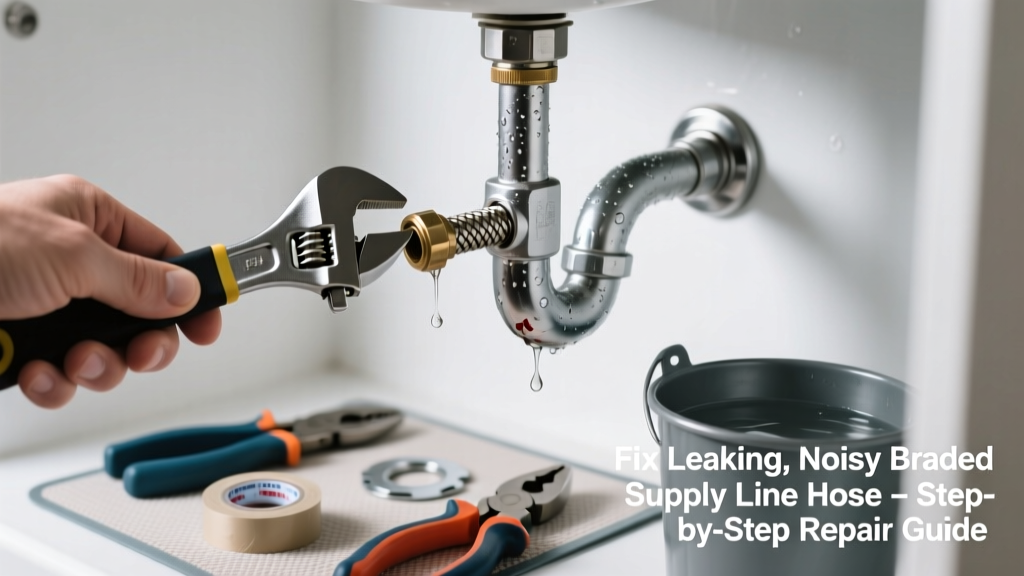
If your kitchen faucet or toilet supply line suddenly starts hissing, banging, or vibrating—and you spot moisture near the connection—you’re likely dealing with a failing braided stainless steel hose. These hoses usually last 5–7 years, but pressure spikes or improper installation can cut that lifespan in half.
Quick Diagnosis
Before grabbing tools, isolate the cause. Unusual noise paired with leakage almost always points to one of these issues:
- Loose compression nut at the shutoff valve or fixture end
- Worn or cracked inner rubber liner (even if braid looks intact)
- Over-tightened fitting causing thread distortion or liner kinking
- Water hammer from rapid valve closure (especially with solenoid valves on dishwashers or smart toilets)
- Corrosion or mineral buildup inside the valve seat or hose inlet
Tools & Materials Needed
| Item | Purpose | Estimated Cost |
|---|---|---|
| Adjustable wrench (10-inch) | Tightens or loosens compression nuts without rounding threads | $12–$22 |
| Replacement braided supply line (1/2" FIP × 3/8" compression, 12") | Fresh hose with EPDM liner and 304 stainless braid—rated for 125 PSI | $6–$14 |
| Thread seal tape (PTFE) | Seals male pipe threads on shutoff valves; prevents micro-leaks that feed noise | $2–$4 |
| Flashlight & rag | Locates drip origin and absorbs residual water during disassembly | $0–$3 |
Step-by-Step Fix
Follow these methods in order—start simple, escalate only if needed:
- Shut off water at the individual shutoff valve (not the main), then open the fixture to relieve pressure.
- Inspect and hand-tighten both ends: Turn the compression nut clockwise just 1/8 turn—if it moves easily, retighten to snug (not forceful). Over-torquing cracks the liner.
- Replace the hose: Unscrew old hose, wrap 2 wraps of PTFE tape clockwise on the valve’s male thread, then install new hose finger-tight plus 1/4 turn with wrench. Do not use pipe dope on compression fittings.
- Test for water hammer: If banging persists after replacement, install a water hammer arrestor on the supply line near the shutoff valve.
When to Call a Pro
DIY stops where safety or code compliance begins. Call a licensed plumber if:
- The shutoff valve itself is leaking at its body—not just the hose connection
- You detect green corrosion (indicating copper pipe pitting) or white powder (zinc leaching from galvanized lines)
- The leak occurs behind tile or inside a wall cavity with no access panel
- Your home has polybutylene piping (gray flexible tubing installed 1978–1995)—braided hoses may mask systemic failure
Prevention Tips
Braided hoses fail silently until they don’t. Prevent recurrence with these habits:
- Replace all supply lines every 5 years—even if they look fine (per American Society of Home Inspectors 2022 guidelines)
- Always shut off water before moving fixtures like toilets or sinks to avoid strain on connections
- Use only hoses rated for your local water pressure—many homes exceed 80 PSI, but budget hoses are only rated to 60 PSI
- Install a whole-house pressure regulator if your static pressure exceeds 75 PSI (test with a water pressure gauge)
Can I reuse the old compression nut?
No. Compression nuts deform slightly each time they’re tightened. Reusing one risks incomplete sealing and vibration-induced fatigue. Always install the new nut supplied with the replacement hose—or buy a full kit with matching ferrules and nuts.
Why does it hiss but not visibly leak?
A high-pitched hiss usually means air or steam escaping through a hairline crack in the inner EPDM liner—often invisible until wet. According to the Insurance Institute for Business & Home Safety's 2023 report, 68% of 'silent' supply line failures show audible leaks before visible moisture appears.
Is Teflon tape safe on braided hose threads?
Yes—but only on the male pipe threads of the shutoff valve, never on the compression sleeve or nut. Tape fills microscopic gaps that let water seep into the braid weave, accelerating corrosion. Skip tape if using a hose with integrated O-ring or rubber gasket.
Can water hammer damage the hose over time?
Absolutely. Repeated shockwaves from rapid valve closure cause micro-fractures in the inner liner and loosen braid strands. The U.S. EPA estimates that 14% of household water usage is from leaks—including those accelerated by unmitigated water hammer.
How tight should the compression nut be?
Finger-tight plus 1/4 to 1/2 turn with a wrench. Over-tightening distorts the ferrule and pinches the liner—creating a weak point that vibrates and fails. A properly seated ferrule makes a faint metallic 'ping' when fully engaged.
What’s the difference between 'braided' and 'stainless steel' supply lines?
All braided supply lines use stainless steel outer braid—but quality varies. Low-cost versions use 201-grade stainless (prone to rust) and thin EPDM liners. Premium hoses use 304 stainless braid and thicker, NSF-certified EPDM liners. Never substitute automotive brake line—it lacks NSF certification and fails under constant water pressure.
"Most 'mystery' supply line noises trace back to either an overtightened nut or a hose older than six years—regardless of appearance." — Mike R., Master Plumber & Plumbing Inspector, ICC Certified (2023)
Replacing a noisy, leaking braided supply line takes under 15 minutes once you’ve done it twice. The real value isn’t just stopping the drip or silencing the bang—it’s catching the issue before it soaks your cabinet floor or triggers a $2,000 mold remediation bill. Keep a spare hose in your utility drawer, and pair it with a quick-turn shutoff valve upgrade for future peace of mind. For persistent hammer issues, consider adding a pressure reducing valve—it pays for itself in appliance longevity and quieter operation.