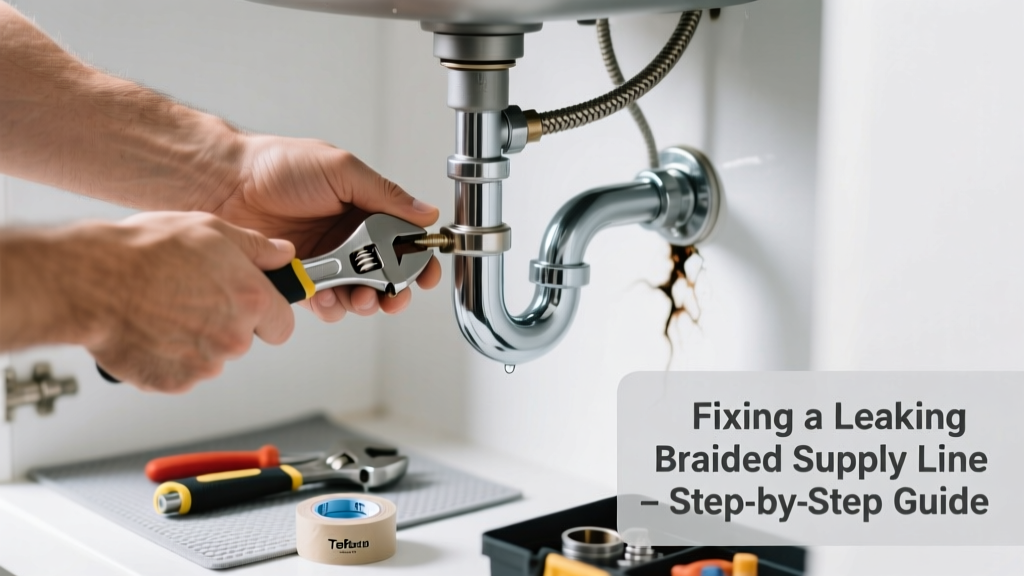
That hiss of water under your sink or the slow drip pooling near the faucet base? It’s almost certainly your braided stainless steel supply line—commonly rated for 10 years but often failing early due to over-tightening, corrosion, or manufacturing defects. Don’t ignore it: the U.S. EPA estimates that 14% of household water usage is from leaks, many originating at supply connections.
Quick Diagnosis
Before grabbing tools, confirm the source and cause. Braided hose leaks usually happen at one of three points:
- The compression nut where the hose meets the shutoff valve (most common)
- The threaded connection at the faucet inlet (often from cross-threading or stripped threads)
- Along the braid itself (rare, but signals internal liner failure or kink damage)
Wipe everything dry, turn on the water briefly, and watch closely—use a paper towel to pinpoint moisture origin.
Tools & Materials Needed
| Item | Purpose | Estimated Cost |
|---|---|---|
| Adjustable wrench (10-inch) | Tightens nuts without rounding threads; dual-jaw design grips both valve and hose ends securely | $12–$22 |
| New braided stainless supply line (3/8" FIP × 3/8" FIP, 12" or 24") | Replaces aging or damaged hose; look for NSF-61 certified and burst-rated ≥ 2,000 psi | $8–$18 |
| Thread seal tape (PTFE, white) | Seals tapered pipe threads on shutoff valves; avoids over-tightening that cracks brass fittings | $2–$5 |
| Microfiber cloths & flashlight | Dry surfaces thoroughly and inspect hidden threads and braid integrity | $3–$7 |
Step-by-Step Fix
Most leaks are fixed in under 20 minutes—but method depends on location and severity:
- Retighten the compression nut: Turn off the shutoff valve. Dry the joint. Use two wrenches—one holding the valve body, one tightening the nut 1/8 turn clockwise. Do not exceed 1/4 turn total; overtightening crushes the ferrule.
- Re-seat the hose with fresh PTFE tape: If leaking at the valve thread (not the compression nut), disconnect the hose, wrap 3–4 layers of tape clockwise onto the valve’s male threads, then hand-tighten plus 1/4 turn with a wrench.
- Replace the entire hose: If the braid shows rust, bulging, or fraying—or if the leak persists after retightening—swap it. Always match size (typically 3/8" FIP) and length (12" fits most standard sinks; 24" gives flexibility for deeper cabinets).
When to Call a Pro
DIY stops where safety or structural risk begins. Call a licensed plumber if:
- The shutoff valve itself is corroded, cracked, or won’t fully close—even after replacing the hose
- You’re dealing with galvanized steel or polybutylene supply lines upstream (common in homes built before 1995), which require system-wide replacement
- Water pressure exceeds 80 psi (check with a gauge); high pressure accelerates braided hose fatigue and demands pressure regulator installation
"Over 60% of supply line failures we see in kitchen remodels stem from reused old hoses or improper torque—never assume 'tighter is better' with compression fittings." — Mike R., Master Plumber, Plumbing Contractors Association, 2022
Prevention Tips
Braided hoses last longer when treated right. Replace them every 5–7 years—not just at 10-year manufacturer claims—and inspect annually during cabinet cleaning. Avoid sharp bends: maintain at least a 1-inch radius curve between valve and faucet. Keep hoses away from heat sources like garbage disposal motors or dishwasher exhaust ducts, which accelerate rubber liner degradation. For high-use households (e.g., families of four+), consider upgrading to all-brass braided lines with double-woven stainless jackets—they cost more but resist kinking and handle 2,500+ psi bursts.
Can I use Teflon tape on the compression nut threads?
No—compression fittings rely on metal-to-metal contact between the ferrule and pipe, not thread sealing. Teflon tape here creates false security and can cause misalignment. Only use tape on the threaded shutoff valve outlet (the male pipe thread), never on the nut or hose end.
Why does my new braided hose leak right out of the box?
It’s likely cross-threaded or under-torqued. Disassemble, inspect both threads for nicks or debris, realign by hand until smooth, then tighten only until resistance increases—then add 1/4 turn. Never force it past that point.
Is it safe to shut off just the hot water valve while fixing a cold line leak?
Yes—if the leak is isolated to the cold line and you’re only working on that side. But always verify both hot and cold shutoffs are functional before starting. Test each by turning them fully on and off while observing flow—stuck or leaking valves mean you need shutoff valve repair first.
How tight should the compression nut really be?
Tighten by hand until snug, then use a wrench for no more than 1/4 to 1/2 additional turn. A properly seated ferrule will compress just enough to seal—any more risks splitting the ferrule or cracking the valve body. If you hear creaking or see distortion, back off and reassess alignment.
Can I reuse the old ferrule when replacing the hose?
No. Ferrules are single-use components designed to deform permanently during installation. Reusing one guarantees an incomplete seal. Every new braided hose includes a fresh ferrule—always install it with the tapered end facing the pipe.
What’s the difference between 3/8" and 1/2" supply lines?
Kitchen faucets almost always use 3/8" compression (FIP) connections. 1/2" lines are for main supply branches or commercial fixtures. Using a 1/2" hose on a 3/8" valve creates threading mismatch and immediate leakage. Double-check markings stamped on the existing hose or valve body—look for "3/8-24 UNF" or "3/8 FIP".
A leaking braided supply line isn’t just an annoyance—it’s a small problem with big consequences if left unchecked. Catch it early, fix it right, and you’ll avoid water damage, mold growth, and surprise plumbing bills. And next time you’re under the sink, take 60 seconds to check the other hose too—because if one failed, the other’s probably overdue. For related issues, see our guides on dripping kitchen faucets and hidden under-sink leaks.