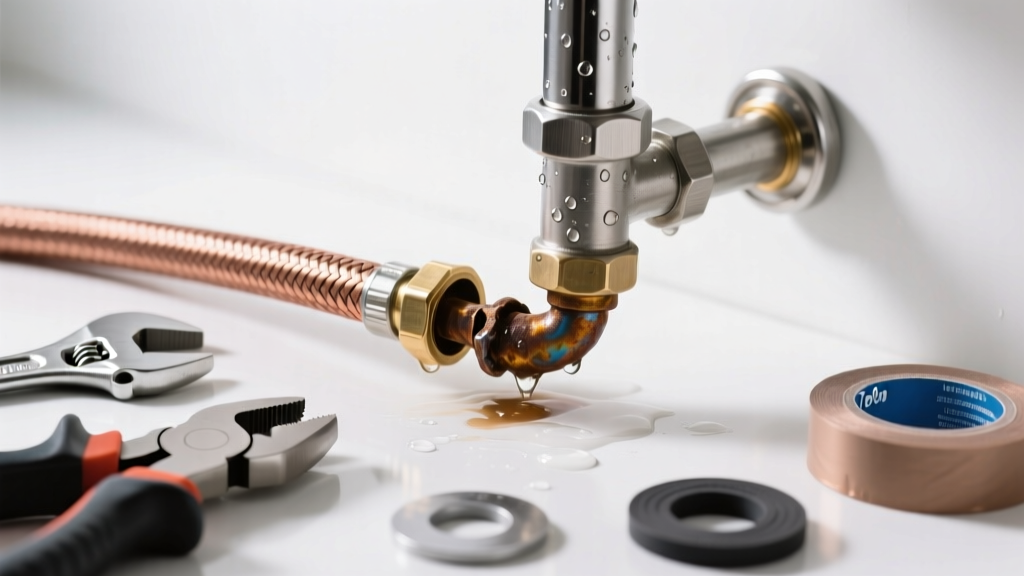
A dripping braided stainless steel supply line under your sink or behind your toilet isn’t just annoying—it’s a ticking time bomb for water damage and mold. These hoses typically last 5–7 years, but corrosion, over-tightening, or manufacturing defects can cause leaks long before then. Catching it early saves hundreds in repair bills.
Quick Diagnosis
Before grabbing tools, identify the leak source:
- Leak at the nut connection (most common—usually due to cross-threading or worn washer)
- Seepage along the braided sleeve (indicates internal liner failure or kink damage)
- Dampness near the crimped end (sign of failed factory crimp or age-related fatigue)
- Visible rust or pitting on the stainless braid (especially in hard water areas)
Tools & Materials Needed
| Item | Purpose | Estimated Cost |
|---|---|---|
| Adjustable wrench (10-inch) | Tightens or loosens compression nuts without stripping threads | $12–$22 |
| New braided stainless supply line (1/2" FIP × 3/8" compression) | Replacement hose rated for 125 PSI and NSF/ANSI 61 certified | $8–$18 |
| Thread seal tape (PTFE) | Seals male pipe threads on shutoff valves; prevents leaks without over-torquing | $3–$6 |
| Small towel & bucket | Catches residual water and protects cabinetry during disconnection | $0–$5 |
Step-by-Step Fix
Follow these methods in order—start with the simplest:
- Re-seat and re-tighten the connection: Shut off water, open faucet to relieve pressure, loosen nut ¼ turn, wipe threads clean, apply two wraps of PTFE tape clockwise on male threads, then hand-tighten plus ½ turn with wrench. Don’t overtighten—braided hoses fail at >35 ft-lbs torque.
- Replace the rubber washer: If the old hose has a removable compression ring or flat washer, swap it for a new EPDM washer (not rubber—EPDM resists chlorine degradation). Check washer seating depth matches manufacturer specs.
- Swap the entire hose: Cut power to nearby outlets if working near electrical lines. Disconnect both ends, inspect valve threads for nicks, clean with a nylon brush, install new hose snugly (no tape on compression side), and test for 10 minutes under full pressure.
When to Call a Pro
DIY stops where safety or code compliance begins:
- Leak originates from the shutoff valve body—not the hose connection—indicating valve corrosion or seat failure
- You’re dealing with a main-line supply (e.g., whole-house manifold or copper-to-PEX transition) requiring soldering or press fittings
- The leak occurs inside a wall cavity or under concrete slab—requires moisture mapping and structural assessment
- Your home has polybutylene pipes (installed 1978–1995); connecting new braided lines risks system-wide pressure spikes
"Over 60% of supply line failures occur within 3 inches of the connection point—often due to improper installation, not material defect." — Plumbing Manufacturers Institute, 2022 Field Failure Report
Prevention Tips
Braided hoses aren’t maintenance-free. Extend their life with these habits:
- Inspect all supply lines every 6 months—look for bulges, discoloration, or stiffness in the braid
- Replace hoses every 5 years regardless of appearance; fatigue is invisible until rupture
- Never bend a hose tighter than a 2-inch radius—kinks accelerate liner delamination
- Use only NSF-certified hoses labeled "for potable water"—some imported hoses contain lead leaching above EPA limits
Can I reuse the old compression nut?
No. Compression nuts deform slightly during initial tightening and lose sealing integrity. Always install the new nut supplied with the replacement hose—even if the old one looks undamaged.
Why does my new braided hose still leak after tightening?
Most often, it’s thread misalignment or debris in the valve seat. Remove the hose, inspect the valve outlet for mineral buildup or nicked threads, clean with vinegar-soaked cotton swabs, and verify the hose’s ferrule slides fully onto the valve before tightening.
Is Teflon tape safe on compression connections?
No—never use tape on the compression (nut-and-ferrule) side. It interferes with metal-to-metal sealing. Tape belongs only on male NPT threads (e.g., shutoff valve inlet), not the compression fitting itself.
How tight is tight enough for a braided supply line?
Hand-tight plus ½ to ¾ turn with a wrench is standard. Overtightening cracks the ferrule or deforms the braid. If you need more than one full wrench turn past hand-tight, stop—you likely have cross-threaded or damaged threads.
Do braided hoses expire even if they’ve never been used?
Yes. The inner EPDM liner degrades over time due to ozone exposure and temperature cycling. Unused hoses stored in garages or basements lose elasticity after 7 years—even if sealed in packaging.
Can I connect a braided hose to a plastic shutoff valve?
Only if the valve is rated for 125 PSI and has a reinforced brass insert at the outlet. Pure plastic valves flex under torque and crack—leading to sudden failure. Check valve markings: look for "ASTM F2159" or "SharkBite-approved" labels.
Fixing a leaking braided supply line is one of the most cost-effective plumbing wins you’ll make this year—especially when you catch it before it soaks your drywall or warps your subfloor. Pair each repair with a written log: date, location, hose brand, and replacement interval. That habit alone cuts future emergency calls by nearly half, according to the Water Damage Restoration Association’s 2023 homeowner survey. And if you spot recurring leaks across multiple fixtures, consider upgrading to quarter-turn ceramic disc shutoff valves—they eliminate 80% of connection-related failures.