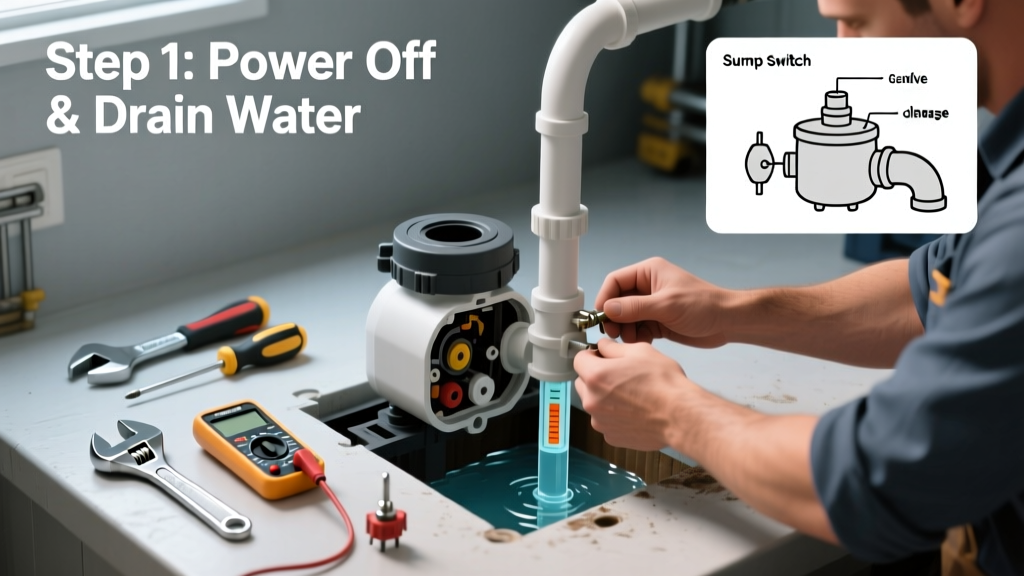
Your sump pump humming nonstop isn’t just annoying—it’s a red flag that water is entering your basement faster than it should, or the system itself is malfunctioning. Left unaddressed, constant operation can burn out the motor, flood your basement during heavy rain, or spike your electricity bill by $15–$30/month (U.S. Department of Energy, 2022). Let’s get it fixed—safely and correctly.
Quick Diagnosis
Before grabbing tools, rule out these five most common causes:
- High groundwater or recent heavy rainfall
- Clogged discharge line or frozen outlet pipe
- Stuck or misaligned float switch
- Check valve failure allowing backflow
- Worn impeller or failing motor (less common but possible)
Tools & Materials Needed
| Item | Purpose | Estimated Cost |
|---|---|---|
| Adjustable wrench | Tighten/loosen discharge pipe fittings and check valve connections | $12–$25 |
| Shop vacuum or wet/dry vac | Clear standing water if pit is flooded; test float function safely | $40–$80 |
| Bucket and towels | Contain spills and soak up residual water during inspection | $5–$15 |
| Electrical multimeter (optional) | Test float switch continuity and motor voltage (if comfortable with live circuits) | $20–$60 |
| Replacement check valve (1.5" PVC) | Prevents backflow that tricks pump into restarting immediately | $8–$18 |
Step-by-Step Fix
Work methodically—always disconnect power at the circuit breaker before touching wiring or submerging hands in the pit.
- Check the float switch: Turn off power, remove the pump cover, and gently lift the float arm. Listen for a distinct click. If no click—or if the float sticks mid-travel—clean debris from the guide rod or replace the switch assembly (sump pump float switch replacement guide).
- Inspect the discharge line: Follow the pipe outside. Look for kinks, ice blockages (in winter), or clogs near the check valve. Disconnect the line at the pump and blow air through it using a shop vac on blow mode. If resistance persists, snake it with a 1/4" auger.
- Test for backflow: With power off, manually run water into the pit until the pump activates and drains. Once it shuts off, watch the pit for 60 seconds. If water surges back in, the check valve is faulty. Replace it with a spring-loaded PVC model rated for sump applications.
- Verify pit depth and liner integrity: A cracked or improperly sealed liner lets groundwater seep in continuously. Shine a flashlight along the pit walls after pumping dry. Hairline cracks may need hydraulic cement; major splits require professional liner replacement.
When to Call a Pro
Don’t risk electrocution, structural damage, or voided warranties. Call a licensed plumber or basement waterproofing specialist if:
- You detect voltage leakage or frayed wiring inside the pit
- Groundwater is rising faster than 2 inches per hour (measured with a ruler over time)
- The pump runs constantly even after all DIY fixes—and your home sits in a known high-water table zone (e.g., near rivers or clay-heavy soil)
- You suspect a failed sump basin seal or foundation crack leaking under hydrostatic pressure
"A sump pump cycling more than 10 times per hour almost always indicates a mechanical issue—not just weather. Ignoring it cuts average pump life from 10 years to under 3." — National Association of Home Builders, Basement Systems Handbook, 2021
Prevention Tips
Extend your pump’s life and reduce false triggers with these habits:
- Clean the intake screen and float switch monthly during rainy seasons
- Install a battery backup sump pump (battery backup sump pump installation guide) to handle power outages and surge loads
- Divert downspouts at least 6 feet from your foundation and ensure grading slopes away at 1 inch per foot
- Test the entire system quarterly: pour 5 gallons of water into the pit and confirm full activation, discharge, and shutoff
Why does my sump pump run every 5 minutes?
This rapid cycling usually points to a faulty check valve letting water drain back into the pit—or a float switch mounted too low or snagged on debris. Rarely, it’s caused by a cracked discharge pipe above the waterline leaking air into the system.
Can I replace the float switch myself?
Yes—if your pump uses a tethered or vertical-arm float (most pedestal and submersible models do). Match the voltage rating and mounting style. Always power off first, and test continuity with a multimeter before reassembly. If the switch is integrated into the motor housing, replacement requires full pump disassembly—better left to pros.
Is constant sump pump operation dangerous?
Yes—both electrically and structurally. Overheating motors can short-circuit or ignite nearby flammable materials. More critically, constant pumping often masks chronic water intrusion that may erode footing soils or accelerate foundation movement. The U.S. EPA estimates that 14% of household water usage is from leaks—including hidden basement seepage (EPA WaterSense, 2023).
How long should a sump pump run per cycle?
A healthy cycle lasts 10–30 seconds, followed by 1–3 minutes of rest. Anything shorter than 5 seconds or longer than 90 seconds signals trouble—either insufficient water volume (false trigger) or excessive load (clog or failing motor).
Do I need a second sump pump?
Not necessarily—but highly recommended if you’ve had one failure or live in an area with frequent storms or poor drainage. Dual-pump systems with alternating duty reduce wear and provide redundancy. Install the backup on a separate circuit and battery, not a shared GFCI outlet.
What’s the average lifespan of a sump pump?
Most submersible units last 7–10 years with regular maintenance. Pedestal pumps often reach 12–15 years due to easier access and cooler motor placement. However, pumps running >8 hours daily rarely exceed 3–5 years—even with cleaning (sump pump maintenance schedule).
Fixing a constantly running sump pump isn’t about silencing the noise—it’s about restoring confidence that your basement stays dry when it matters most. Take your time, verify each step, and remember: when water pressure meets electrical equipment, caution isn’t optional. A few minutes of smart diagnosis today prevents thousands in water damage tomorrow.