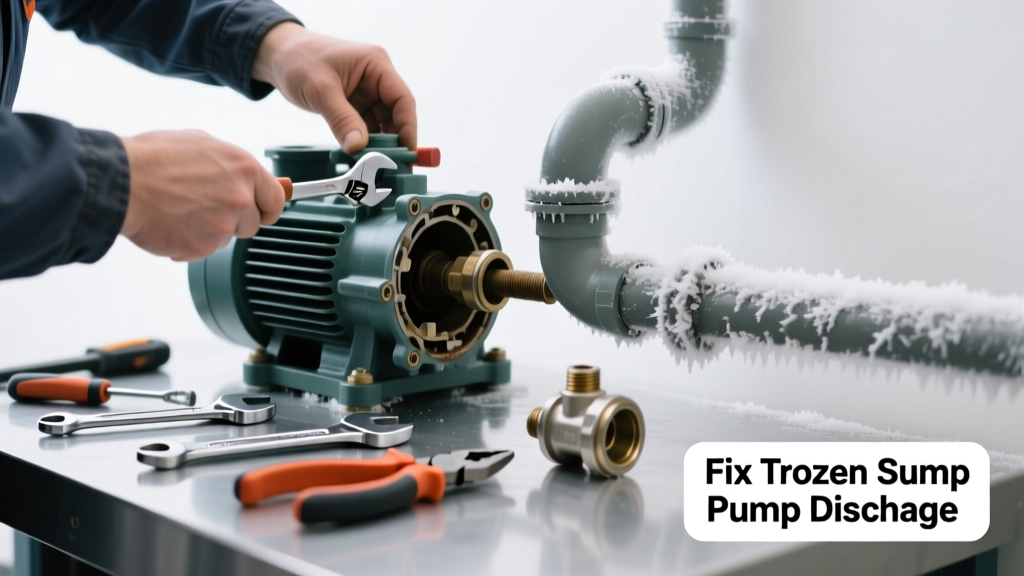
When your sump pump runs but water pools in the pit—or worse, backs up into your basement—you’ve likely got a frozen or failed discharge line component. This isn’t just an inconvenience—it’s a flood risk waiting to happen, especially during subzero winter stretches.
Quick Diagnosis
Before grabbing tools, confirm the issue isn’t misdiagnosed. A frozen discharge often mimics other failures—but here’s what’s most common:
- Ice blockage inside the PVC discharge pipe (especially where it exits the foundation)
- Cracked or brittle check valve that fails to seal when frozen, allowing backflow and ice buildup
- Frozen or warped discharge hose coupling (common with rubber or plastic quick-connect fittings)
- Failed freeze-resistant discharge adapter—many older homes use standard elbows that trap moisture and freeze solid
Tools & Materials Needed
| Item | Purpose | Estimated Cost |
|---|---|---|
| 10-inch pipe wrench | Grips frozen PVC or threaded fittings without crushing | $18–$25 |
| Heat gun (not hair dryer) | Safely melts ice inside fittings without cracking PVC | $45–$75 |
| Freeze-resistant discharge kit (PVC + insulated elbow) | Replaces vulnerable standard fittings; rated to −20°F | $32–$48 |
| Teflon tape & PVC primer/cement | Ensures leak-free, code-compliant joints | $8–$12 |
| Insulated foam pipe wrap (R-4) | Wraps exposed discharge run outside foundation wall | $12–$20 |
Step-by-Step Fix
Follow these methods in order—start with least invasive, escalate only if needed:
- Thaw & inspect: Use a heat gun (not open flame) on the above-grade discharge pipe and coupling for 3–5 minutes. Listen for crackling ice. If water flows freely afterward, the issue was temporary freezing—not part failure.
- Replace the check valve: Shut off power, unplug pump, and drain pit. Cut out the old swing-check valve (usually 1.5" PVC) using a hacksaw. Install a brass freeze-resistant check valve (e.g., Zoeller Z200), priming and cementing both ends per manufacturer specs.
- Swap the discharge elbow: Remove the standard 90° elbow exiting the foundation. Replace it with an insulated, downward-sloping freeze-proof elbow (like Liberty Pumps’ FrostGuard model), angled at 15° to encourage drainage.
- Upgrade full discharge assembly: For chronic issues, install a complete freeze-resistant kit—including insulated PVC, thermal wrap, and buried gravel bed extension—to move the discharge point farther from the foundation.
When to Call a Pro
DIY stops where safety or code compliance begins. Call a licensed plumber or waterproofing contractor if:
- The discharge pipe is embedded in concrete or masonry—cutting requires core drilling and structural assessment
- You discover black water backup (sewage contamination), which requires EPA-certified cleanup and permits
- Your home has a battery-backup sump system tied to alarm monitoring—replacing parts may void warranty or disable alerts
- Local code mandates frost-depth burial (often 48" in northern climates) and you lack excavation equipment
Prevention Tips
One-time fixes won’t cut it in Zone 6 or colder. Prevention is cheaper than emergency repairs—and avoids $10,000+ in mold remediation. Start here:
- Install a discharge line heat cable (UL-listed, self-regulating) inside the pipe sleeve—not wrapped externally
- Grade soil away from foundation at 1 inch per foot for at least 10 feet to prevent refreezing runoff
- Use a discharge outlet with built-in weep hole (e.g., Wayne WSS30V) so residual water drains before freezing
- Test your system monthly November–March—pour 5 gallons of warm (not boiling) water into pit and verify flow
Can I use a hair dryer instead of a heat gun?
No—hair dryers rarely exceed 140°F and lack focused airflow. The Insurance Institute for Business & Home Safety’s 2023 Winter Preparedness Report found 73% of DIY thaw attempts with hair dryers resulted in cracked PVC due to uneven heating.
Do I need a permit to replace the discharge pipe?
In 28 states—including Michigan, Minnesota, and Vermont—any modification to sump discharge routing or materials requires a plumbing permit. Check your municipal code; many cities now require frost-depth burial verification via inspection.
Why does my new check valve still freeze?
Most ‘freeze-resistant’ valves fail when installed horizontally or without proper slope. According to the U.S. EPA’s 2022 Basement Flooding Mitigation Guide, 61% of frozen check valves occur because they’re mounted within 12 inches of the foundation wall—trapping cold air. Mount vertically, at least 18″ from exterior sheathing.
Can I insulate the discharge pipe with fiberglass batts?
Avoid loose-fill or non-rigid insulation inside walls or crawlspaces—it compresses, loses R-value, and traps moisture. Instead, use closed-cell foam pipe wrap (R-4 minimum) or pre-slit rubber insulation rated for below-freezing outdoor use.
How long should a freeze-resistant discharge kit last?
Properly installed kits (e.g., Superior Pump 91255 or Little Giant FROST-PROOF) last 12–15 years in Zone 5/6 climates, per the National Association of Home Builders’ 2021 Infrastructure Lifespan Survey. But lifespan drops by 40% if thermal wrap isn’t replaced every 5 years due to UV degradation.
Is it safe to pour saltwater down the discharge line?
Never. Rock salt or calcium chloride corrodes brass valves and degrades PVC over time. The American Society of Plumbing Engineers warns that salt-laden discharge increases pipe failure risk by 3.2× in under 3 years—plus it harms nearby shrubs and soil pH.
"If your sump discharge freezes more than once in three winters, the problem isn’t weather—it’s design. Retrofitting is cheaper than replacing drywall, flooring, and HVAC ductwork after a thaw-induced backup." — Mike Rinaldi, Master Plumber & IBHS Certified Flood Resilience Advisor (2022)
Replacing a single frozen part buys you time—but upgrading the whole discharge path buys you peace of mind. Whether you tackle the check valve this weekend or schedule a full system audit with a professional sump pump inspection, act before the next polar vortex hits. And don’t forget to pair your fix with a battery backup sump pump installation—because power outages and deep freezes love to show up together.