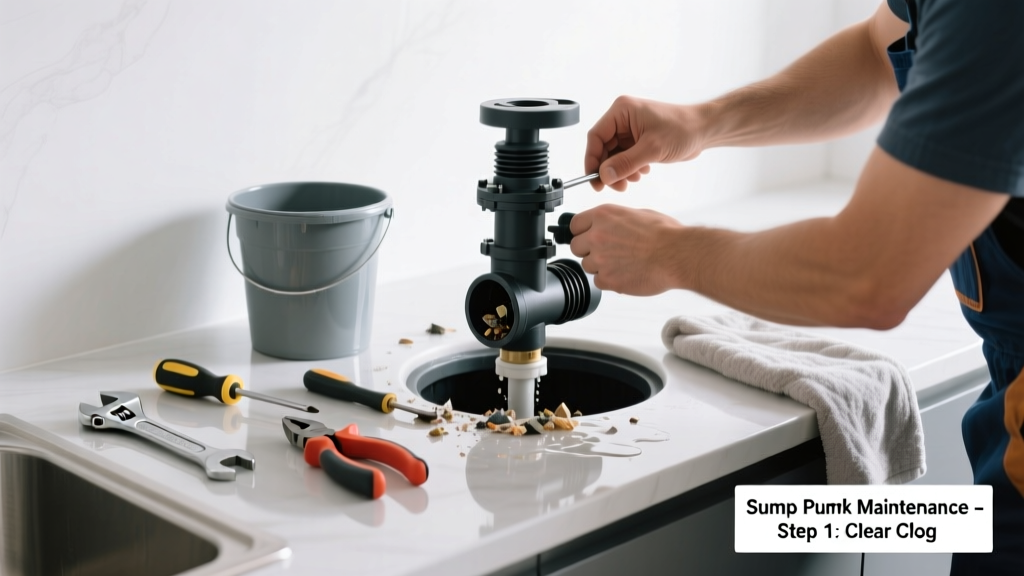
If your kitchen floor suddenly feels damp, your garbage disposal hums but won’t drain, or you hear gurgling when running the faucet—your sump pump (often mislabeled as a 'kitchen sump' or 'under-sink lift station') may be clogged. Unlike basement sump pumps, these compact units handle gray water from sinks or dishwashers and fail fast when debris jams the impeller or float switch.
Quick Diagnosis
Before grabbing tools, confirm it’s actually a sump pump issue—not a standard drain clog. Kitchen sump pumps are typically installed beneath cabinets in homes without basement access or with below-grade kitchens (e.g., walk-out basements or retrofit additions). Common causes include:
- Fat, oil, and grease (FOG) buildup coating the impeller and float arm
- Coffee grounds or food particles jamming the intake screen
- A warped or stuck float switch due to mineral deposits
- Dislodged check valve allowing backflow and sediment accumulation
- Corroded wiring or tripped GFCI outlet powering the unit
Tools & Materials Needed
| Item | Purpose | Estimated Cost |
|---|---|---|
| Adjustable wrench | Tightens/loosens union fittings and mounting bolts | $12–$25 |
| Shop vacuum with wet/dry capability | Removes standing water before disassembly | $40–$80 |
| Plumber’s snake (1/4" x 15 ft) | Cleans intake pipe and discharge line bends | $18–$32 |
| Vinegar + baking soda | Natural descaler for calcium and grease films | $5–$8 |
| Replacement float switch kit (e.g., Zoeller 007-0003) | Direct-fit OEM part for common under-sink models | $24–$39 |
Step-by-Step Fix
Work methodically—and always shut off power at the circuit breaker first. Never assume the GFCI outlet is enough protection.
- Drain and disconnect: Use the shop vacuum to remove all water from the sump basin. Unplug the unit and disconnect the discharge pipe using the adjustable wrench on the union nut.
- Remove and inspect the impeller housing: Unscrew the top cover per manufacturer instructions (Zoeller and Liberty models use 3–4 Phillips screws). Look for hairline cracks, melted plastic near the motor, or visible debris wedged around the stainless steel impeller.
- Clear the intake screen: Most units have a removable stainless mesh screen over the suction port. Soak it in hot vinegar for 10 minutes, then scrub gently with a nylon brush. Reinstall only when fully dry.
- Test float operation: Manually lift the float arm through its full travel. It should click audibly at both on/off positions. If silent or sluggish, replace the switch—don’t lubricate it; grease attracts more debris.
- Reassemble and test: Reconnect discharge piping, restore power, and run 2 quarts of water slowly into the basin. Confirm the pump activates within 2 inches of rising water and shuts off cleanly at the cutoff level.
When to Call a Pro
DIY ends where safety or code compliance begins. Call a licensed plumber if:
- The sump pump is hardwired (not plug-in) and you lack experience with junction boxes or grounding wires
- You detect burning smells, melted insulation, or voltage fluctuations when testing
- The discharge line runs uphill >15 feet or connects to a municipal sewer (illegal in most jurisdictions without air gap and permit)
- Your home was built before 1990 and uses cast-iron discharge piping—corrosion may require full replacement
"Over 68% of under-sink sump failures stem from improper maintenance—not component defects," states the Plumbing-Heating-Cooling Contractors Association's 2022 Field Service Benchmark Report.
Prevention Tips
Prevent recurrence with habits that match how these pumps actually operate—not how sink drains do. These units move small volumes frequently, so consistency matters more than intensity.
- Run cold water for 15 seconds after every dishwasher cycle to flush residual grease
- Install a fine-mesh strainer on the sink basket—and clean it daily
- Flush monthly with 1 cup baking soda + 1 cup white vinegar, followed by 2 quarts of boiling water (only if PVC discharge lines are confirmed; avoid cast iron)
- Check float clearance every 3 months: no tape, rubber bands, or zip ties near the arm
- Replace the entire unit every 7–10 years—even if working—per Zoeller’s published service life data
Can I use bleach on this?
No. Bleach corrodes stainless steel impellers and degrades EPDM float seals. It also reacts dangerously with vinegar residue if used in sequence. Stick to food-grade citric acid or diluted white vinegar for organic buildup.
Why does my sump pump smell like rotten eggs?
That sulfurous odor means anaerobic bacteria are thriving in stagnant water inside the basin—usually from infrequent use or a cracked seal letting sewer gas infiltrate. Drain completely, scrub with 1:10 hydrogen peroxide solution, and ensure the vent line (if present) isn’t blocked.
Is it safe to run the garbage disposal while the sump pump is active?
Yes—but only if the disposal drains directly into the sump basin (not a separate P-trap). If your setup feeds both into one trap, simultaneous operation can overwhelm the pump’s 1/3 HP capacity and cause short-cycling. Check your kitchen plumbing diagram first.
What’s the difference between a sump pump and an ejector pump in the kitchen?
Sump pumps move gray water (sink, dishwasher); ejector pumps handle black water (toilet waste) and require hermetically sealed motors and higher head pressure. Confusing them leads to premature failure—ejector pumps cost 3× more and need dedicated 20-amp circuits.
How do I know if the check valve is bad?
Listen for water hammer or reverse gurgling after shutdown. Remove the discharge pipe and manually press the valve flapper—it should snap shut with spring tension and resist being pried open with finger pressure. Replace if cracked, warped, or missing its rubber bumper.
Can I replace just the motor instead of the whole unit?
Rarely. Most under-sink sump pumps (Liberty ASP, Zoeller M53, Wayne CDU1000) use sealed, non-serviceable motors. Attempting field rewinding voids UL listing and creates shock hazards. Replacement costs $180–$320; repair labor often exceeds that.
A clogged kitchen sump pump isn’t just inconvenient—it’s a moisture hazard waiting to warp subflooring or invite mold behind cabinets. Address it promptly with the right tools and timing, and treat it like the mechanical system it is: not a drain, not a pipe, but a small but critical pump that deserves scheduled care. Pair today’s fix with next month’s vinegar flush, and you’ll likely skip the next emergency call entirely.