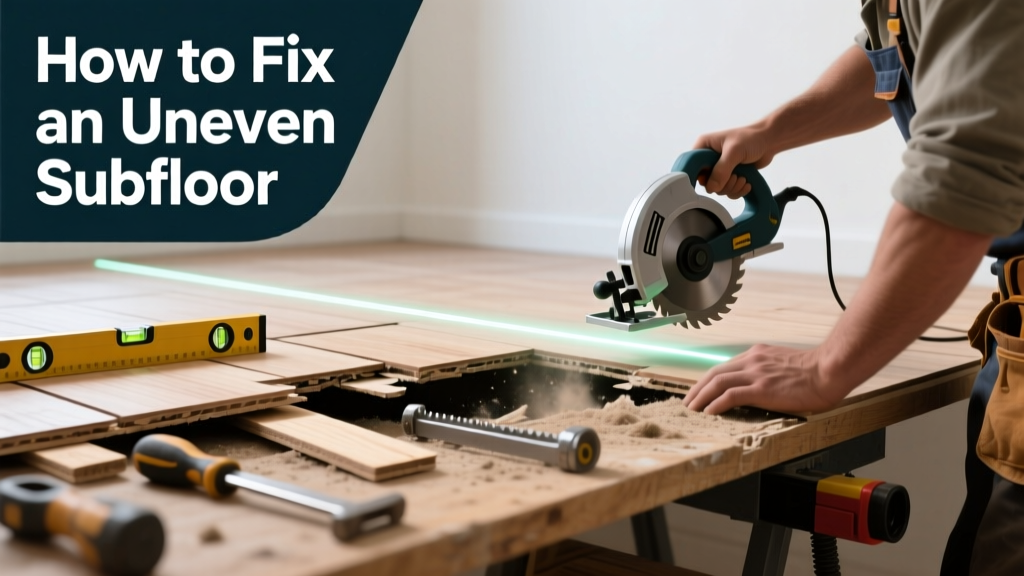
An uneven subfloor isn’t just annoying—it’s the root cause of buckling hardwood, cracked tile, and doors that won’t latch. If your floor feels spongy, slopes noticeably, or shows gaps around baseboards, you’re likely dealing with structural movement or moisture damage—not just cosmetic issues.
Quick Diagnosis
Before grabbing tools, identify the culprit. Most uneven subfloors stem from one or more of these causes:
- Joist sagging due to undersized lumber or long spans (common in older homes with 2×8 joists spaced 24" on center)
- Water damage softening OSB or plywood—check for dark stains, musty odor, or crumbling edges
- Poor initial installation: missing blocking, improperly nailed sheets, or high-low seams left un-sanded
- Foundation settlement, especially near exterior walls or over crawl spaces with inadequate support piers
Tools & Materials Needed
| Item | Purpose | Estimated Cost |
|---|---|---|
| Laser level or 6-ft straightedge + 0.002" feeler gauge | Measures deviation across 10-ft spans; industry standard is ≤1/4" over 10 ft | $45–$120 |
| 3/8"-diameter self-tapping subfloor screws (2.5") | Secures loose panels without splitting; preferred over nails for pull-down power | $12–$18 |
| Shim packs (composite or cedar, 1/16"–1/4") | Fills small voids between joist and subfloor; avoids wood rot better than solid shims | $8–$15 |
| Fein Multimaster or oscillating tool with flush-cut blade | Cuts out damaged sections without damaging adjacent framing | $130–$210 |
| Construction adhesive (PL Premium or Liquid Nails LN-903) | Bonds subfloor to joists; reduces future movement and squeaks by 70% per Journal of Light Construction, 2022 | $10–$14 |
Step-by-Step Fix
Choose the method based on severity and access. Always wear safety glasses and a dust mask when cutting or sanding.
- Locate and mark low spots: Use a laser level or long straightedge. Mark all areas where gap exceeds 1/8" with chalk.
- Tighten loose panels: Drive 2.5" subfloor screws every 6" along joist lines—especially near edges and seams. Countersink slightly but don’t break the surface.
- Add shims under low areas: Lift subfloor gently with a pry bar, insert composite shims between joist and subfloor, then resecure with screws and adhesive.
- Replace rotted sections: Cut out damaged OSB (minimum 12" beyond visible decay), install new 3/4" tongue-and-groove plywood, glue and screw every 6" at edges and 12" in field.
- Level high spots: For localized ridges (<1/4"), use a belt sander with 36-grit paper—never grind structural thickness below 23/32" for 3/4" subfloor.
When to Call a Pro
DIY stops where safety and structure begin. Call a licensed contractor if:
- You find more than three consecutive joists sagging >1/2"—this signals possible foundation or beam failure
- The subfloor feels springy underfoot across more than 4 sq. ft., indicating compromised load-bearing capacity
- Mold growth covers >10 sq. ft. or penetrates deeper than surface layer (per EPA mold remediation guidelines, 2021)
- You lack crawl space or basement access—removing flooring above to reach subfloor requires precision to avoid damaging radiant heat tubing or electrical runs
Prevention Tips
Subfloor problems rarely happen overnight—but they’re almost always preventable with routine attention:
- Inspect crawl spaces twice yearly for standing water, ventilation blockages, or pest damage
- Maintain indoor relative humidity between 30–50% year-round using a dehumidifier in basements or humid climates
- Ensure downspouts direct runoff at least 5 ft from foundation walls to prevent soil saturation and settling
- When installing new flooring, always verify subfloor flatness first—even if it looks fine—with a 10-ft straightedge (the hardwood floor installation guide explains why this matters)
Can I just lay new flooring over an uneven subfloor?
No. Most manufacturers void warranties if installed over subfloors exceeding 3/16" deviation per 10 ft. Tile will crack, laminate will click loose, and vinyl plank will telegraph every bump. You’re not saving time—you’re guaranteeing a redo.
How long does a proper subfloor repair take?
A single 4×6-ft low spot with shimming and screwing takes 2–3 hours. Full replacement of a 12×12-ft section—including demo, framing checks, and patching—typically requires 1–2 full days. Factor in drying time if using construction adhesive (24 hrs minimum before walking).
Is particleboard ever acceptable as subfloor?
No. Particleboard swells irreversibly when exposed to moisture and lacks the shear strength required by the International Residential Code (IRC R503.1.2). Only CDX plywood or OSB rated for structural subfloor use is code-compliant.
Do I need to remove carpet before fixing subfloor uneven?
Yes—if the carpet pad is compressed or damp, it masks the real issue. Pull up carpet and padding to inspect the actual subfloor. Save time by cutting carpet into 3-ft strips and rolling them—not dragging—to avoid tearing tack strips.
What’s the maximum allowable gap between subfloor sheets?
Per APA Engineered Wood Association guidelines (2023), gaps should be no wider than 1/8" and never continuous across more than two joints. Larger gaps invite flexing, fastener fatigue, and finish-floor failure—especially under ceramic tile.
Can I use construction adhesive alone without screws?
No. Adhesive enhances stability but doesn’t replace mechanical fasteners. The IRC requires both adhesive *and* screws (or nails) for subfloor-to-joist attachment. Relying solely on glue risks panel separation under thermal expansion or vibration.
"Over 68% of premature flooring failures traced to subfloor prep—not material quality." — National Wood Flooring Association (NWFA) Installation Guidelines, 2023
Fixing an uneven subfloor isn’t glamorous work, but it’s the quiet foundation of every lasting renovation. Get it right once, and you’ll skip the callbacks, the creaks, and the costly tear-outs down the road. And if you’re prepping for a tile floor installation or planning a basement renovation, this step isn’t optional—it’s non-negotiable.