That sharp *creak* under your morning coffee run isn’t just annoying—it’s a red flag that something’s loose between your floor and joists. Most squeaks come from simple friction or movement in the subfloor system, not structural failure—and 80% can be fixed without tearing up your finished floor, according to the National Association of Home Builders’ 2022 Remodeling Report.
Quick Diagnosis
Squeaks happen where energy transfers—usually at points of contact. Before grabbing tools, pinpoint the source:
- Subfloor panels rubbing against joists due to shrinkage or poor nailing
- Gaps between subfloor sheets allowing flex and vibration
- Loose nails or screws pulling out of joists or framing
- Joist movement caused by seasonal humidity swings or undersized lumber
- Insufficient blocking or bridging between joists (especially in older homes)
Tools & Materials Needed
| Item | Purpose | Estimated Cost |
|---|---|---|
| Drill with countersink bit | Drives screws below surface without splitting wood | $25–$65 |
| 1¼" coated deck screws | Stronger hold than nails; won’t loosen over time | $8–$12 per box |
| Stud finder with deep-scan mode | Finds joist centers through finished flooring (carpet, hardwood, or tile) | $35–$90 |
| Shim kit (wood or composite) | Fills gaps between subfloor and joist when access is limited | $5–$15 |
| Construction adhesive (polyurethane-based) | Bonds subfloor to joists permanently; reduces future movement | $10–$18 per tube |
Step-by-Step Fix
Choose the method based on your access and flooring type. Start with the least invasive:
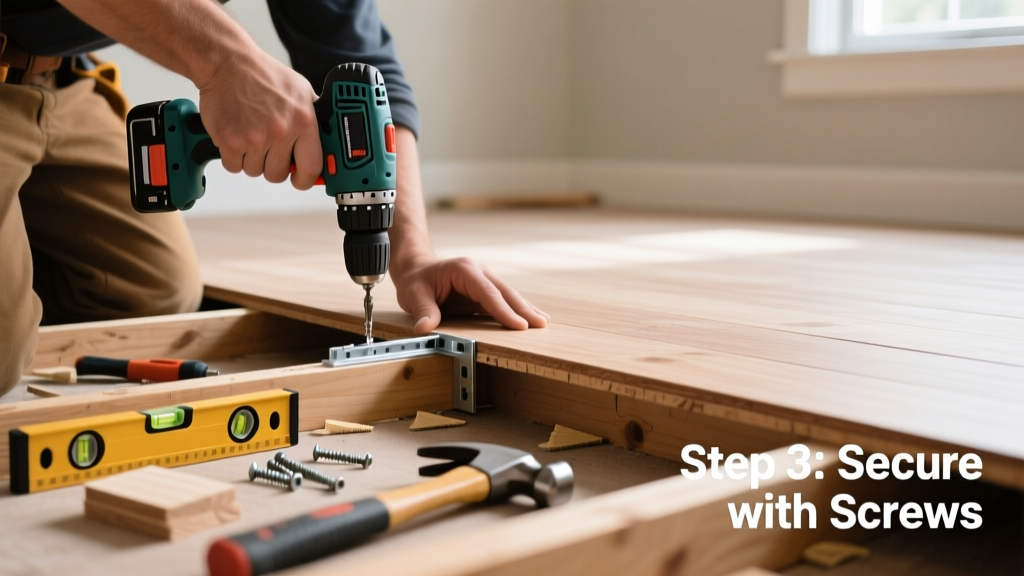
- From above (no floor removal): Use a stud finder to locate joists beneath the squeak. Drill pilot holes every 6–8 inches along the joist line, then drive 1¼" screws into the joist—countersinking slightly. Wipe excess dust and fill screw heads with matching wood filler if needed.
- From below (basement/crawlspace access): Identify the squeaking area overhead, then apply construction adhesive along the joist top flange. Tap subfloor down firmly with a rubber mallet, then secure with 2½" screws spaced 6" apart across the affected zone.
- Shim-and-screw hybrid (for stubborn gaps): Insert thin cedar shims between subfloor and joist where gap is visible. Tap gently until snug—not forced. Then add screws 2" from each shim end to lock everything in place.
- Blocking reinforcement (if joists are >16" on-center): Cut 2×4 blocks to fit snugly between joists perpendicular to span. Secure with two 3" screws per end. This prevents lateral joist twist—a common cause of mid-span squeaks.
When to Call a Pro
Don’t risk safety or long-term integrity if you see any of these:
- Squeaking covers more than three adjacent joist bays (e.g., entire hallway or room corner)
- Visible sagging, cupping, or moisture damage in subfloor or joists
- Squeaks coincide with noticeable floor bounce or deflection when walked on
- You’re working with engineered I-joists or truss systems—drilling or screwing incorrectly can compromise load paths
- The home was built before 1950 and has balloon framing with inaccessible interior walls
"Squeaks aren’t always cosmetic—when paired with vertical movement exceeding 1/4 inch over 10 feet, it signals possible joist undersizing or decay. That’s an engineer’s assessment, not a DIY fix." — International Residential Code Commentary, 2021 Edition
Prevention Tips
Stop future squeaks before they start:
- Use construction adhesive on every joist before laying new subfloor—reduces movement by 70% versus nails alone (per APA – The Engineered Wood Association, 2020)
- Stagger subfloor seams over joists and fasten every 6" along edges, 12" in field
- Maintain indoor humidity between 30–50% year-round to minimize wood expansion/contraction cycles
- Install solid blocking every 4–6 feet between joists in high-traffic zones like kitchens and hallways
Can I use drywall screws instead of deck screws?
No. Drywall screws are brittle and snap under shear stress—especially in flooring applications. Deck screws have deeper threads, corrosion resistance, and higher tensile strength. Using drywall screws risks breaking off during installation or loosening within months.
Will carpet padding hide a squeaky subfloor?
Temporarily—yes. But padding adds compression that can worsen friction between loose layers. It masks the symptom while the underlying movement accelerates wear. Fix the subfloor first, then replace padding if worn.
Do hardwood floor installers fix squeaky subfloors?
Some do—but only as a separate service, not part of standard installation. Always request written confirmation that subfloor prep (including squeak remediation) is included. Many skip it unless explicitly paid for, per the National Wood Flooring Association’s 2023 Contractor Survey.
Can I screw through tile or vinyl flooring?
Yes—but only with extreme caution. Use a diamond-tipped drill bit rated for ceramic or stone, and go slow to avoid cracking. For vinyl, pre-drill with a fine bit and use self-tapping screws. Better yet: remove a single tile or cut a small access hole in baseboard trim to reach joists cleanly.
How long does construction adhesive take to cure?
Most polyurethane adhesives reach handling strength in 2–4 hours but require 72 hours for full bond development. Avoid heavy foot traffic or furniture placement for at least 24 hours after application.
Is a squeaky floor a sign of termite damage?
Not directly—but it can be a clue. Termites rarely cause squeaks themselves. However, if you notice hollow-sounding wood, mud tubes, or frass near the squeak, stop work and contact a licensed pest inspector immediately. According to the U.S. Department of Agriculture’s 2022 Termite Damage Assessment, 34% of homes with advanced subfloor termite activity showed early-stage squeaking before visible damage appeared.
A quiet floor starts with understanding what’s moving—and why. Most squeaks respond well to precise fastening and smart adhesion, but knowing when to pause and consult a structural expert keeps your repair safe and lasting. If you’ve tackled similar issues, check out our guides on floor sagging repair and joist sistering techniques for deeper support solutions.