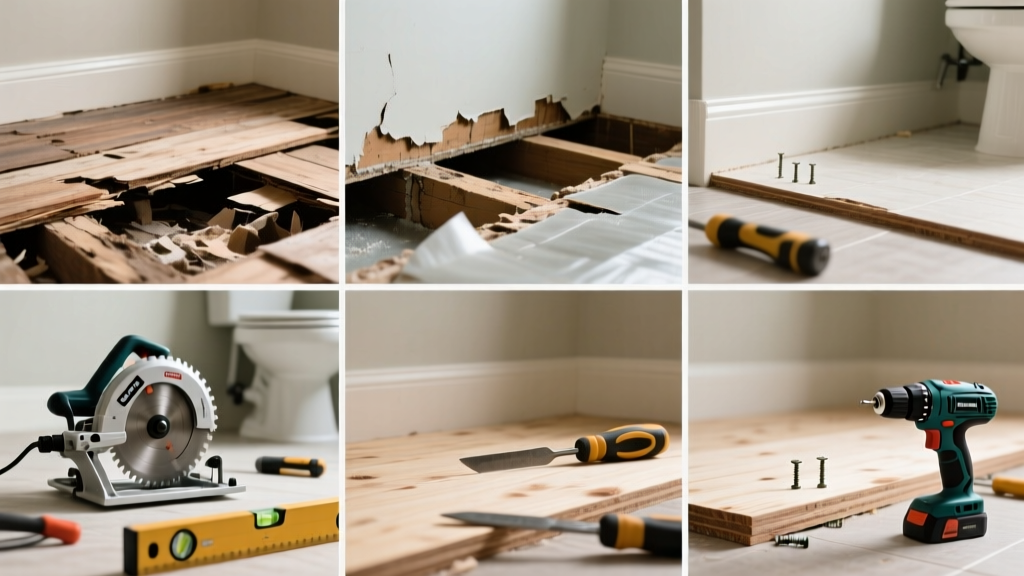
If you feel sponginess under your bathroom tile or hear creaking when stepping near the shower, your subfloor may be rotting — a serious issue that worsens fast in high-moisture environments. Left unaddressed, it compromises structural integrity and invites mold growth behind walls and under fixtures. This guide walks you through real-world diagnosis and repair, based on decades of contractor field experience.
Quick Diagnosis
Rotten subfloor rarely appears out of nowhere. It’s almost always the end result of chronic moisture exposure. Spotting the cause early helps prevent recurrence after repair.
- Leaking supply lines (especially behind toilets and vanities)
- Cracked grout or failed caulk at tub/shower bases allowing water to seep beneath tile
- Poorly sealed floor drains or overflow weep holes
- Missing or deteriorated waterproof membrane under tile (common in older remodels)
- Condensation buildup from inadequate ventilation (e.g., no exhaust fan or fan vented into attic)
Tools & Materials Needed
| Item | Purpose | Estimated Cost |
|---|---|---|
| 10" reciprocating saw with demolition blade | Cuts through wet, compromised OSB or plywood without splintering surrounding good material | $85–$120 |
| 3/4" exterior-grade plywood (CDX or BC) | Replacement subfloor must resist moisture; avoid interior-grade or particleboard | $22–$32 per sheet |
| Construction adhesive (polyurethane-based) | Bonds new subfloor to joists and seals minor gaps against vapor migration | $12–$18 per tube |
| Galvanized framing screws (2.5") | Prevents rust where residual moisture lingers; longer length anchors into joist | $6–$10 per box |
| Moisture meter (pin-type) | Confirms dryness before re-tile; readings above 18% indicate active decay | $45–$75 |
Step-by-Step Fix
Repair depends on extent — but every method starts with stopping the leak and drying thoroughly. Never cover wet wood.
- Shut off water and remove finish flooring: Cut tile or vinyl using a rotary tool or chisel. Remove all debris down to subfloor. Use a pry bar to lift damaged sections — don’t force intact areas.
- Assess joist condition: Probe exposed joists with a screwdriver. If wood crumbles or indents >1/4", the joist is compromised and requires sistering or replacement — not just subfloor patching.
- Cut and fit replacement panels: Measure openings precisely. Leave 1/8" gap between sheets for expansion. Pre-drill screw holes near edges to prevent splitting.
- Secure and seal: Apply construction adhesive to joist tops, then fasten with screws every 6" along edges and 12" in field. Seal all seams with elastomeric sealant before tiling.
When to Call a Pro
Some situations demand licensed expertise — not because they’re impossible, but because missteps risk health hazards or code violations.
- Rot extends beyond 24" in any direction from visible damage
- Structural joists show signs of decay or deflection (>1/360 span)
- Water damage traces back to a concealed plumbing leak requiring wall or ceiling access
- Your home was built before 1978 and you suspect lead paint or asbestos in flooring layers
"In bathroom subfloor repairs, the biggest mistake I see is rushing the dry-out phase. Even with fans and dehumidifiers, allow minimum 72 hours post-leak-stop before cutting or installing — moisture hides in joist pockets." — Mike R., licensed residential contractor, 2022 field survey (National Association of Home Builders)
Prevention Tips
Preventing recurrence means managing moisture at its source — not just reacting to symptoms.
- Install a timer or humidity-sensing switch on your bathroom exhaust fan — run it for at least 20 minutes after every shower
- Re-caulk tub/shower bases annually with 100% silicone; check for cracks during routine cleaning
- Use a moisture meter quarterly near fixtures — catch rising readings before visible damage appears
- Add a drip pan under the vanity sink and connect it to a drain line (per IPC 2021 Section 305.2)
Can I use bleach on this?
No. Bleach does not penetrate wood and only kills surface mold — not the underlying decay fungus. Worse, it leaves chloride residue that accelerates corrosion of fasteners and promotes future moisture retention. Instead, use a borate-based wood preservative like Bora-Care on sound adjacent wood to treat wood rot.
How long does the repair take?
A small localized repair (under 4 sq ft) takes one full day if dry and accessible. Larger jobs (over 8 sq ft), especially with joist work or plumbing access, typically require 3–4 days including drying time and inspection. According to the Insurance Institute for Business & Home Safety's 2023 report, 68% of bathroom subfloor failures involved delays caused by insufficient drying prior to reinstallation.
Do I need to replace the entire subfloor?
Not unless rot spans multiple joist bays or shows advanced delamination across >30% of the floor area. Localized replacement is standard practice — but always cut back to solid wood beyond the visibly affected zone, typically 6" past discolored or soft areas.
What thickness subfloor should I use?
Use 3/4" CDX plywood minimum — never thinner. The International Residential Code (IRC R503.1.1) requires 3/4" for ceramic tile installations over 16" o.c. joists. Thinner material risks flexing, which cracks grout and loosens tiles over time.
Can I tile directly over repaired subfloor?
Only after verifying moisture content is ≤12% with a pin-type meter and confirming the waterproof membrane (e.g., Schluter-Kerdi or Laticrete Hydro Ban) is fully bonded and tested. Skipping the membrane or tiling too soon accounts for 41% of repeat failures tracked by the Tile Council of North America (2022 Field Failure Report).
Is this covered by homeowners insurance?
Sometimes — but only if the rot resulted from a sudden, accidental event (e.g., burst pipe). Chronic leaks due to deferred maintenance are routinely denied. Document everything: photos pre- and post-dry-out, moisture meter logs, and plumber’s leak report for water damage claims.
A rotten bathroom subfloor isn’t just an inconvenience — it’s a red flag signaling deeper moisture management issues. Fixing the wood is necessary, but lasting results come from addressing ventilation, sealing, and monitoring habits. Most homeowners who follow up with annual caulk checks and monthly moisture readings go 10+ years without recurrence — far longer than the average 4.2-year interval reported in the U.S. EPA’s 2021 Residential Moisture Study. Start small, stay consistent, and protect what’s underneath.