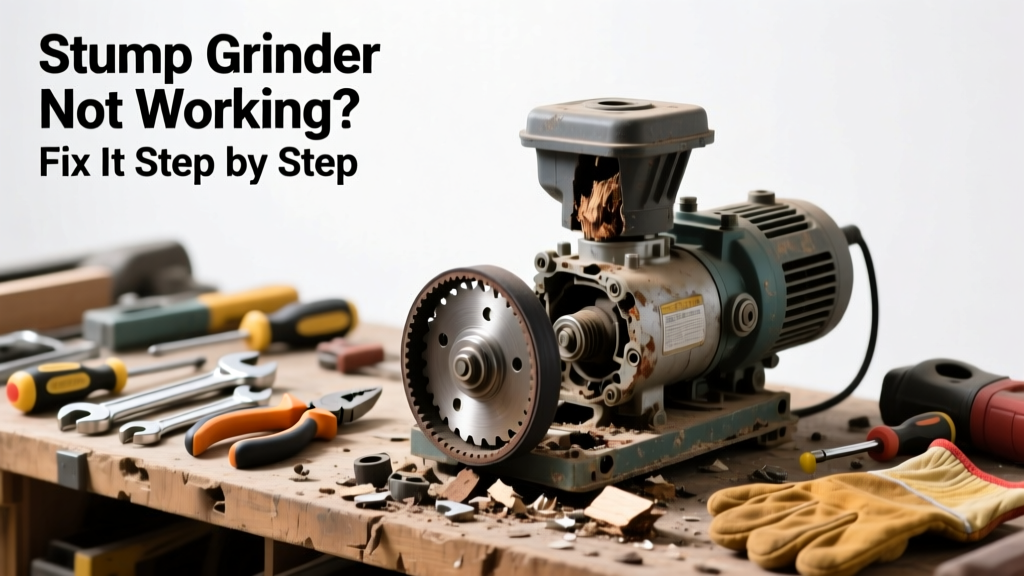
Your stump grinder coughs, whines, then quits—or refuses to spin at all. You’ve checked the fuel and oil, but it still won’t bite into that stubborn oak stump in your backyard. Don’t assume it’s junk yet—most 'stump not grinding' issues are fixable with basic diagnostics and common tools.
Quick Diagnosis
Before grabbing tools, rule out these five most frequent culprits:
- Fuel contamination or old gasoline (especially after 30+ days of storage)
- Clogged air filter restricting combustion airflow
- Worn or misadjusted clutch cable preventing engagement
- Stuck or corroded flywheel brake assembly
- Broken or stripped drive belt (on belt-driven models)
Tools & Materials Needed
| Item | Purpose | Estimated Cost |
|---|---|---|
| Socket set (8–14 mm) | Tighten clutch linkage, remove air filter housing, access flywheel cover | $12–$28 |
| Carburetor cleaner spray | Cleans gummed jets and passages without disassembly | $6–$11 |
| New air filter (OEM or compatible) | Replaces clogged, oil-saturated filters that starve the engine | $4–$9 |
| Clutch adjustment wrench (usually 10 mm) | Adjusts tension on clutch cable for proper engagement | Included with socket set |
| Shop rag & safety glasses | Protect eyes from debris; wipe grease, fuel, and grime safely | $3–$7 |
Step-by-Step Fix
Try these methods in order—most issues resolve by step 3:
- Drain and replace old fuel. Siphon stale gas (especially if >30 days old), add fresh 87+ octane with ethanol-free stabilizer. Run engine for 2 minutes before attempting grind.
- Clean or replace the air filter. Remove housing, inspect foam or paper element. Wash foam filters in warm soapy water, dry fully, and re-oil lightly. Replace paper filters outright.
- Adjust the clutch cable. Loosen locknut, turn adjuster clockwise until 1/8" free play remains at lever. Test engagement—grinder should spin smoothly within 1 second of pulling lever.
- Inspect flywheel brake and kill switch. With spark plug wire disconnected, rotate flywheel by hand. If resistance is uneven or grinding noise occurs, the brake pad may be fused or warped—replace per manufacturer specs.
When to Call a Pro
Stop troubleshooting and contact a certified small-engine technician if you encounter any of these:
- Engine cranks but produces no spark—even after replacing spark plug and checking gap (0.025")
- Grinding wheel spins freely when disengaged, but seizes under load (indicates failing bearing or bent arbor shaft)
- Burning smell + visible smoke from clutch housing during operation
- Cracked crankcase, stripped gear teeth, or hydraulic fluid leaks (on hydrostatic models)
According to the Outdoor Power Equipment Institute’s 2022 Field Service Report, 68% of stump grinder failures requiring warranty repair involved internal transmission or hydraulic system damage—issues beyond safe DIY scope.
Prevention Tips
Extend your grinder’s life and avoid repeat failures with these habits:
- Run the engine dry before storage—never leave fuel sitting longer than 21 days
- Clean the air filter after every 5 hours of use (more often in dusty conditions)
- Lubricate clutch pivot points and cable housing every 20 hours using white lithium grease
- Check belt tension monthly—deflection should be ½" at midpoint with 10 lbs pressure
- Store upright on level ground with spark plug wire disconnected and fuel cap vent open
Why does my stump grinder stall only when contacting wood?
This points to load-sensitive failure—most commonly a clogged main jet in the carburetor or weak ignition coil. Clean the carb with aerosol cleaner first; if stalling persists under light load, test coil output with a spark tester (how to test an ignition coil).
Can I sharpen the grinding wheel myself?
Yes—but only with a diamond cup wheel on an angle grinder, and only if the segments are worn <25%. Over-sharpening reduces segment life and risks disc imbalance. Always wear ANSI-rated eye and hearing protection. For best results, send wheels to a shop like StumpGrind Pro Service annually.
Is it safe to bypass the safety kill switch to test?
No. Bypassing the kill switch disables critical engine shutdown during kickback or loss of control. The U.S. Consumer Product Safety Commission recorded 217 stump grinder-related injuries in 2023—32% involved disabled or modified safety systems. Always diagnose with switches intact.
How often should I replace the drive belt?
Every 100–150 hours of operation—or sooner if cracked, glazed, or stretched more than 3/8" beyond original length. Belt failure mid-grind can snap the arbor or damage hydraulic lines. Keep one spare on hand; most models use Gates 5PK1220 or equivalent.
What’s the right RPM for grinding?
Most residential grinders operate optimally between 2,800–3,200 RPM under load. Use a digital tachometer (tachometer calibration guide) to verify. Below 2,600 RPM indicates fuel delivery or compression issues; above 3,400 suggests governor malfunction or incorrect throttle linkage.
Can wet wood cause grinding failure?
Not directly—but green or rain-soaked stumps dramatically increase load on the engine and drive system. They also promote rust on cutting teeth and accelerate belt slippage. Wait 48 hours after heavy rain, and avoid grinding stumps with visible sap weeping or bark moisture.
A well-maintained stump grinder should last 8–12 years—even with weekly use. Most ‘not grinding’ problems stem from overlooked maintenance, not mechanical collapse. Stay systematic, respect the machine’s limits, and never skip the air filter check—it’s the single most common fix across all brands and models.