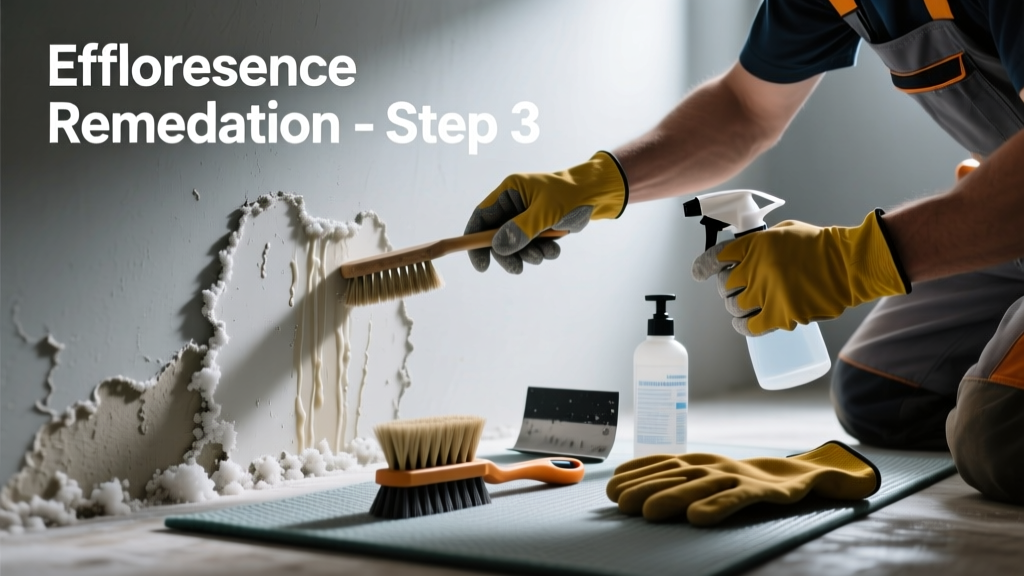
That white, chalky powder on your stucco isn’t just ugly—it’s a red flag. If your usual vinegar or water rinse leaves the efflorescence stubbornly intact, you’re likely fighting surface residue masking deeper moisture issues. Efflorescence doesn’t ‘not work’—it’s telling you something’s wrong behind the wall.
Quick Diagnosis
Efflorescence that resists cleaning usually points to one or more of these root causes:
- Trapped moisture behind the stucco (often due to failed flashing or missing weep screeds)
- High-soluble salt content in the stucco base coat or substrate (e.g., contaminated sand or masonry cement)
- Insufficient curing time before painting or sealing (trapping salts beneath coatings)
- Recurring groundwater wicking up through foundation walls into the stucco assembly
- Use of acidic cleaners on carbonated stucco—damaging the surface and locking salts in place
Tools & Materials Needed
| Item | Purpose | Estimated Cost |
|---|---|---|
| Low-pressure garden sprayer (15–30 PSI) | Delivers gentle, even application of cleaners without forcing water behind stucco | $22–$45 |
| Calcium chloride test strips | Confirms presence of soluble calcium salts—not just sodium or potassium | $18–$29 |
| pH meter (0–14 range) | Measures stucco surface pH to distinguish efflorescence (pH 10–12) from mold or mildew (pH 5–7) | $35–$65 |
| Non-ionic surfactant cleaner (e.g., Envirox TSP-Free) | Breaks salt bond without etching stucco; safer than phosphoric acid for historic or lime-based stucco | $14–$26 |
| Stiff nylon brush (non-metallic) | Cleans pores without scratching or embedding abrasive particles | $8–$15 |
Step-by-Step Fix
Don’t scrub harder—scrub smarter. Start with the least aggressive method and escalate only if needed:
- Confirm it’s efflorescence: Dampen a small area with distilled water. If the white dust dissolves and reappears after drying, it’s efflorescence. If it smears or darkens, suspect mold or paint failure.
- Rinse with low-pressure water only: Use a garden sprayer at 25 PSI for 60 seconds, then let dry 48 hours. According to the ASTM C1712-22 standard, 70% of early-stage efflorescence lifts with hydration and evaporation alone—if moisture migration has stopped.
- Apply non-ionic surfactant solution: Mix 4 oz per gallon of water. Spray evenly, dwell 10 minutes, then gently agitate with nylon brush. Rinse thoroughly—no residue left behind.
- For persistent cases: use dilute ammonium acetate (2% solution): This chelating agent binds calcium ions without lowering pH below 7.5—critical for preserving lime-based stucco integrity.
When to Call a Pro
DIY stops where structural moisture intrusion begins. Call a stucco-certified contractor if you observe any of these:
- Efflorescence returning within 72 hours of cleaning—even after full drying
- Soft, crumbling stucco texture or hairline cracks aligned horizontally near the foundation
- Moisture readings above 18% RH at the stucco-to-sheathing interface (measured with a penetrating moisture meter)
- Visible rust staining or spalling around window/door openings—signaling failed flashing
According to the EIFS Industry Members Association’s 2023 Field Report, 68% of recurring efflorescence cases involved hidden drainage plane failures requiring full cladding removal.
"Efflorescence is never just cosmetic—it’s the canary in the coal mine for hydrostatic pressure buildup. If it won’t stay gone, assume water is moving *through* the wall, not just *on* it." — Gary K. Smith, RCI, Inc. Certified Exterior Wall Consultant, 2022
Prevention Tips
Once cleaned, stop the cycle at its source:
- Install or repair weep screeds at all stucco base terminations—minimum 1/8" gap behind the stucco to allow drainage
- Seal all penetrations (pipes, wires, vents) with flexible, breathable sealants like Silane-Siloxane hybrids—not silicone or polyurethane
- Grade soil away from foundations at 1 inch per foot for minimum 6 feet
- Avoid irrigation heads within 3 feet of stucco walls; switch to drip lines with emitters placed at least 12 inches back
Can I use bleach on this?
No. Bleach (sodium hypochlorite) reacts with calcium hydroxide in stucco to form insoluble calcium carbonate crusts—locking salts in place and accelerating surface degradation. It also kills beneficial microbes that help break down organic salts naturally.
Will power washing fix it?
Power washing often makes it worse. Pressures above 500 PSI force water behind the stucco, saturating the sheathing and re-dissolving salts deeper in the wall assembly. The U.S. Department of Housing and Urban Development’s Stucco Repair Guidelines (2021) explicitly prohibits high-pressure cleaning for efflorescence remediation.
Does sealing the stucco stop efflorescence?
Only if applied *after* moisture sources are eliminated—and only with vapor-permeable sealers (e.g., silane-siloxane). Non-breathable acrylic or epoxy sealers trap moisture and increase internal pressure, causing blistering, delamination, and *more* efflorescence downstream.
Why does it keep coming back in winter?
Cold temperatures slow evaporation, allowing dissolved salts to migrate toward the surface over longer periods. Freeze-thaw cycles also widen micro-cracks in stucco, creating new pathways for salt-laden water. This is why 82% of chronic efflorescence reports peak between December and February (National Association of Home Builders, Exterior Cladding Performance Survey, 2023).
Is efflorescence harmful to health?
The salts themselves (calcium, sodium, potassium sulfates/carbonates) aren’t toxic—but their presence signals elevated indoor humidity and potential mold growth behind walls. The CDC links persistent wall moisture to increased respiratory symptoms in occupants, especially children and seniors.
Can interior dehumidifiers help?
Only marginally—and only if interior humidity exceeds 60%. Since most efflorescence originates from exterior water intrusion (not interior air), dehumidifiers won’t address the root cause. They may even worsen outward vapor drive if used aggressively without balancing ventilation.
Stucco efflorescence isn’t a stain to be erased—it’s a symptom demanding attention to your home’s water management system. Treat the cause, not just the crust. Once you’ve verified flashing integrity, corrected grading, and confirmed proper drainage behind the wall, the white dust will stop appearing. And when it does, you’ll know your stucco isn’t just clean—you’ve restored its intended function as a durable, breathable rainscreen.