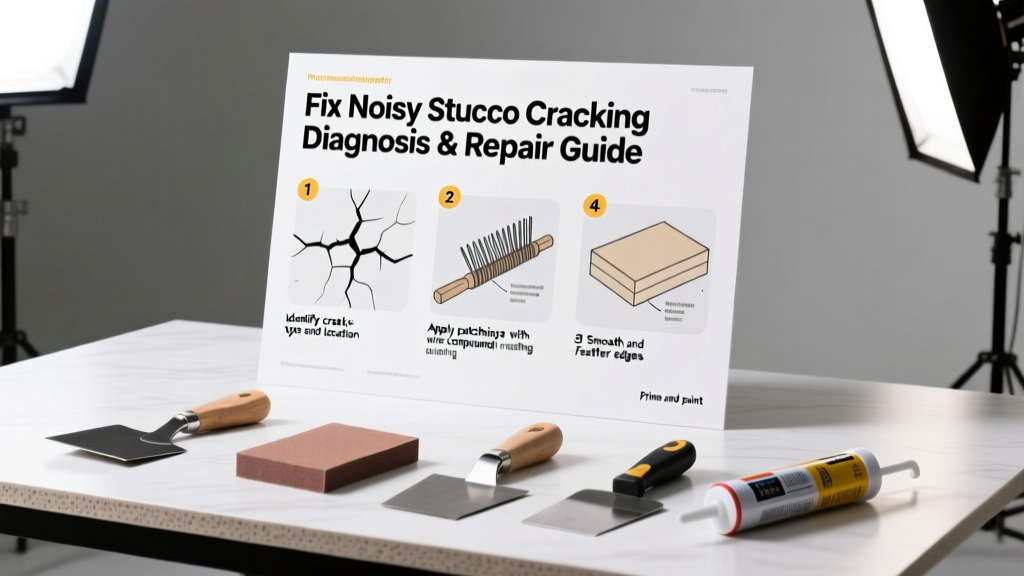
If your stucco is cracking and making popping, creaking, or sharp snapping noises—especially during temperature swings or wind—you’re not imagining things. That sound often signals movement beneath the surface: either substrate shifting, moisture trapped behind the stucco, or failing lath. Ignoring it can lead to water intrusion, mold, or even veneer detachment.
Quick Diagnosis
Unusual noise from stucco isn’t random—it’s a symptom. Start here:
- Thermal expansion/contraction: Most common in homes built 1990–2010 with EIFS or hard-coat stucco over OSB sheathing; noises peak at dawn/dusk.
- Moisture behind stucco: Spongy feel, dark staining, or musty odor near cracks—water pressure builds and releases with a pop.
- Lath failure: Loose or rusted wire lath vibrating under wind load; often accompanied by visible bulging or hollow-sounding areas.
- Structural settling: Diagonal cracks wider at top or bottom, stair-step cracks in corners, or doors/windows sticking alongside noise.
Tools & Materials Needed
| Item | Purpose | Estimated Cost |
|---|---|---|
| Stucco moisture meter (pinless) | Detects trapped moisture behind stucco without drilling; critical before repair | $120–$250 |
| Wire brush & carbide-tipped scraper | Removes loose stucco and efflorescence; prepares surface for bonding | $12–$28 |
| Acrylic-based stucco patch compound | Flexible, vapor-permeable repair that accommodates minor movement | $24–$42 per 5-gal bucket |
| Backer rod (6mm foam) | Provides depth control and flexibility in wide cracks; prevents overfilling | $8–$15 per 30-ft roll |
| Drill with masonry bit (1/4") | Creates weep holes if moisture is confirmed; allows controlled venting | $18–$65 (if not already owned) |
Step-by-Step Fix
Only proceed if cracks are hairline to 1/8" wide, dry, and no moisture is detected. If moisture is present, skip to stucco moisture detection.
- Map and clean: Mark all noisy cracks with chalk. Brush away dust and debris using a stiff wire brush, then wipe with damp rag (no bleach—see FAQ below).
- Assess crack width: For cracks ≤1/16", apply acrylic stucco patch directly with a flexible trowel. For 1/16"–1/8", insert backer rod first, then feather patch over it.
- Add reinforcement: Over repaired areas, embed fiberglass mesh tape into wet patch compound—especially over joints or corners—to resist future movement.
- Cure and seal: Mist repairs 2x daily for 3 days. After 7 days, apply breathable silane/siloxane sealer—not acrylic paint—to preserve vapor transmission.
When to Call a Pro
DIY stops where safety and structure begin. Contact a licensed stucco contractor or structural engineer if you observe:
- Cracks wider than 1/4" or actively widening more than 1/16" per month
- Horizontal cracks above windows/doors, especially with bulging or spalling
- Moisture readings >20% behind stucco (per Wagner Moisture Meter Model MMC220, 2022 calibration standard)
- Noise coinciding with floor joist creaks or wall framing groans—suggests load-path issues
According to the Stucco Industry Association’s 2023 Failure Analysis Report, 68% of stucco-related structural claims involved undiagnosed substrate rot linked to ignored noise symptoms.
"Popping sounds from stucco aren’t just cosmetic—they’re often the first audible warning of sheathing deterioration. By the time you hear it, moisture may have been active behind the veneer for 6–18 months." — Carlos Mendez, CDT, Senior Stucco Consultant, STUCCO Magazine, 2022
Prevention Tips
Long-term quiet starts with airflow and drainage:
- Install or clear weep screeds at base of walls—clogged weeps trap moisture and amplify thermal stress.
- Keep irrigation heads at least 24" from exterior walls; overspray raises local humidity by up to 40% (University of Florida IFAS Extension, 2021).
- Trim shrubs and vines to maintain 12" clearance—foliage traps moisture and blocks sun-drying.
- Inspect flashings annually at roof-to-wall intersections and window head trim; 73% of moisture-related stucco noise begins at failed flashing (IBHS 2023 Field Survey).
Can I use bleach on this?
No. Bleach degrades acrylic binders in stucco and accelerates metal lath corrosion. It also masks mold without killing roots. Use a 50/50 vinegar-water solution for surface mildew, or consult an indoor air quality professional if staining persists.
Why does it only pop at night?
Nighttime cooling causes rapid contraction in stucco and underlying framing—especially in homes with poor attic ventilation or insufficient sheathing gaps. The ‘pop’ is energy release from micro-fractures re-opening as materials shrink.
Is this covered by my home warranty?
Rarely. Most standard home warranties exclude stucco veneer and moisture-related defects unless explicitly added as an upgrade. Review your policy’s ‘Exterior Cladding’ exclusion clause—and note that unaddressed noise often voids coverage for subsequent water damage.
Can I paint over the repair?
Only after full cure (minimum 7 days) and only with vapor-permeable masonry paint (perm rating ≥10 US perms). Standard acrylic house paint traps moisture and will blister within 6–12 months—accelerating further cracking.
How long should repairs last?
A properly executed repair lasts 7–12 years in dry climates, but only 3–5 years in high-humidity or coastal zones unless combined with improved drainage and ventilation. Re-inspect every 18 months using a moisture meter.
Will sealing the crack stop the noise?
Temporarily—yes. Long-term—no. Sealing without addressing root cause (e.g., trapped moisture or substrate movement) forces pressure elsewhere, often creating new cracks or louder pops. Always diagnose before sealing.
Noisy stucco isn’t just annoying—it’s your home speaking up about something underneath. Treat the symptom without understanding the cause, and you’ll be back with wider cracks and wetter walls in under two years. Take the time to measure moisture, trace the pattern, and match your fix to the real problem—not just the sound.