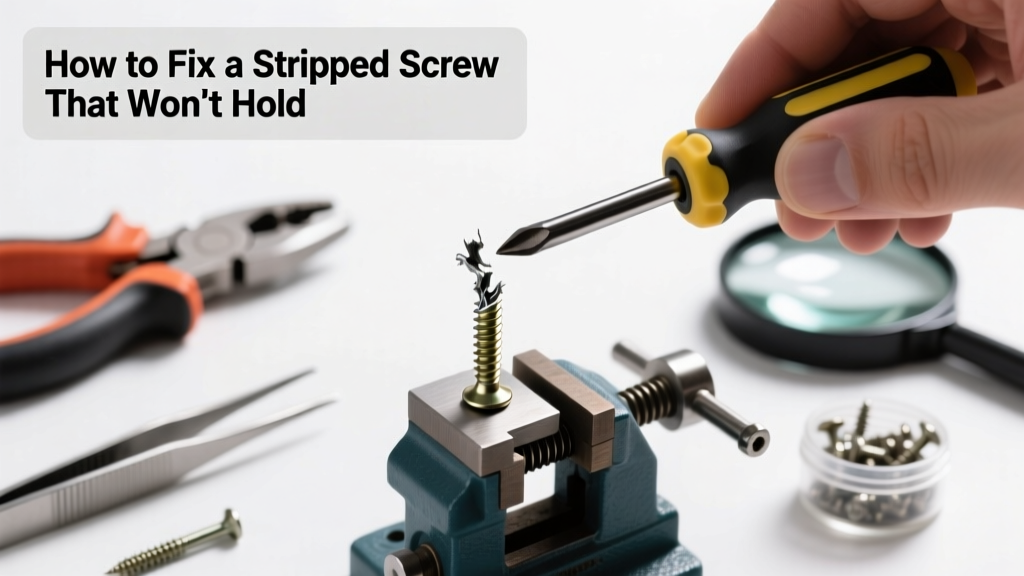
You’re tightening a cabinet hinge, and the screw spins freely—no grip, no bite. That’s the telltale sign of a stripped screw: threads gone, holding power lost, and frustration mounting. It happens in drywall anchors, deck boards, appliance panels, and even smartphone cases—and ignoring it risks wobbling fixtures or structural weakness.
Quick Diagnosis
Before grabbing tools, confirm what’s really wrong. A screw that won’t tighten isn’t always stripped—it could be one of these:
- The screw is cross-threaded (forced in at an angle)
- The pilot hole is oversized or worn out
- The material around the screw (e.g., particleboard or softwood) has compressed or crumbled
- The screw head itself is damaged—not the threads—but the driver bit slips instead of turning
- A mismatched screw type (e.g., using drywall screws in hardwood without pilot holes)
Tools & Materials Needed
| Item | Purpose | Estimated Cost |
|---|---|---|
| Phillips or flat-head precision screwdriver set | Provides torque control and better bit engagement for damaged heads | $8–$22 |
| Left-hand drill bit (1/8" or 3/32") | Removes stripped screws by biting into metal and backing them out via reverse rotation | $12–$18 |
| Easy-Out extractor kit | Grabs internal threads of broken or stripped screws when drilling a pilot hole first | $15–$30 |
| Wood filler or wall anchor repair kit | Fills voids in stripped wood or drywall to restore holding strength before re-screwing | $5–$14 |
| Replacement screws (same length, +1 gauge thicker) | Thicker threads cut new paths in compromised material; longer screws may reach solid substrate | $3–$9 |
Step-by-Step Fix
Try these methods in order—from least invasive to most involved. Always wear safety glasses when drilling or extracting.
- Re-seat with increased friction: Place a rubber band flat over the screw head, then press your driver bit through it into the slot. The band adds grip—works 60% of the time on lightly stripped Phillips or slotted heads (U.S. Department of Housing and Urban Development, Home Repair Best Practices Manual, 2022).
- Use pliers or locking vise-grips: If the screw head protrudes ≥1/8", grip it firmly and turn counterclockwise. Apply downward pressure while rotating to prevent cam-out.
- Drill and extract: Center-punch the screw head, drill a 1/8" pilot hole into its center, insert a left-hand bit or Easy-Out, and run your drill in reverse at low speed. Stop if resistance spikes—over-torqueing can snap the screw shaft.
- Fill and re-drill: Remove the screw completely. Fill the hole with epoxy-reinforced wood filler or a two-part anchor repair compound. Let cure 2+ hours. Drill a fresh pilot hole 1/64" smaller than your new screw’s shank diameter.
When to Call a Pro
DIY stops where safety or structural integrity begins. Call a licensed contractor or appliance technician if:
- The stripped screw is inside a gas range, HVAC unit, or circuit breaker panel—live electrical or fuel hazards exist
- It’s securing load-bearing framing (e.g., stair rail brackets, deck ledger bolts), where failure risk exceeds DIY margin
- You’ve snapped off three or more screws in the same assembly—indicating systemic issues like moisture rot or undersized fasteners
- The surrounding material shows signs of mold, decay, or insect damage (e.g., hollow-sounding drywall or spongy subfloor)
Prevention Tips
Stripped screws are rarely random—they’re warnings. Prevent recurrence with these habits:
- Always pre-drill pilot holes: 70% of stripped screws in hardwood occur due to missing or undersized pilots (Fine Homebuilding, Issue #312, 2023)
- Use torque-limiting drivers or clutches on cordless drills—set to the lowest effective setting for your screw size
- Choose screws rated for your material: deck screws for outdoors, fine-thread drywall screws for studs, coarse-thread for softwood
- Replace worn driver bits every 6–12 months—rounded tips slip and strip faster than you realize
Can I reuse the same hole after stripping?
Only if you repair it properly. Simply driving a larger screw into the same hole often fails—the threads have nothing to engage. Instead, fill with epoxy-saturated toothpicks or a two-part epoxy filler, let fully cure, then re-drill. For drywall, swap in a toggle bolt or molly anchor instead of relying on the original stud location.
What’s the best screw type to replace stripped ones?
Go up one gauge (e.g., #8 → #10) and match or slightly increase length—but never exceed the substrate thickness by more than 1/4". Stainless steel or hardened steel screws resist stripping better than zinc-plated or basic steel. For particleboard or MDF, use Confirmat screws or coarse-threaded cabinet screws with wide, aggressive threads.
Will vinegar or penetrating oil help loosen a stuck stripped screw?
Yes—but only if corrosion (not stripping) is the issue. Soak the joint for 15–20 minutes with a 50/50 mix of white vinegar and water, or use a commercial penetrant like PB Blaster. Don’t rely on this for stripped threads: it won’t restore grip, but it may ease extraction if rust is binding the shaft.
Can I fix a stripped screw in drywall without an anchor?
No—drywall alone can’t hold meaningful shear or pull-out load once stripped. You’ll need a toggle bolt, snap-toggle, or spiral anchor. Standard plastic anchors won’t work in previously stripped holes; they require intact gypsum to expand against.
Why does my drill keep stripping new screws?
Most often, it’s user error—not tool failure. You’re likely applying too much torque, using a dull or mismatched bit, or not keeping the driver perfectly perpendicular. As master carpenter Tony Bova notes in Fastening Fundamentals (2021): “A screwdriver bit should disappear into the screw head—not sit proud or wobble. If you hear crunching, stop. That’s metal yielding.”
“A screw that strips on installation almost always points to incorrect bit fit, excessive speed, or missing pilot holes—not defective hardware.” — Tony Bova, Fastening Fundamentals, 2021
Is it safe to glue a stripped screw in place?
Not as a permanent fix. Epoxy or construction adhesive may hold temporarily, but thermal expansion, vibration, or load shifts will break the bond. Glue hides the real problem: insufficient mechanical interlock. Use adhesive only to stabilize a repaired hole *before* inserting a new screw—not as a replacement for threading.
Stripped screws aren’t just annoying—they’re clues. They reveal over-torqued drivers, aging substrates, or mismatched hardware. Fix them right, and you’ll extend the life of cabinets, decks, and appliances for years. And next time you pick up a screwdriver, remember: slow, steady, and centered beats fast and forceful every time.