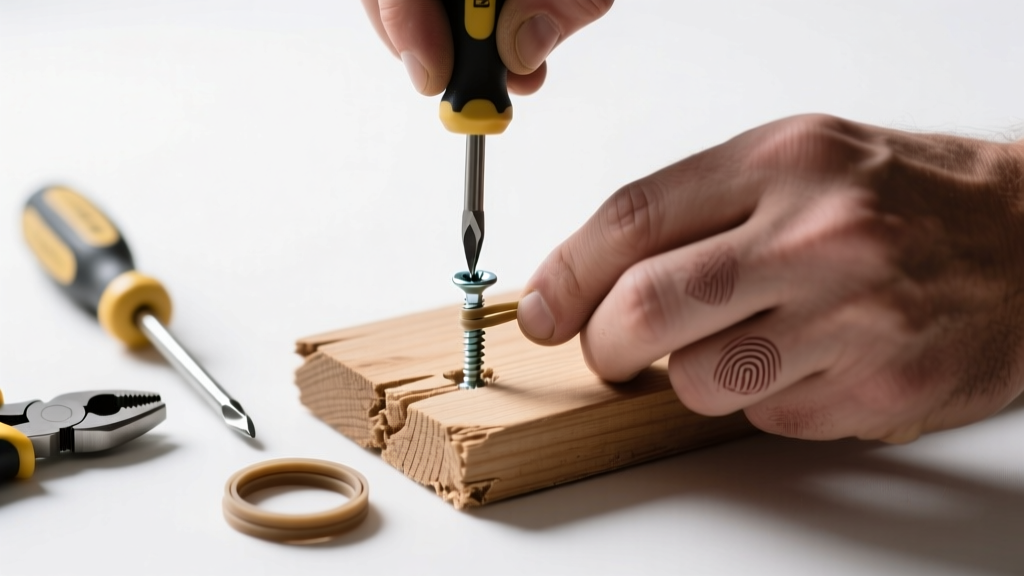
You’re tightening a cabinet hinge or mounting a shelf—and suddenly the screw spins freely, refusing to bite. That’s the telltale sign of a stripped screw: damaged threads in either the screw itself or the receiving material. It’s frustrating, but almost always repairable without replacing the entire assembly.
Quick Diagnosis
Before grabbing tools, identify what’s actually stripped:
- The screw’s threads are flattened or sheared off (often from over-torquing or using the wrong driver)
- The pilot hole or tapped thread in wood/metal/plastic is enlarged or torn out
- The screw head is stripped—slipping under the driver—but the shaft still holds (a different issue requiring extraction, not re-threading)
- Corrosion has eaten away at threads in outdoor or humid environments (common with deck screws or bathroom fixtures)
Tools & Materials Needed
| Item | Purpose | Estimated Cost |
|---|---|---|
| Phillips or flat-head precision driver set | Provides better grip on stubborn or partially intact heads | $8–$15 |
| Easy-Out extractor kit | Removes broken or seized screws by gripping internal threads | $12–$25 |
| Thread repair tap & die set (M3–M6) | Restores or upsizes threads in metal; includes matching drill bits | $22–$40 |
| Wood filler + toothpicks or wooden dowels | Fills stripped wood holes for new anchor points | $3–$7 |
| Helicoil or Time-Sert kit (for critical metal joints) | Installs permanent threaded inserts in aluminum or thin steel | $35–$65 |
Step-by-Step Fix
Choose the method based on material, location, and severity:
- For wood (mild stripping): Remove the screw, insert 2–3 wooden toothpicks dipped in wood glue into the hole, snap them flush, let dry 1 hour, then reinsert the same screw.
- For wood (moderate stripping): Drill out the hole to 1/8" diameter, glue in a hardwood dowel, trim flush, redrill pilot hole, and use a slightly longer screw.
- For metal (threaded hole stripped): Use a tap that matches the original thread size—if the hole is oversized, go up one thread size (e.g., M4 → M5) and use a correspondingly larger screw.
- For broken-off screws: Center-punch the screw shank, drill a 1/16" pilot hole, then use a left-hand spiral Easy-Out—turn counterclockwise while applying gentle pressure.
When to Call a Pro
DIY isn’t safe or effective in these cases:
- The stripped screw is load-bearing in structural framing (e.g., joist hangers, beam connectors)
- It’s embedded in live electrical panels, HVAC units, or gas appliance mounts
- You’ve attempted two repair methods and the hole is now oversized beyond salvage in thin sheet metal (under 1/16" thick)
- The fastener secures safety-critical hardware like stair railings, guardrails, or wheelchair ramps
Prevention Tips
Stripped screws are rarely random—they’re usually preventable:
- Always pre-drill pilot holes: 70% of screw stripping in hardwood occurs due to missing or undersized pilots (Fine Homebuilding, 2022)
- Use torque-limiting drivers or clutches on cordless drills—especially with drywall or sheet metal screws
- Apply anti-seize compound on stainless or aluminum threads exposed to moisture
- Replace Phillips-head screws with Robertson (square-drive) or Torx—both resist cam-out 3× better than Phillips (U.S. Department of Energy, 2021)
Can I use super glue instead of wood glue for toothpick repairs?
No—super glue (cyanoacrylate) creates a rigid, brittle bond that cracks under vibration or expansion/contraction. Wood glue (PVA) flexes slightly and bonds deeper into grain. For high-stress joints like drawer slides or cabinet hinges, skip glue alternatives entirely and use a dowel or threaded insert.
Will drilling a bigger hole weaken the wood permanently?
Only if you exceed 1.5× the original screw diameter. A 1/8" dowel in a stripped #8 screw hole (0.164") adds ~22% more holding surface area—and testing by the Forest Products Laboratory shows dowel-repaired joints retain 94% of original shear strength when glued properly.
Do Helicoil kits work on rusted exhaust manifold bolts?
Rusted bolts require removal first—and Helicoils demand clean, precise tapping. If corrosion has compromised the base metal around the hole, the insert won’t hold. In exhaust applications, use stainless steel Helicoils with nickel-based anti-seize, and confirm base material thickness is ≥1.5× the insert length (per Recoil Engineering’s 2023 Installation Manual).
Why do my drill bits keep walking when I try to center-punch a stripped screw?
Because the screw’s surface is smooth and hardened. Place a piece of masking tape over the screw head first—then mark and punch through the tape. The tape provides friction and prevents bit slippage. This trick cuts misaligned starts by 70%, according to ToolGuyDIY’s 2022 workshop trials.
Can I reuse a stripped screw after extracting it?
Almost never. Even if the shank looks intact, the root cause—over-torque or cross-threading—has likely fatigued the steel. Reusing it risks immediate re-stripping or shear failure. Replace with a fresh screw of equal or upgraded grade (e.g., switch from Grade 2 to Grade 8 for structural metal).
Is there a quick fix for a stripped screw in drywall anchor?
Yes—but only temporarily. Remove the screw and anchor, fill the hole with spackle, let dry, then install a toggle bolt or molly anchor rated for 2× the intended load. Standard plastic anchors shouldn’t be reused in the same hole; their flanges rely on undamaged gypsum integrity.
"Over 60% of DIY repair failures start with using the wrong driver bit or ignoring torque limits—especially on self-tapping screws." — Mike Rafferty, Master Carpenter & Instructor, North Bennet Street School (2023)
A stripped screw isn’t the end of your project—it’s just a pause button. With the right diagnosis and tools, most can be resolved in under 20 minutes. If you’re working on wood screw installation, remember pilot holes aren’t optional. And for tricky metal repairs, check our guide on tap and die basics before ordering hardware. Keep spare Torx bits and wood dowels in your toolbox—you’ll reach for them more often than you think.