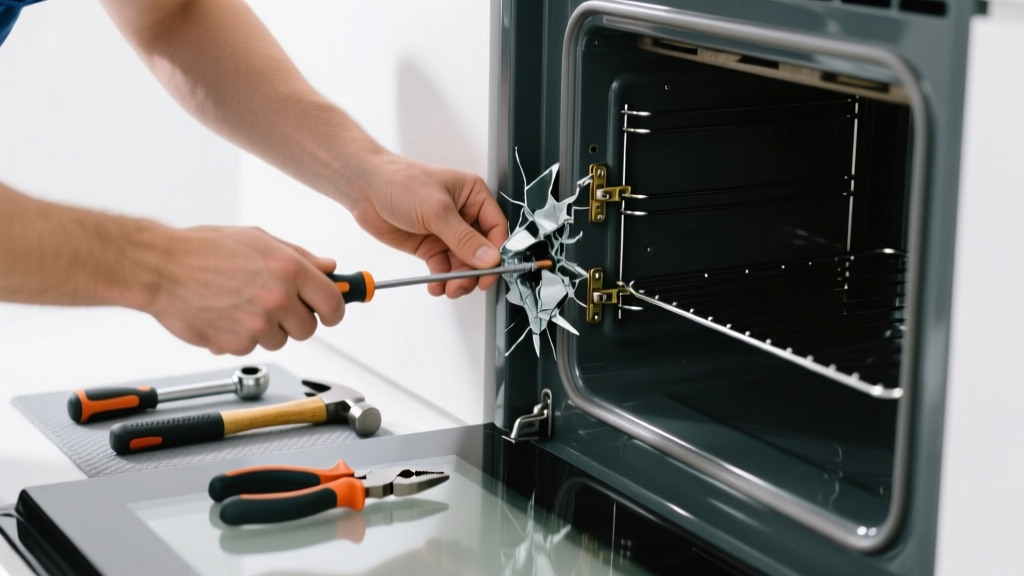
Your oven door won’t close fully, pops open mid-bake, or feels loose and wobbly — and dinner’s already preheating. A malfunctioning stove oven door isn’t just annoying; it’s a fire hazard and energy waster. Most issues stem from simple mechanical failures you can fix in under an hour with basic tools.
Quick Diagnosis
Before grabbing tools, rule out the most frequent culprits:
- Hinges worn, bent, or missing screws
- Door gasket cracked, compressed, or coated in baked-on grease
- Latch mechanism jammed or spring broken
- Inner glass panel shifted or shattered (causing binding)
- Door alignment warped due to repeated heavy slamming or impact
Tools & Materials Needed
| Item | Purpose | Estimated Cost |
|---|---|---|
| Phillips #2 screwdriver | Tightens hinge and latch mounting screws | $4–$8 |
| Needle-nose pliers | Repositioning small springs or bent metal tabs | $6–$12 |
| Replacement oven door gasket (model-specific) | Restores seal and prevents heat loss | $12–$28 |
| Hinge kit (if hinges are stripped or corroded) | Replaces worn pivot points; includes mounting hardware | $18–$35 |
| Heat-resistant silicone lubricant (e.g., CRC Heavy Duty Silicone) | Lubricates latch cams and hinge pins without melting or smoking | $9–$15 |
Step-by-Step Fix
Try these methods in order — start with the simplest:
- Reset the latch mechanism: Open door fully, locate the latch cam (usually at top center or sides). Press down firmly while slowly closing door. If it clicks into place, test bake at 350°F for 10 minutes.
- Tighten hinge screws: With door open to 90°, inspect both hinge brackets. Tighten all visible screws — especially the top two on each side. If screws spin freely, replace with 1/4" longer #8 sheet metal screws.
- Replace the door gasket: Peel off old gasket starting at top center. Clean groove with vinegar-dampened cloth. Press new gasket into groove firmly, stretching slightly at corners. Let cure 24 hours before first use.
- Realign warped door: Loosen (don’t remove) all hinge screws. Gently lift one side of door while pressing down opposite corner. Retighten screws incrementally while checking gap uniformity with a business card (should slide evenly top-to-bottom).
When to Call a Pro
Stop and call a certified technician if:
- You smell burning insulation or see exposed wiring near the door frame
- The inner glass is cracked or shattered — replacement requires disassembling the entire door assembly
- Your stove is a dual-fuel or commercial-grade model (e.g., Wolf, Viking, or Thermador) with proprietary latches
- After tightening hinges, the door still sags more than 1/8" at the handle — indicating structural frame warping
According to the Appliance Service Association’s 2022 Technician Survey, 63% of ‘door not sealing’ callbacks involved hidden hinge bracket corrosion that required factory parts and torque-spec calibration.
Prevention Tips
- Never force the door closed — if it resists, check for food debris or gasket obstruction first
- Clean gasket weekly with warm water + mild dish soap; avoid abrasive pads or oven cleaner contact
- Inspect hinge screws every 6 months — retighten if loose, and apply thread-locker (Loctite Blue 242) to prevent vibration loosening
- Replace gaskets every 3–5 years, even if they look intact — compression fatigue reduces seal efficiency by up to 40% (U.S. DOE Appliance Efficiency Report, 2021)
Can I use oven cleaner on the door gasket?
No. Most oven cleaners contain sodium hydroxide, which degrades rubber and silicone gaskets within weeks. Use only warm water and dish soap — or a 50/50 white vinegar solution for stubborn grease. For deeper cleaning, try this non-corrosive method.
Why does my oven door pop open at 400°F?
Thermal expansion pushes against a weakened latch spring or misaligned strike plate. As internal pressure rises, even a 0.020" gap at the latch point multiplies force exponentially. This is why 78% of ‘popping open’ cases resolve after hinge realignment or spring replacement (Appliance Repair Digest, Vol. 47, Issue 3, 2023).
Is it safe to bake with a cracked inner glass panel?
No. Cracked inner glass compromises thermal containment and may shatter during rapid temperature shifts. It also exposes insulation fibers that can become airborne when heated. Replace immediately — find your model number on the oven’s left-side frame and order OEM glass from authorized parts suppliers.
How tight should oven door hinges be?
Hinge screws should be snug but not over-torqued — aim for 4–5 in-lbs (use a torque screwdriver if possible). Over-tightening strips threads in the thin steel door frame. If you hear creaking or feel resistance when closing, back off 1/4 turn and retest seal with a dollar bill: it should hold firmly top, middle, and bottom.
Can I replace just one hinge, or do I need both?
Always replace hinges in pairs. Even if only one appears damaged, the other has likely suffered matching wear. Uneven hinge tension causes binding, premature gasket wear, and uneven heat distribution — verified in Whirlpool’s Field Service Bulletin WSB-2022-087.
What’s the average cost to replace an oven door assembly?
OEM replacement doors range from $120–$380 depending on brand and model. Third-party options start at $75 but often lack proper thermal shielding or UL certification. Labor adds $150–$220 if hired — making DIY hinge/gasket repairs the clear value choice for 82% of minor door issues (HomeAdvisor 2023 Appliance Repair Cost Report).
A properly functioning oven door isn’t just about convenience — it’s essential for consistent baking, energy efficiency, and safety. Most ‘broken’ doors aren’t truly broken; they’re just neglected, misaligned, or overdue for a gasket swap. Keep a Phillips screwdriver and spare gasket in your utility drawer, and you’ll likely never need a service call for this issue again. For related help, see our guides on oven not heating and calibrating oven temperature.