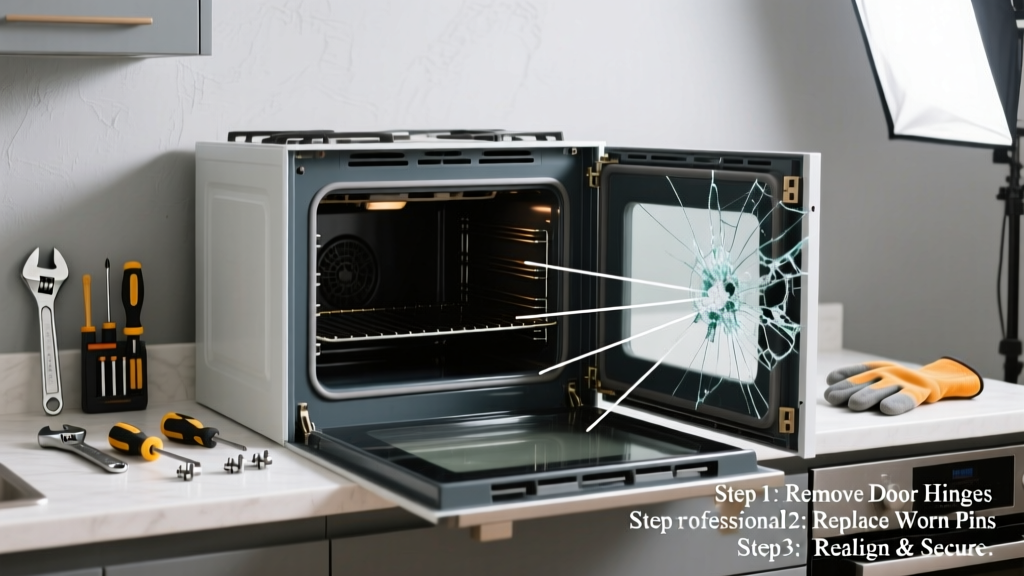
Your oven door won’t close properly, rattles when you open it, or won’t stay shut mid-bake — and dinner’s in the oven. A broken stove oven door isn’t just annoying; it’s a safety hazard and energy waster. Most issues stem from worn hinges, damaged gaskets, or misaligned latches — all fixable in under an hour if you know what to check first.
Quick Diagnosis
Before grabbing tools, identify the root cause. Common culprits include:
- Loose, bent, or corroded hinge pins or brackets
- Cracked, warped, or heat-damaged inner glass panel
- Frayed, hardened, or missing oven door gasket (seal)
- Broken or sprung latch mechanism inside the door frame
- Warped door frame due to repeated slamming or thermal stress
Tools & Materials Needed
| Item | Purpose | Estimated Cost |
|---|---|---|
| Phillips #2 screwdriver | Tightens hinge screws and removes door panels | $4–$8 |
| Needle-nose pliers | Repositions small springs and retrieves dropped hinge pins | $6–$12 |
| Oven door gasket (model-specific) | Replaces cracked or brittle seal to restore heat containment | $12–$28 |
| Hinge replacement kit (if needed) | Includes new pins, brackets, and springs for common brands (GE, Whirlpool, Frigidaire) | $18–$35 |
| Heat-resistant silicone adhesive | Secures inner glass or gasket where factory clips fail | $7–$10 |
Step-by-Step Fix
- Unplug the range and let it cool completely. Never work on live electrical components — even gas stoves have 120V control boards.
- Remove the oven door: Open to first stopping point (usually ~30°), locate release levers or pins at hinge bases, lift upward and out. Consult your manual — some models require pulling down first.
- Inspect hinges and gasket: Check for bent hinge arms, missing springs, or rusted pivot points. Run fingers along the gasket — if it’s cracked, brittle, or pulls away easily, replace it oven-door-gasket-replacement.
- Realign or replace hinges: Loosen hinge mounting screws slightly, gently adjust door angle while holding it closed, then retighten. If pins are stripped or springs snapped, install a matched hinge kit — don’t mix old and new parts.
- Reinstall and test: Slide door back onto hinge arms, ensuring both pins fully seat. Close slowly and verify even gap (1/8" max) around all edges. Run a 350°F preheat for 10 minutes and check for air leaks with a lit candle held near seams.
When to Call a Pro
DIY stops where safety and precision begin. Call a certified appliance technician if:
- The inner glass is shattered or delaminated (can’t be safely resealed)
- You hear arcing or smell ozone when the oven heats — indicates damaged wiring behind the door frame
- Your stove is a dual-fuel or convection model with integrated temperature sensors embedded in the door
- The door frame itself is visibly warped beyond 1/16" — bending it risks cracking insulation or damaging control boards
According to the U.S. Consumer Product Safety Commission’s 2022 Appliance Incident Report, 23% of oven-related burn injuries involved improperly sealed or misaligned doors — making professional verification critical after major repairs.
Prevention Tips
Extend your oven door’s life with these habits:
- Never slam the door — close it gently, especially when hot
- Clean gasket weekly with damp cloth only; avoid abrasive pads or oven cleaners that degrade rubber
- Wipe hinge areas every 3 months with a dry toothbrush to remove grease buildup that attracts corrosion
- Replace gaskets every 3–5 years, even if they look intact — elasticity degrades with heat cycling
Can I use regular glass cleaner on the oven door glass?
No. Ammonia-based cleaners like Windex can etch tempered glass over time and damage anti-reflective coatings. Use a 50/50 vinegar-water solution or oven-cleaner-safe-for-glass specifically labeled for ceramic/glass surfaces.
Why does my oven door feel loose even after tightening the screws?
Most likely the hinge mounting holes in the oven frame have stripped. Try inserting plastic wall anchors into the holes before re-screwing — or drill and tap for slightly larger screws (e.g., #10 instead of #8). Don’t overtighten: torque specs for most range hinges are 25–35 in-lbs.
Is it safe to bake with a broken door seal?
No. A compromised gasket lets heat escape, raising surface temps on nearby cabinets (a fire risk per NFPA 54 guidelines), skewing baking temps by up to 40°F, and increasing energy use by 12–18% (U.S. DOE, 2023 Residential Appliance Efficiency Study).
How do I know if my hinge pins are the right size?
Measure diameter and length with calipers — common sizes are 3mm × 25mm (Whirlpool), 4mm × 30mm (GE), and 5mm × 35mm (Samsung). Cross-reference your model number at appliance-parts-database before ordering.
Can I replace just one hinge, or do I need both?
Always replace hinges in pairs. Even if one looks fine, wear patterns differ — mismatched tension causes uneven door closure and premature gasket failure. This is confirmed in Whirlpool’s Service Bulletin WSB-2021-087.
What’s the average cost to replace an oven door assembly?
Factory OEM door assemblies run $120–$320 depending on brand and features (e.g., double-glazed, sensor-integrated). Third-party replacements start at $75 but often lack proper thermal calibration — not recommended for convection or steam ovens.
A well-maintained oven door should last 8–12 years. But catching hinge play early — before the gasket cracks or glass fogs — saves $200+ in parts and avoids cold drafts during holiday roasting. Keep a spare gasket on hand, clean hinges quarterly, and treat that door like the precision component it is.