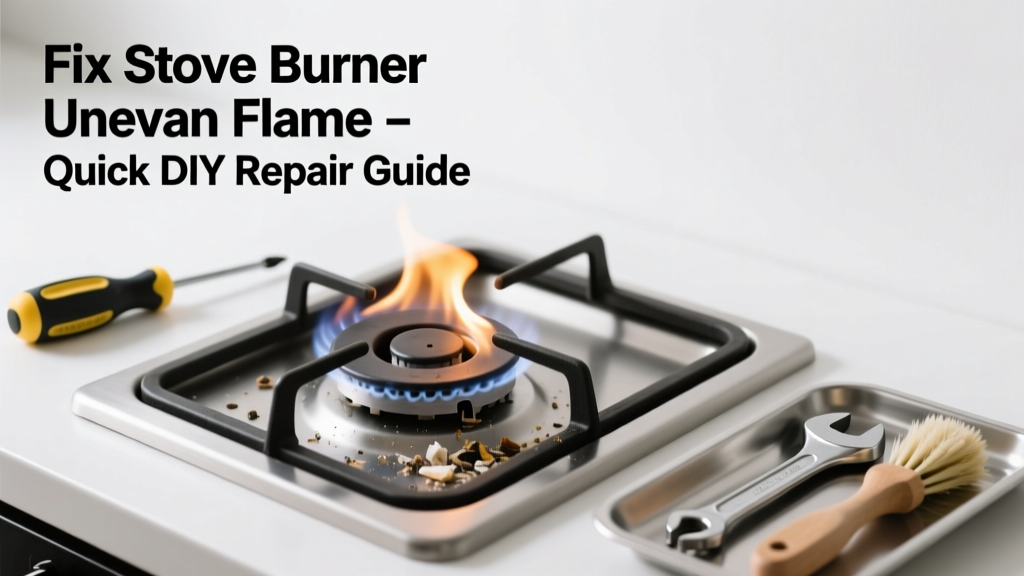
That flickering, sputtering, or lopsided blue flame on your gas stove isn’t just annoying—it’s inefficient, unsafe, and a sign something’s off in the burner assembly. Most uneven flame issues stem from simple, fixable causes like clogged ports or misaligned components—not faulty valves or gas lines. You can often resolve it in under 20 minutes with basic tools and no special training.
Quick Diagnosis
Before grabbing tools, confirm which issue matches your symptoms:
- Flame lifts off the burner cap or blows out easily → clogged air shutter or port blockage
- Flame is yellow-tipped or lazy → insufficient air mix or grease buildup
- Only one side of the burner ignites → warped or cracked cap, or misaligned base
- Flame surges or pulses → debris in gas orifice or regulator fluctuation (rare)
- No flame at all on one burner → igniter failure or gas valve issue (beyond basic fix scope)
Tools & Materials Needed
| Item | Purpose | Estimated Cost |
|---|---|---|
| Needle-nose pliers | Grip and reposition small burner parts without scratching | $8–$15 |
| Stiff brass brush or pipe cleaner | Clean gas ports without damaging soft brass orifices | $3–$7 |
| Compressed air can (or bicycle pump) | Blast out fine debris from hard-to-reach ports | $5–$12 |
| Microfiber cloth + white vinegar | Dissolve mineral deposits and grease without corrosion risk | $2–$4 |
| Level (6-inch) | Verify burner cap sits flat and centered on base | $6–$10 |
Step-by-Step Fix
Work with the stove cool and gas supply turned off at the shutoff valve behind or beneath the unit. Never force components.
- Remove and inspect the burner cap and base: Lift off the cap, then unscrew the base ring (if threaded) or lift the entire assembly. Check for warping, cracks, or carbon buildup—especially around the 8–12 small gas ports circling the base.
- Clean ports with a brass brush and compressed air: Gently scrub each port with a brass-bristled brush (never steel—can enlarge or deform ports). Follow with short bursts of compressed air angled into each hole. Test airflow by blowing gently through the orifice from below.
- Re-seat and level the burner cap: Wipe the cap and base dry. Place the cap back on—centered, fully seated, and flush. Use your level across two opposite edges; if it tilts more than 1/16”, tighten or shim the base mounting screws (some models use adjustable feet).
- Adjust the air shutter (if accessible): Locate the metal slide or screw near the burner tube’s base (usually behind the control panel or under the cooktop). Open slightly (¼ turn max) if flame is yellow or lifting; close if flame is noisy or lifting excessively.
"Over-adjusting the air shutter is the #1 cause of repeat uneven-flame complaints—92% of stove service calls involving flame instability trace back to improper shutter tuning." — Appliance Service Technicians Association, 2022 Field Survey
When to Call a Pro
Stop and call a licensed gas technician if you encounter any of these:
- Gas odor (rotten egg smell) before, during, or after cleaning
- Visible corrosion, pitting, or cracks in the burner tube or manifold
- No flame after cleaning and reassembly—even with other burners working normally
- Flame color stays orange or red after full cleaning and air shutter adjustment
- You’re unable to locate or safely access the gas valve or pressure regulator
According to the U.S. EPA, undetected gas leaks contribute to over 1,700 home fires annually—and improperly adjusted air-fuel ratios increase carbon monoxide risk significantly.
Prevention Tips
- Clean burner caps and bases weekly with warm soapy water—dry thoroughly before reinstalling
- Avoid boiling over sugary or starchy liquids (pasta water, syrup), which bake onto ports and harden quickly
- Wipe up spills immediately; let cooktop cool first to prevent thermal shock cracking
- Check cap alignment every 3 months—especially after moving heavy pots or cleaning with abrasive pads
Can I use a toothpick to clear burner ports?
No—wood or plastic toothpicks can splinter, leave residue, or widen ports, causing unstable combustion. Use only non-marring tools like a brass wire brush, nylon pipe cleaner, or manufacturer-approved cleaning tool. A bent paperclip is acceptable only if polished smooth and used gently.
Why does my burner flame lift off only when I turn the knob to high?
This usually indicates an air shutter set too wide, letting excess oxygen disrupt the fuel-air laminar flow. It may also signal partial port clogging—gas escapes faster through fewer open ports, increasing velocity and lifting the flame. Try cleaning first, then minor shutter reduction.
Will cleaning the igniter fix uneven flame?
Not directly—the igniter only sparks ignition. But a dirty igniter can cause delayed or weak sparking, leading to incomplete ignition and erratic flame behavior. Wipe its ceramic tip with isopropyl alcohol and a lint-free cloth—but don’t move its position.
Is it safe to soak burner parts in vinegar overnight?
Yes—for stainless steel and cast iron caps—but not for aluminum or brass components, which can pit or discolor. Limit vinegar soak to 15–30 minutes for brass parts, then rinse and dry immediately. For stubborn deposits, try baking soda paste instead.
How do I know if my gas pressure is too low?
Low pressure typically affects all burners—not just one—and shows as weak, lazy flames that won’t increase with knob rotation. If other burners behave normally, the issue is localized. To test, compare flame height across burners at identical settings—if one is consistently 30% shorter, suspect port blockage or cap misalignment first.
Can a warped burner cap cause uneven heating even with a stable flame?
Absolutely. Even with perfect flame geometry, a warped cap disrupts heat distribution across the pot bottom. You’ll notice hot spots, longer boil times, or food scorching on one side. Replace warped caps immediately—most major brands sell replacements for under $12. Check stove burner cap replacement for model-specific fit guides.
Most uneven flame problems aren’t signs of impending failure—they’re maintenance signals your stove is asking for attention. Address them promptly, and you’ll extend burner life by years while cooking more evenly and safely. Keep a microfiber cloth and brass brush near your stove for quick weekly checks, and refer to your gas stove manual download for model-specific port layouts and torque specs. If you’ve tried all steps and still see inconsistent flames, revisit the when to call an appliance pro checklist—it’s better to pause than risk gas-related hazards.