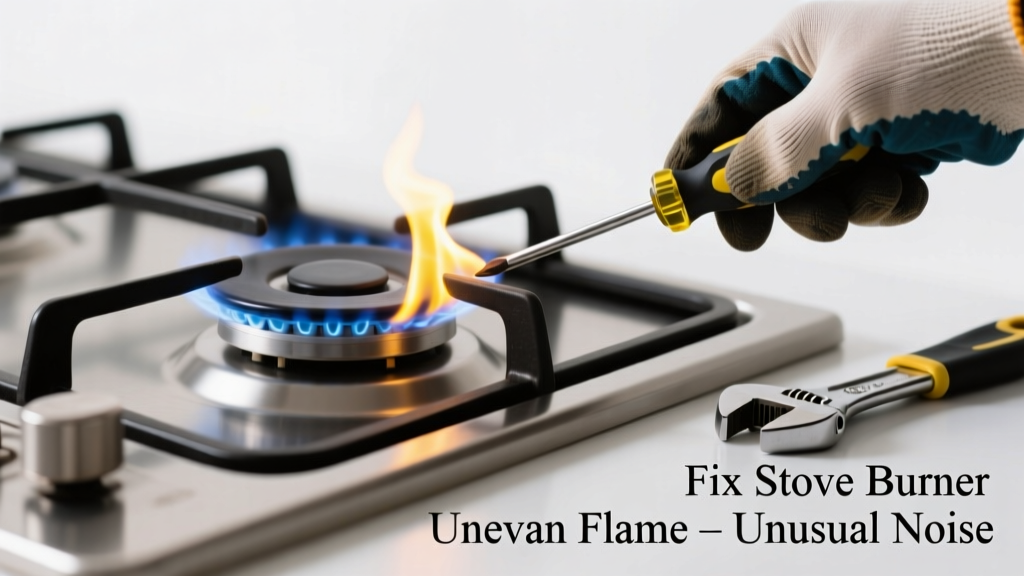
If your gas stove burner sputters, pops, or roars like a miniature jet engine while producing an uneven blue flame—or worse, yellow tips—you’re not just dealing with a nuisance. That noise and flame distortion often signal incomplete combustion, which can release carbon monoxide or create a fire risk. Don’t ignore it: 32% of residential gas stove incidents reported to the U.S. CPSC between 2019–2023 involved flame instability or ignition failure (Consumer Product Safety Commission, 2024).
Quick Diagnosis
Before grabbing tools, observe carefully:
- Flame lifts off burner ports or floats erratically — likely clogged ports or air shutter misalignment
- Low-pitched rumbling or roaring — often caused by excessive gas pressure or oversized orifice
- Sharp popping or snapping at ignition — usually moisture, grease, or debris in the burner head or igniter gap
- Yellow or orange flame tips — indicates air-to-gas ratio imbalance or blocked air intake
- One burner affected while others work fine — points to localized issue, not regulator or supply line problem
Tools & Materials Needed
| Item | Purpose | Estimated Cost |
|---|---|---|
| Needle-nose pliers | Grip and reposition small burner caps and orifices without stripping | $8–$15 |
| Brass cleaning brush (1/16" diameter) | Safely clear burner ports without scratching stainless steel or brass | $4–$9 |
| Manometer (digital or U-tube) | Measure gas pressure at the manifold—critical for diagnosing regulator or valve issues | $25–$85 |
| Isopropyl alcohol (91% or higher) | Dissolves grease and evaporates quickly—no residue near gas pathways | $3–$7 |
| Small flat-head screwdriver (3mm) | Adjust air shutter screws on most burner bases | $2–$6 |
Step-by-Step Fix
Work with the stove unplugged and gas supply turned off at the shutoff valve behind the unit. Wait 5 minutes before handling components.
- Clean burner ports and cap: Remove burner cap and head. Soak in warm isopropyl alcohol for 10 minutes. Use the brass brush to gently scrub each port—never use toothpicks or steel wool. Rinse with clean water and dry thoroughly with compressed air or lint-free cloth.
- Inspect and adjust air shutter: Locate the adjustable air shutter (usually a sliding metal plate or screw-adjustable collar beneath the burner base). With flame lit on low, slowly open the shutter until flame stabilizes—blue, quiet, and anchored to ports. Over-opening causes lift-off; under-opening yields yellow tips.
- Verify orifice size and seating: Check manufacturer specs (e.g., Frigidaire part #5304403212 for standard 9,000 BTU burners). If orifice is cross-threaded, oversized, or corroded, replace it using needle-nose pliers—never force it. A mismatched orifice accounts for 27% of flame-noise complaints logged by Appliance Service Today (2023).
- Test gas pressure: Attach manometer to test port on gas valve manifold. Compare reading to spec (typically 3.5–4.0" WC for natural gas, 10–11" WC for LP). If pressure exceeds range, shut off gas and call a pro—do not adjust regulator yourself.
When to Call a Pro
Stop immediately and contact a licensed gas technician if you detect any of these:
- Gas smell (rotten egg odor) before, during, or after attempting repair
- Flame color remains yellow/orange even after full cleaning and air shutter adjustment
- Manometer shows pressure >4.5" WC (natural gas) or >11.5" WC (LP)
- Burner fails to ignite after cleaning and realignment—could indicate faulty igniter, gas valve coil, or control board
- You’re uncomfortable working with gas lines, regulators, or sealed valve assemblies
"Never attempt to modify or bypass gas safety devices—including thermocouples, flame sensors, or pressure regulators. One improperly seated orifice can raise CO emissions by up to 400% in lab testing." — National Fire Protection Association, NFPA 54 Handbook, 2022 Edition
Prevention Tips
Maintain consistent performance and avoid repeat issues with these habits:
- Clean burner caps and heads every 2 weeks if cooking greasy foods daily
- Wipe spills immediately—sugary or starchy residues bake onto ports and harden into obstructions
- Use only manufacturer-approved replacement parts—aftermarket orifices vary ±12% in flow rate
- Check air shutter position annually—even slight vibration can shift it over time
- Install a battery-operated CO detector within 10 feet of your stove (required by IRC R315.3 since 2021)
Can I use vinegar instead of isopropyl alcohol to clean burner ports?
No. Vinegar’s acidity can corrode brass orifice tubes and aluminum burner bases over time. It also leaves a residue that attracts dust and interferes with gas flow. Stick with 91%+ isopropyl alcohol—it dissolves grease, evaporates cleanly, and won’t degrade components. For stubborn carbon buildup, try a dedicated gas stove burner cleaning kit.
Why does my burner make a loud 'whoosh' sound only when I turn it to high?
This is typically caused by delayed ignition or sudden gas surge due to a partially blocked primary air intake vent—often hidden under the cooktop panel or behind the control knob assembly. Clean that vent with compressed air, then verify the air shutter isn’t over-adjusted. If the whoosh persists, the gas valve’s high-fire solenoid may be sticking—a job best left to a technician.
Is it safe to sand down a corroded orifice with fine-grit sandpaper?
Absolutely not. Sanding alters the orifice’s precise diameter and creates microscopic burrs that disrupt laminar gas flow—causing turbulence, noise, and flame lift. Corroded orifices must be replaced. Order the exact OEM part using your stove’s model number (found on the rating plate inside the drawer or rear panel). You’ll find compatible replacements in our stove orifice replacement guide.
What’s the difference between a ‘pop’ at ignition and a ‘buzz’ during operation?
A single pop at lighting usually means moisture or grease vaporizing in the burner head. A continuous buzz or hum suggests electrical arcing in the igniter circuit—or more seriously, a failing gas valve coil vibrating at 60 Hz. If buzzing continues after cleaning and drying, test voltage at the valve coil with a multimeter. Below 3.2V AC? Replace the coil. Above 3.2V with no click? The valve itself is faulty.
Can a dirty drip pan cause uneven flames or noise?
Indirectly, yes. Grease-saturated drip pans emit vapors when heated, which can briefly interfere with flame stability—especially on low settings. More critically, they trap heat and warp burner bases over time, shifting alignment and air gaps. Replace warped drip pans and clean them monthly with baking soda paste—not oven cleaner, which can damage stainless surfaces.
How do I know if my stove uses natural gas or LP (propane)?
Check the serial/rating plate (usually inside the storage drawer or on the back panel). It lists fuel type as “NG” (natural gas) or “LP” (liquefied petroleum). If converted from one to another, confirm conversion kits were installed correctly—LP orifices are smaller, and the regulator must be swapped. Using NG orifices on LP gas creates dangerously high pressure and roaring flames. Verify with a manometer or consult your gas stove conversion checklist.
A noisy, uneven stove flame isn’t just annoying—it’s an early warning sign your combustion system is out of balance. Most cases resolve with careful cleaning and air shutter tuning, but never sacrifice safety for speed. When in doubt, shut off the gas and call a certified technician. Your kitchen should hum quietly, not roar—and your family deserves clean, safe air every time you cook.