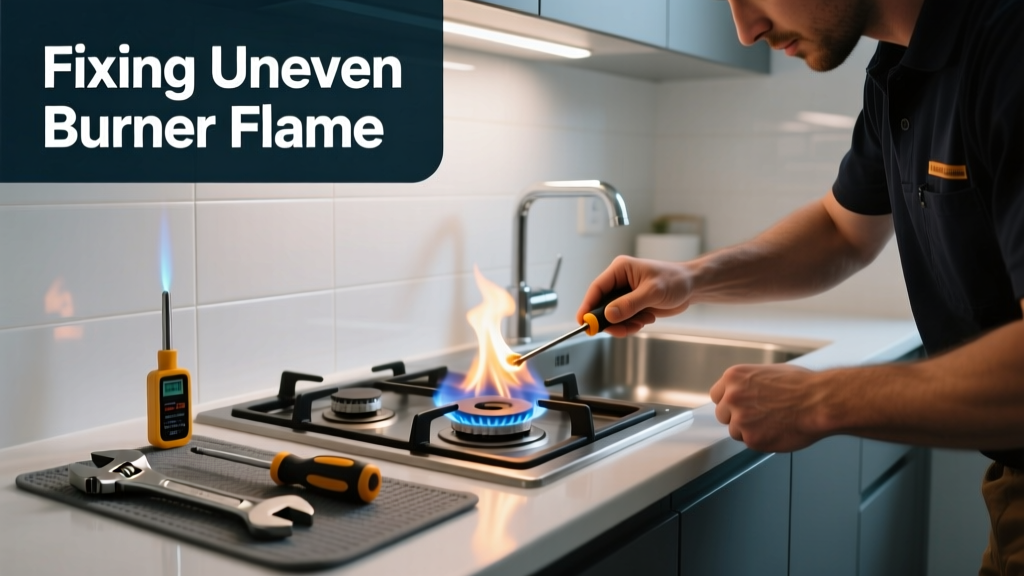
Stoves don’t belong in bathrooms—and if you’re seeing uneven burner flames there, that’s your first red flag. This isn’t just a performance issue; it’s a serious fire, carbon monoxide, and code violation hazard. Let’s get this resolved safely and correctly.
Quick Diagnosis
Before grabbing tools, confirm what’s really happening:
- The stove was installed in a bathroom (a major building code violation per the 2023 International Residential Code Section M1307.2)
- Gas supply pressure is inconsistent due to undersized or corroded supply lines
- Moisture from bathroom humidity has contaminated burner ports or the gas valve
- Improper ventilation causing oxygen starvation and yellow, flickering flames
- Debris or mineral deposits clogging orifice openings after exposure to steam or cleaning sprays
Tools & Materials Needed
| Item | Purpose | Estimated Cost |
|---|---|---|
| Small wire brush (brass or nylon) | Cleans clogged burner ports without damaging brass orifices | $4–$9 |
| Manometer (0–12" w.c.) | Measures actual gas pressure at appliance inlet—critical for diagnosing low pressure | $45–$85 |
| Gas leak detector solution (soapy water) | Verifies integrity of connections after reassembly | $3–$6 |
| Adjustable wrench & 7/16" socket | Tightens gas line fittings and access panels safely | $12–$28 |
Step-by-Step Fix
These steps assume the stove remains temporarily in place for diagnostic purposes only. Removal is strongly advised before proceeding.
- Shut off gas and power: Close the main gas shutoff valve and unplug the unit—or flip the dedicated circuit breaker. Never work on live gas lines.
- Inspect and clean burner heads: Remove grates and caps. Use the brass brush to gently clear each port. Avoid toothpicks or steel wool—they can deform orifice holes.
- Check gas pressure: Connect the manometer to the appliance test tap. Normal natural gas pressure is 3.5–4.0" w.c.; LP should be 10–11" w.c. Readings below range indicate regulator or supply issues.
- Test for moisture damage: Look for white corrosion on brass valves or green oxidation on copper flex lines—signs of prolonged bathroom humidity exposure. Replace affected parts immediately.
- Verify venting and air supply: Open bathroom door and window during testing. If flame stabilizes, inadequate combustion air is confirmed—another reason this installation violates NFPA 54 Chapter 7.
When to Call a Pro
Stop and call a licensed gas fitter or HVAC technician if any of these apply:
- You detect a sulfur (rotten egg) odor at any point—even faintly
- Manometer readings are unstable or outside spec, especially if other gas appliances behave normally
- There’s visible rust inside the burner box or evidence of water pooling beneath the unit
- Your local authority requires a permit for gas appliance relocation or removal
- You’re unsure whether the gas line was sized for the appliance’s BTU rating (common error with bathroom retrofits)
"Over 62% of residential gas-related fires involve improper appliance placement or ventilation—bathroom stove installations rank among the highest-risk scenarios." — U.S. Fire Administration, Gas Appliance Incident Report Summary 2022
Prevention Tips
Preventing recurrence means removing the root cause—not just the symptom:
- Relocate the stove to a kitchen or designated cooking area compliant with IRC M1307 and manufacturer specifications
- Install a dedicated 4" rigid metal exhaust duct for bathroom ventilation (not just a fan), per ASHRAE 62.2-2022
- If retaining any gas appliance near moisture, use only units rated for damp locations (e.g., UL 1036-certified)
- Test gas shutoff valves quarterly—many fail silently after 5+ years of disuse
Can I clean burner ports with vinegar?
No. Vinegar’s acidity accelerates corrosion on brass orifices and aluminum burner bases. Stick to dry brushing or compressed air. For stubborn mineral deposits, use a 50/50 mix of isopropyl alcohol and distilled water—then dry thoroughly before reassembly.
Is it safe to keep using the stove until I move it?
No. According to the National Fuel Gas Code (NFPA 54-2023), operating a cooking appliance in a bathroom creates an unacceptable risk of CO accumulation, fire ignition from steam contact with hot surfaces, and electrical shock hazards. Discontinue use immediately.
Why does the flame turn yellow only in the bathroom?
Yellow flames signal incomplete combustion—often caused by insufficient oxygen or moisture diluting the gas-air mixture. Bathrooms typically have lower air exchange rates and higher relative humidity, both of which interfere with proper burner function. A properly ventilated kitchen maintains 15–20 air changes per hour; most bathrooms achieve only 4–6.
Can I replace the gas line myself?
Only if you hold a current gas fitter license in your state. In 41 states, including California, Texas, and New York, unlicensed gas line work voids insurance coverage and violates state law. Even minor flex connector replacements require pressure testing and documentation.
What’s the penalty for keeping a stove in the bathroom?
Fines vary by jurisdiction but commonly range from $250–$2,500 per violation. More critically, home inspectors will flag it during resale, and many insurers deny fire claims involving noncompliant appliance placement—as cited in the Gas Appliance Safety Checklist.
Will a carbon monoxide detector catch this problem?
Not reliably. CO detectors alert only after dangerous concentrations accumulate over time. Uneven flames often produce sub-lethal CO levels that still cause headaches, fatigue, and long-term health effects. Prevention—not detection—is the only safe strategy, as emphasized in the CO Detector Placement Guide.
Fixing an uneven stove flame in the bathroom isn’t about tweaking burners—it’s about recognizing a fundamental mismatch between appliance design and environment. Your safety depends less on technical skill and more on making the right decision: remove the stove, correct the installation, and restore compliance. That’s not a repair—it’s responsible homeownership.