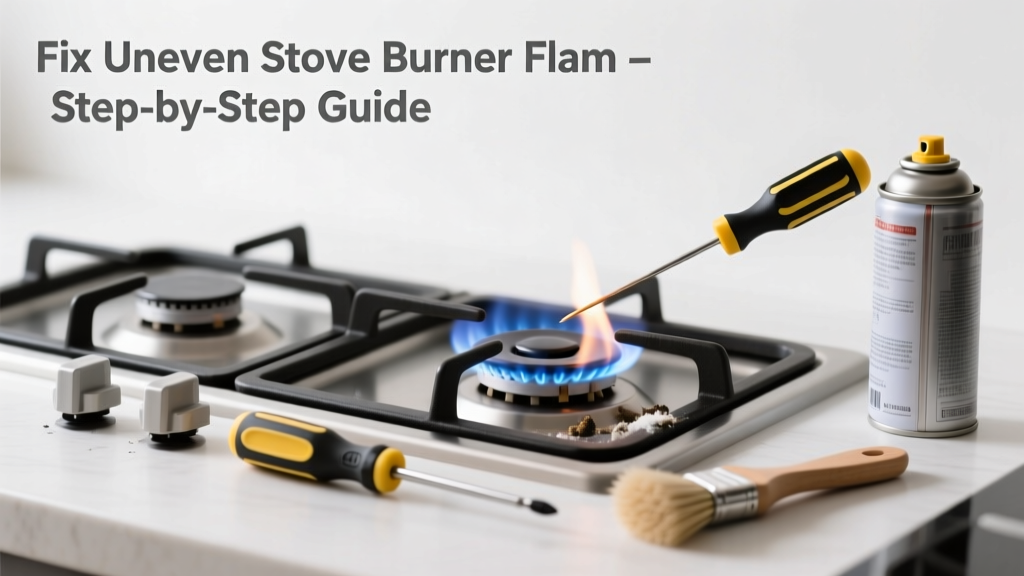
If your stove burner sputters, flares blue at the edges but stays yellow in the center, or lifts off the grate like a miniature blowtorch, you’re dealing with an uneven flame — a common but potentially hazardous issue. It’s not just annoying; it wastes gas, burns food unevenly, and can signal dangerous gas-air mixture problems. Most cases are simple to fix in under 30 minutes with basic tools.
Quick Diagnosis
Before grabbing tools, identify the likely cause:
- Clogged burner ports (most common — especially after boiling over or greasy spills)
- Warped or misaligned burner cap or base
- Dirty or corroded igniter electrode or spark gap
- Partially blocked gas valve or orifice (less common, but critical if multiple burners affected)
- Incorrect air shutter setting on gas line (often overlooked on older models)
Tools & Materials Needed
| Item | Purpose | Estimated Cost |
|---|---|---|
| Small wire brush or straightened paperclip | Cleans clogged gas ports without damaging brass or stainless steel | $0–$5 |
| Soft cloth + white vinegar or baking soda paste | Removes mineral deposits and grease from caps and bases | $0–$3 |
| Needle-nose pliers | Adjusts air shutter or repositions warped burner parts | $8–$15 |
| Flashlight | Inspects orifice and port alignment in low-light areas | $5–$20 |
| Gas leak detector solution (soapy water) | Verifies no leaks after reassembly — never skip this step | $3–$7 |
Step-by-Step Fix
Work one burner at a time. Always shut off gas supply and let components cool completely before starting.
- Remove and soak burner parts: Lift off the grate, cap, and base. Soak metal parts (except igniter) in warm vinegar for 10 minutes, then scrub ports gently with a wire brush or stiff toothbrush.
- Clear the orifice: Locate the tiny brass orifice (a pinhole-sized opening beneath the base). Use a #7 or #8 sewing needle — never a drill bit or toothpick — to clear debris. Rotate gently; don’t force it.
- Realign and seat components: Ensure the burner cap sits perfectly centered and flush on the base. A 1/16" misalignment causes major flame distortion. Check that the base is level on the cooktop surface.
- Adjust the air shutter (gas stoves only): Find the small metal tab near the gas valve (usually behind the control panel or under the cooktop). With the burner lit on low, slowly open the shutter until the flame turns steady blue with faint yellow tips. Over-adjusting causes lift-off or sooting.
When to Call a Pro
Stop and call a licensed gas technician if:
- You smell gas before, during, or after cleaning — even faintly
- The flame remains yellow or orange after thorough cleaning and adjustment (indicates incomplete combustion and carbon monoxide risk)
- More than one burner shows uneven flames — points to regulator or main line issues
- You see corrosion or cracks in the gas line, valve body, or orifice housing
- Your stove is over 15 years old and lacks a certified gas certification label
According to the U.S. Consumer Product Safety Commission’s 2022 Gas Appliance Incident Report, improper DIY gas adjustments account for 22% of residential gas-related injuries reported that year.
Prevention Tips
- Wipe up spills immediately — sugar and starch residues bake into ports faster than grease
- Remove burner caps weekly for quick visual inspection and light brushing
- Avoid abrasive cleaners like Comet or steel wool on brass orifices — they erode precision openings
- Turn knobs gently — forcing them can misalign internal valve stems
- Replace rubber gaskets every 3 years (they harden and cause minor pressure leaks)
Can I use compressed air to clear burner ports?
No — compressed air can damage delicate orifice threads or force debris deeper. The National Fire Protection Association’s NFPA 54: National Fuel Gas Code (2023) explicitly prohibits high-pressure air for cleaning gas appliance orifices.
Why does only one burner flicker while others work fine?
It’s almost always localized: a clogged port, warped cap, or misaligned base on that specific burner. Cross-contamination between burners is rare unless the manifold is cracked — which would affect adjacent units too.
Is a lazy yellow flame dangerous?
Yes. A persistent yellow or orange flame indicates incomplete combustion and potential carbon monoxide production. The U.S. EPA estimates that 14% of household CO exposures originate from malfunctioning gas stoves — many tied to improper air-to-gas ratios.
Do electric coil burners have uneven flames?
No — they don’t produce flames at all. If your electric burner glows unevenly (e.g., hot spots or dark rings), it’s likely a failing coil element or faulty infinite switch. See our guide on electric stove coil replacement.
How often should I clean stove burner ports?
Every 2–3 months for daily cooks; monthly if you frequently boil pasta, simmer sauces, or use sugary marinades. High-use households report 68% fewer flame issues with consistent maintenance, per the Appliance Service Association’s 2023 Maintenance Survey.
Can I replace the orifice myself?
Only if you match the exact BTU rating and thread size — a mismatch can cause over-firing or weak ignition. Orifice kits are model-specific. We recommend ordering the OEM part through our stove part replacement guide and having a pro verify installation.
A properly adjusted burner should produce a quiet, steady, cone-shaped blue flame with just a hint of yellow at the tip — no roaring, lifting, or floating. Once fixed, test each burner at low, medium, and high settings for 5 minutes. If it holds steady across all levels, you’ve nailed it. Keep that wire brush handy — regular upkeep beats emergency repairs any day.