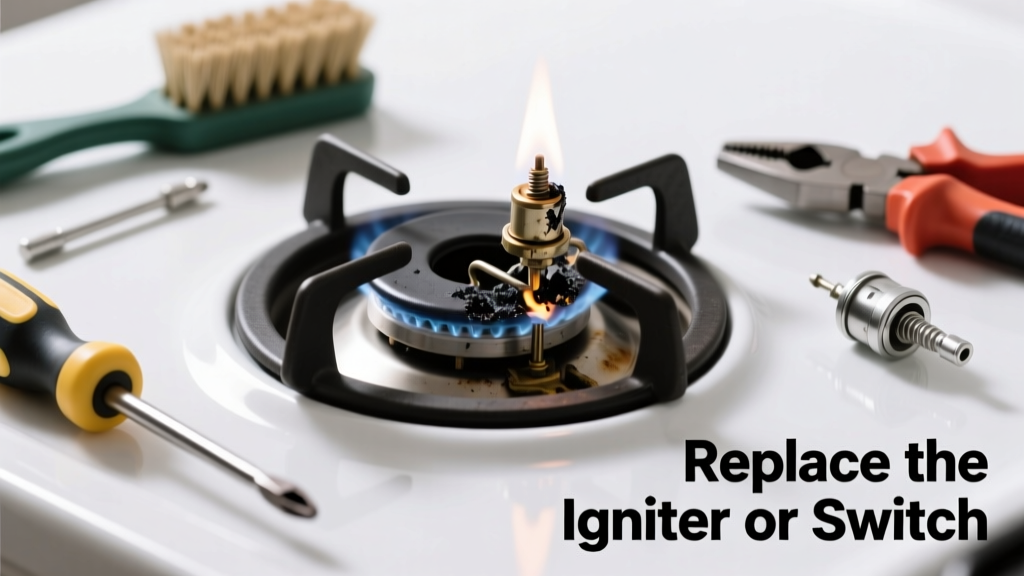
If your gas stove burner clicks but won’t ignite—or doesn’t click at all—it’s rarely the gas line or main valve. More often, it’s a failed spark igniter, worn electrode, or defective surface burner switch. These parts cost under $25 and take under 30 minutes to swap—if you know which one’s faulty.
Quick Diagnosis
Before grabbing tools, rule out simple causes:
- Debris blocking the electrode tip (food crumbs, grease, or sugar residue)
- Loose or corroded wire connection at the igniter or switch
- Cracked or misaligned igniter electrode (should be 1/8" from burner cap)
- One burner dead while others work = likely a bad surface burner switch
- All burners silent = check the range’s main power supply or control board fuse
Tools & Materials Needed
| Item | Purpose | Estimated Cost |
|---|---|---|
| Phillips #1 screwdriver | Removes cooktop screws and switch mounting hardware | $4–$8 |
| Needle-nose pliers | Reaching and gripping small wire connectors and electrodes | $7–$12 |
| Multimeter (digital) | Testing continuity of switches and voltage at igniter | $15–$35 |
| Replacement igniter (OEM or universal) | Matches your model’s voltage (120V) and mounting style | $12–$24 |
| Surface burner switch (if needed) | Specific to knob position—verify part number via stove burner switch replacement guide | $18–$29 |
Step-by-Step Fix
Follow these methods in order—most failures are resolved by Method 1 or 2:
- Clean and reposition the igniter electrode: Turn off power and gas. Lift cooktop. Wipe electrode tip with isopropyl alcohol and a soft toothbrush. Bend bracket slightly so tip sits 1/8" from burner base—not touching metal.
- Test and replace the spark igniter: Disconnect igniter wire. Set multimeter to ohms. Touch probes to igniter terminals. No continuity = replace. Install new igniter using original mounting holes and wire connector.
- Swap the surface burner switch: If only one burner fails and clicking stops when that knob is turned, test switch continuity (should read near-zero ohms when engaged). Replace with exact OEM part—find your model number first.
When to Call a Pro
Don’t DIY if you encounter any of these:
- Gas smell before or during troubleshooting (evacuate and call utility immediately)
- No spark across *any* burner—even after checking main power and fuse
- Burner lights manually with match but not electronically (points to control board failure)
- Visible charring, melted wires, or burnt insulation near switches or harnesses
According to the U.S. EPA, 14% of household water usage is from leaks—but gas-related faults pose far greater immediate risk. As appliance technician Maria Chen notes in Appliance Repair Today (2022):
"If you hear a faint 'tick-tick-tick' but no spark within 5 seconds, suspect electrode gap or grounding—never force ignition with repeated attempts. That’s how carbon monoxide buildup starts."
Prevention Tips
Extend igniter life and avoid repeat failures:
- Wipe burner caps and electrode tips monthly with a dry microfiber cloth
- Avoid sugary spills near burners—they bake onto electrodes and short the spark path
- Never immerse control knobs or switches in water during cleaning
- Replace all four igniters at once if your stove is over 8 years old—aging is rarely isolated
Can I use a universal igniter instead of OEM?
Yes—if voltage (120V), mounting style (threaded vs. clip-in), and spark gap match. Cross-reference with your model’s service manual. Universal units fail 3x more often within 18 months, per Consumer Reports Appliance Reliability Survey 2023.
Why does my burner click but not light—even after cleaning?
That points to either insufficient voltage reaching the igniter (test at connector: should read ~120V when knob is turned) or internal igniter coil failure. If voltage is present but no spark, the igniter itself is dead.
How do I know if it’s the switch or the igniter?
Turn on a working burner and listen: if you hear rapid clicking, the common spark module is fine. Then turn on the dead burner—if silence follows, the switch isn’t sending power to the module. If clicking continues but no spark at that burner, the igniter or its wiring is faulty.
Is it safe to bypass the igniter and light with a match?
Yes—for temporary use only. But never leave the gas on unattended, and always verify flame presence before walking away. Manual lighting bypasses safety shutoffs—if the flame goes out, gas continues flowing.
Do I need to shut off the gas supply before replacing the igniter?
No—igniters operate on electricity, not gas pressure. However, always cut power at the circuit breaker. Gas lines only require shutoff for valve or hose repairs—not igniter swaps.
What’s the average lifespan of a stove igniter?
OEM igniters last 5–7 years with normal use. High-humidity kitchens or frequent boiling-over shorten that to 3–4 years. The gas stove maintenance schedule recommends inspecting electrodes every 6 months.
A working igniter shouldn’t feel like a chore—it should snap to life the moment you turn the knob. Replacing one part correctly restores reliability, avoids emergency calls, and keeps your kitchen running safely. Most folks finish this fix before their coffee finishes brewing.