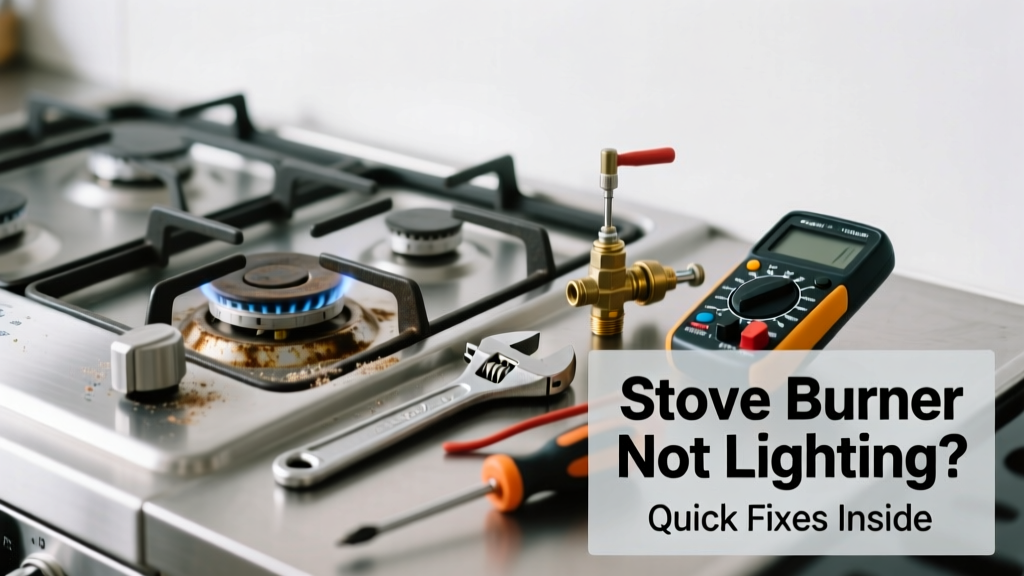
Your gas stove burner clicks but won’t ignite — or worse, it’s silent when you turn the knob. That moment of hesitation before dinner starts is frustrating, but most causes are simple, safe to address, and take under 15 minutes.
Quick Diagnosis
Before grabbing tools, rule out the obvious:
- Gas supply valve is fully open (check behind or beneath the stove)
- Control knob isn’t stuck or misaligned on the stem
- No visible debris blocking the burner cap, base, or ignition port
- Other burners light fine — isolating whether it’s one burner or the whole system
- Power outage affecting electric ignition (if your stove uses 120V for spark)
Tools & Materials Needed
| Item | Purpose | Estimated Cost |
|---|---|---|
| Small wire brush or stiff toothbrush | Cleans carbon buildup from igniter tip and burner ports | $3–$8 |
| Needle or straightened paperclip | Unclogs tiny gas ports around burner head | $0–$1 |
| Multimeter (digital, with continuity setting) | Tests igniter resistance and circuit continuity | $15–$40 |
| Replacement igniter (model-specific) | Swaps out cracked, corroded, or failed spark electrode | $12–$28 |
| Isopropyl alcohol (91%) and lint-free cloth | Removes grease/oil residue without damaging plastic or ceramic parts | $5–$10 |
Step-by-Step Fix
- Clean the burner assembly: Remove the grate, cap, and base. Soak metal parts in warm soapy water, then scrub ports with a needle and brush. Wipe igniter tip with alcohol-dampened cloth — never sand or file it.
- Check alignment: Re-seat the burner cap squarely; even a 1/16" misalignment prevents proper sparking. Confirm the igniter tip sits 1/8"–3/16" from the burner base — adjust gently if bent.
- Test ignition sound and spark: Turn knob to ‘Lite’ while watching the igniter. A healthy spark is loud, sharp, and blue-white. If silent, test voltage at the igniter wires with a multimeter (should read ~120V AC when knob is pressed). No voltage? Trace back to spark module or wiring harness.
- Replace the igniter (if needed): Disconnect power/gas, unscrew the old electrode, and install the OEM replacement — don’t substitute universal igniters unless explicitly cross-referenced for your model (e.g., Whirlpool W10857162 or Frigidaire 5304481087).
When to Call a Pro
Stop and call a licensed appliance technician if:
- You smell gas at any point — evacuate and call your utility company immediately
- The spark module tests good but no burners ignite (points to main control board failure)
- You measure voltage at the igniter but see no spark — indicates internal short or grounding fault
- Your stove is under warranty (DIY repairs may void coverage)
According to the U.S. EPA estimates that 14% of household water usage is from leaks — but gas leaks are far more urgent:
"A single unlit burner with gas flowing can release over 0.5 cubic feet per minute — enough to reach explosive concentration in a closed kitchen within 8 minutes." — National Fire Protection Association (NFPA 54, 2023)
Prevention Tips
- Wipe burner caps weekly to prevent grease hardening in ports
- Remove and deep-clean all burner parts every 3 months — especially after boiling over
- Avoid abrasive cleaners on igniter tips; they erode the ceramic coating
- Turn knobs gently — forcing them damages switch contacts and stem gears
Why does only one burner fail while others work?
Most often, it’s localized — a clogged port, misaligned cap, or broken igniter specific to that burner. Since each burner has its own electrode and gas valve (though sharing a spark module), failure rarely cascades unless the module itself is failing.
Can I light the burner manually with a match?
Yes — but only if you’re certain gas is flowing and you hear a steady hiss. Hold a long-reach lighter or match near the burner edge while turning the knob to ‘Light’. Never do this if you smell gas or suspect a leak. Manual lighting bypasses the igniter but doesn’t fix the root cause.
What if the igniter clicks but no flame appears?
That means gas isn’t reaching the burner head. Check for blockages in the orifice (tiny brass fitting under the burner base) or kinked flex tube. Also verify the gas valve behind the stove is fully open — partial closure reduces pressure below ignition threshold.
How long should a stove igniter last?
OEM igniters typically last 5–8 years with normal use. Frequent cleaning and avoiding physical contact extend life. After 7 years, resistance drift becomes common — a healthy igniter reads 1.5–2.5kΩ; above 3.5kΩ means replacement is due (how to test igniter resistance).
Is it safe to replace the spark module myself?
Only if you’re experienced with 120V appliance wiring and have the exact part number. Spark modules handle high-voltage pulses (up to 15,000V) and require precise grounding. Incorrect installation risks arcing, control board damage, or shock. For most homeowners, hiring a certified technician is safer and often faster than troubleshooting module-level faults.
Why does the burner light sometimes but not consistently?
Inconsistent ignition usually points to marginal gas pressure, moisture in the ignition circuit (common after steam-cleaning), or intermittent contact in the control knob switch. Test by cycling the knob rapidly 10 times — if it lights on the 7th try, the switch is likely worn and needs replacement (stove knob switch replacement guide).
Fixing a stubborn burner doesn’t require magic — just methodical cleaning, careful observation, and knowing when your limits begin. Most issues resolve in under 10 minutes once you identify whether it’s dirt, misalignment, or a dying component. Keep your toolkit stocked and your burners breathing freely — dinner waits for no one, but neither should your stove.