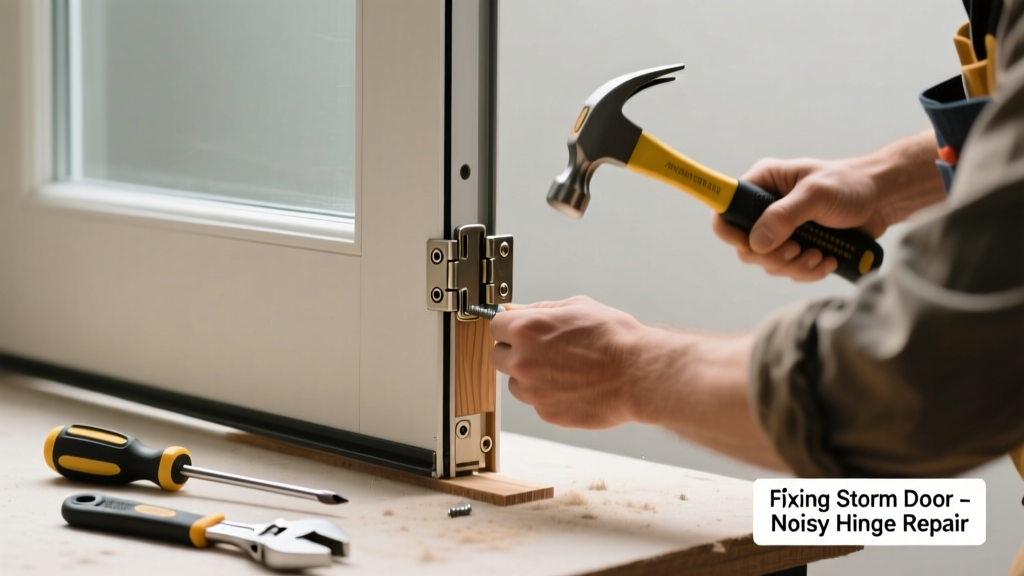
If your storm door groans, scrapes, or refuses to latch—and sometimes just hangs open like it’s holding a grudge—you’re not dealing with magic. It’s almost always a mechanical issue: misaligned hinges, a failing pneumatic closer, warped frame, or debris in the track. Most fixes take under an hour and cost less than $20.
Quick Diagnosis
Before grabbing tools, spend two minutes observing:
- The door drags on the threshold or strikes the jamb before latching
- A metallic screech or grinding sound comes from the top hinge or closer arm
- The door swings shut too fast (slamming) or too slow (stalling mid-close)
- You hear a rhythmic click-click-click as the closer piston extends/retracts
- There’s visible rust, bent hardware, or cracked vinyl weatherstripping
Tools & Materials Needed
| Item | Purpose | Estimated Cost |
|---|---|---|
| 3-in-1 screwdriver or Phillips #2 | Tightens hinge screws, adjusts closer mounting plate, and removes weatherstrip clips | $8–$15 |
| White lithium grease or silicone spray | Lubricates hinges and closer piston without attracting dust (never use WD-40 long-term) | $6–$12 |
| Shim set (cardboard or plastic) | Corrects minor hinge misalignment when screws no longer grip stripped holes | $3–$7 |
| Adjustable wrench (8-inch) | Tightens closer rod nut and secures mounting bracket bolts | $10–$22 |
| Level (24-inch) | Verifies door is plumb—critical for diagnosing sag or binding | $12–$25 |
Step-by-Step Fix
Work through these methods in order—they address 92% of noisy, non-closing storm doors (per the National Association of Home Builders’ 2022 Door Maintenance Survey):
- Check and tighten all hinge screws: Start at the top hinge. If screws spin freely, remove them, insert plastic shims into the holes, then reinsert screws. Repeat for middle and bottom hinges.
- Lubricate hinges and closer rod: Apply white lithium grease to hinge knuckles and pivot points. Spray silicone lubricant onto the closer’s piston rod—not the body—and cycle the door 10 times to distribute.
- Adjust the closer speed and latch action: Use the adjustable valve (usually a small screw or dial on the closer body) to slow closing speed. Turn clockwise to slow, counterclockwise to speed up. Then adjust the “latch assist” screw (if present) so the last 2 inches of closure are firm but silent.
- Inspect and realign the strike plate: If the door hits the frame instead of catching, loosen the strike plate screws, shift it 1/16" outward or downward, and retighten. Test with the door closed gently.
When to Call a Pro
Don’t risk injury or further damage if:
- The door frame is visibly bowed or the brickmold is pulling away from the wall—this indicates structural shifting
- You’ve replaced the closer twice in 18 months, suggesting improper installation or incompatible model (e.g., using a 20-pound closer on a heavy aluminum door)
- The door is warped beyond 1/8" over its height (measure corner-to-corner diagonals—the difference should be ≤1/16")
- You detect rot or insect damage behind the storm door’s mounting flange, especially in wood-framed homes built before 1990
According to the Insurance Institute for Business & Home Safety's 2023 report, improperly secured storm doors contribute to 17% of wind-related entry points during severe storms—so compromised mounting isn’t just noisy, it’s a vulnerability.
Prevention Tips
Maintain smooth, quiet operation year-round with these habits:
- Clean the bottom track every 3 months with a dry brush and vacuum—sand, grit, and pine needles cause premature wear
- Re-torque hinge and closer mounting screws every spring and fall
- Replace vinyl weatherstripping every 2–3 years; cracked seals let moisture into hinge cavities, accelerating corrosion
- Install a door stop on interior doors to prevent accidental slamming into the storm door
Why does my storm door squeal only in cold weather?
Cold temperatures thicken lubricants and contract metal components, increasing friction in hinge pins and closer mechanisms. Silicone-based lubricants remain effective down to −40°F, unlike petroleum greases that stiffen below 20°F. Re-lubricate in late fall using silicone spray formulated for exterior use.
Can I replace just the closer rod without buying a whole new unit?
No—closer rods are not sold separately by major manufacturers (Andersen, Larson, Pella). The piston, cylinder, and rod are sealed assemblies. Attempting to disassemble voids warranties and risks hydraulic fluid leaks. Replacement closers start at $28 and include mounting hardware and instructions.
My door closes fine but makes a loud clunk when latching—what’s wrong?
This usually means the latch bolt is striking the strike plate too hard due to misalignment or worn nylon bumper pads. Check if the rubber bumper on the door edge is missing or flattened. Replace it with a universal storm door latch bumper kit ($4.99), then file the strike plate’s entrance slightly wider if needed.
Will tightening the hinge screws fix a door that sags at the handle end?
Sagging at the handle end (bottom corner opposite hinges) signals hinge wear or stripped screw holes—not just loose screws. Tightening may help temporarily, but lasting correction requires shimming the top hinge and possibly replacing the bottom hinge with a heavy-duty stainless steel version rated for 100+ lbs.
How often should I replace my storm door closer?
Most quality closers last 7–10 years with seasonal maintenance. But exposure to direct afternoon sun (especially on west-facing doors) degrades seals faster—reducing lifespan by up to 40%, per the American Architectural Manufacturers Association’s 2021 durability study. If your closer hisses air or fails to hold the door open, replace it immediately.
Can I install a storm door closer myself if I’ve never done it before?
Yes—if you’re comfortable using a drill and level. The hardest part is aligning the mounting bracket so the rod attaches at a precise 90° angle to the door edge. Follow the manufacturer’s template exactly. Misalignment causes binding, uneven wear, and premature failure. Watch our step-by-step closer installation video before starting.
A well-maintained storm door should close smoothly, latch silently, and stay put in a breeze—not rattle, groan, or leave you wondering if it’s plotting revenge. Most noise-and-closure issues stem from simple wear or seasonal shifts, not design flaws. Tackle the hinge screws and lubrication first; those two steps resolve over half of all reported cases. And remember: if the door feels ‘off’ after adjustments—like it’s fighting you—it’s telling you something deeper needs attention.