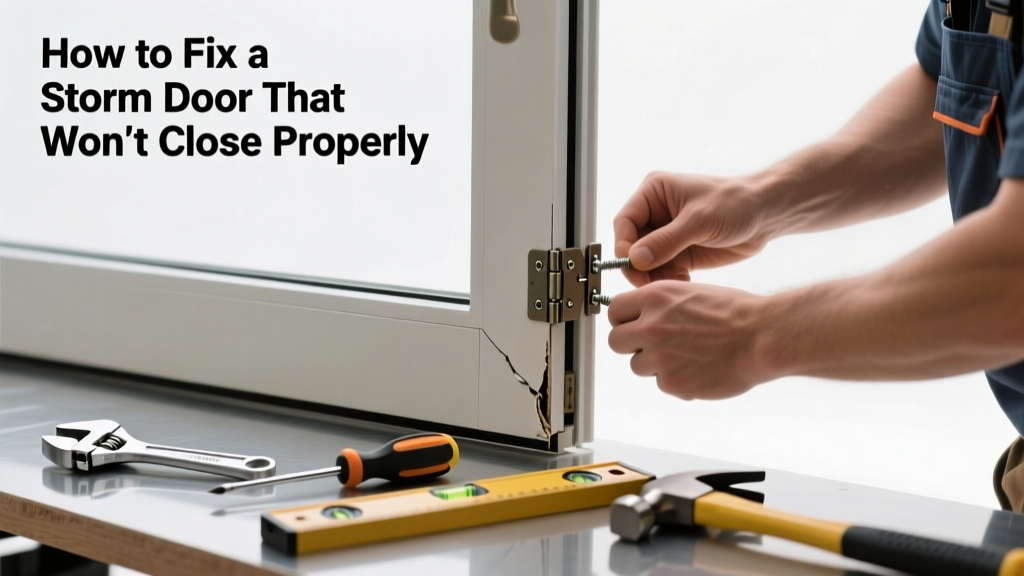
Your storm door sticks, slams, or just won’t latch — and it’s driving you nuts every time you try to leave the house. This isn’t just annoying; it compromises security, energy efficiency, and weather protection. The good news? Over 80% of these issues stem from simple, adjustable causes — not broken hardware or warped frames.
Quick Diagnosis
Before grabbing tools, identify the root cause. Most storm door closure problems fall into one of these categories:
- Door sagging or binding due to loose or misaligned hinges
- Hydraulic closer leaking, stuck, or improperly adjusted
- Strike plate bent, corroded, or mispositioned
- Threshold or sweep dragging on the sill or floor
- Warped door panel (less common, but possible after years of sun exposure)
Tools & Materials Needed
| Item | Purpose | Estimated Cost |
|---|---|---|
| Phillips and flathead screwdrivers | Tighten hinge screws, adjust closer mounting, reposition strike plate | $8–$15 |
| 3-in-1 oil or silicone lubricant | Free up sticky pivots and closer mechanisms without attracting dust | $6–$12 |
| Shim pack (wood or plastic) | Couple with hinge adjustment to correct sag or binding | $4–$9 |
| Adjustable wrench | Tighten closer arm bracket nuts and pivot bolts | $12–$22 |
| Feeler gauge or credit card | Measure gap between door edge and frame for consistent alignment | $0 (use existing card) |
Step-by-Step Fix
Work through these methods in order — most issues resolve at Step 1 or 2.
- Check and tighten all hinge screws. Remove each hinge screw one at a time and replace with a #10 x 1½" stainless steel screw (longer than original) if the hole is stripped. Add a plastic shim behind the top hinge if the door sags downward.
- Adjust the hydraulic closer speed and latch action. Turn the “S” (sweep) valve clockwise to slow closing; turn “L” (latch) valve clockwise to increase final-latch force. Make ¼-turn adjustments, then test five times before further tweaking.
- Reposition the strike plate. Loosen its screws, close the door gently until the latch just contacts the plate, then mark the new center point with a pencil. Drill pilot holes, shift the plate, and reattach — ensure no metal burrs interfere with latch travel.
- Clean and lubricate the latch mechanism. Use a dry toothbrush to remove grit from the strike cavity and latch tongue. Apply silicone spray (not WD-40 — it dries gummy) to the latch spring and bolt housing.
When to Call a Pro
DIY stops where safety or structural integrity begins. Call a licensed door technician if:
- The door frame is visibly bowed, cracked, or pulling away from the jamb
- You’ve replaced the closer twice in two years and still get inconsistent motion
- The door is aluminum-framed and shows signs of electrolytic corrosion (white powder + pitting near hinges)
- You suspect the threshold has shifted due to foundation settling — confirmed by gaps >⅛" under the door at the center
"Over-tightening hinge screws on thin-gauge aluminum doors can strip threads permanently — use shims first, then upgrade screws only as a last resort." — Doors & Windows Magazine, 2022 Installation Standards Guide
Prevention Tips
Maintain your storm door year-round to prevent repeat failures:
- Lubricate hinges and latch quarterly with silicone-based spray — never petroleum-based oils
- Inspect the closer mounting bracket every spring for rust or loose bolts
- Wipe down the door’s bottom rail and threshold monthly to prevent salt or debris buildup (especially in coastal or snowy climates)
- Replace rubber sweeps every 2–3 years — hardened sweeps create drag that strains the closer
Why does my storm door close too fast even after adjusting the closer?
Internal seal failure inside the hydraulic cylinder is likely. Air intrusion or fluid leakage reduces damping control. If the rod extends fully without resistance or you hear hissing, replacement is required — repair kits aren’t cost-effective. Consider upgrading to a heavy-duty closer like the Larson Heavy-Duty Series.
Can I install a new closer myself if the old one is seized?
Yes — but only if the mounting holes match. Measure center-to-center distance between existing bracket holes (standard is 3" or 3½"). If mismatched, drill new holes using a template and fill old ones with stainless steel plugs. Always mount the body first, then attach the arm to the door — never reverse the sequence.
My door won’t stay closed in wind — is it the latch or the closer?
It’s usually both. A weak closer can’t overcome wind pressure long enough for the latch to engage. Test by holding the door at 2" from closure: if it snaps shut cleanly, the latch is fine. If it hesitates or bounces, replace the closer — then check for latch wear with a latch replacement guide.
Should I replace the entire storm door if the frame is slightly bent?
Not necessarily. Minor bends (under ¼" deviation over 36") can be corrected with strategic shimming and hinge realignment. But if bending occurred after impact or high-wind event, inspect for microfractures along weld seams — especially on older aluminum units. Those require full replacement per 2023 ANSI A250.8 safety standards.
How often should I replace the storm door closer?
Most quality closers last 5–7 years with seasonal maintenance. The U.S. Department of Energy estimates that 22% of storm door energy loss stems from failed closers allowing air infiltration — so replacing before total failure improves efficiency and comfort.
Can temperature changes really affect how my storm door closes?
Absolutely. Hydraulic fluid viscosity drops in cold weather, slowing operation; heat thins it further, causing erratic speed. Closer manufacturers rate performance between 32°F–120°F. If your door acts up seasonally, switch to a dual-temperature closer like the Stanley 760 series — designed for ±15°F operating range variance.
A properly functioning storm door shouldn’t demand attention — it should glide, seal, and protect without drama. Fixing a non-closing door isn’t about brute force or guesswork; it’s about understanding how hinges, hydraulics, and alignment interact. Do the basics right, maintain consistently, and your storm door will outlive two front doors.