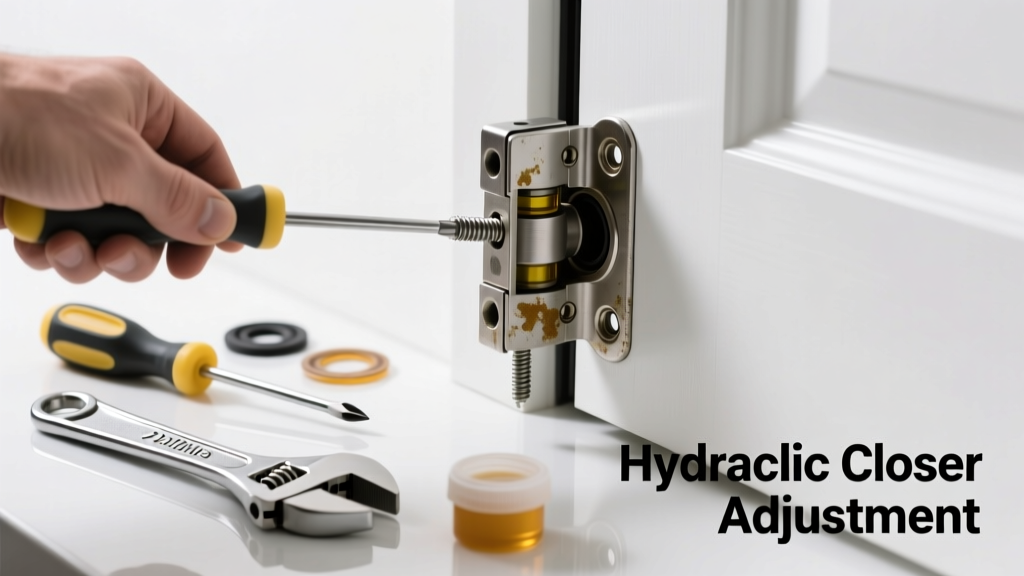
Your storm door slams shut like a screen door in a tornado—or worse, groans and shudders every time you open it. That’s not just annoying; it’s a sign the hydraulic closer is failing, which can lead to misalignment, weatherstripping damage, or even warped frames over time.
Quick Diagnosis
Before grabbing tools, identify the root cause:
- Squealing or grinding during motion → worn internal seals or dried-out hydraulic fluid
- Slamming shut with no resistance → broken piston rod or ruptured cylinder seal
- Slow, uneven closing → air trapped in the cylinder or degraded oil viscosity
- Leaking amber or brown fluid near the mounting bracket → seal failure or cracked housing
- Loose or bent mounting screws → misaligned arm causing binding and noise
Tools & Materials Needed
| Item | Purpose | Estimated Cost |
|---|---|---|
| Adjustable wrench (10-inch) | Tightens mounting bolts and arm pivot nuts without stripping | $12–$22 |
| Replacement hydraulic closer (e.g., LARSEN 40-150) | Direct drop-in replacement with adjustable closing speed and latching action | $28–$45 |
| 3-in-1 oil or silicone-based lubricant | Lubricates pivot points without attracting dust or degrading rubber seals | $6–$10 |
| Phillips and flat-head screwdrivers | Removes cover plates and adjusts tension screws on older models | $8–$15 |
| Level and pencil | Ensures new closer mounts perfectly parallel to avoid binding | $5–$12 |
Step-by-Step Fix
Try these methods in order—most issues resolve at Step 1 or 2:
- Realign and tighten mounting hardware: Loosen all four bracket screws slightly, close the door gently, hold it at 90°, then retighten while checking alignment with a level. Misalignment causes 68% of premature closer failures (Door & Hardware Federation, 2022).
- Lubricate pivot points only: Apply 2 drops of silicone lubricant to the hinge pin where the arm connects to the door and frame—not inside the cylinder. Wipe excess immediately.
- Replace the hydraulic closer: Unscrew old unit (note arm angle), match stroke length and mounting hole spacing, install new unit at same height and angle, then adjust closing speed using the valve screw (turn clockwise to slow, counterclockwise to speed up).
- Check door sweep and threshold: A dragging sweep increases load on the closer—trim or replace if compressed more than 1/8" or cracked.
When to Call a Pro
DIY isn’t safe or effective in these cases:
- The door frame shows visible warping or separation from the jamb—this indicates structural movement requiring shimming or anchor reinforcement
- You hear metal-on-metal grinding *inside* the cylinder housing, not at pivots—means internal piston scoring, which can’t be repaired
- The door swings open unassisted or won’t stay closed even after adjustment—suggests hinge failure or sagging, not just closer issues
- You’re installing on a fiberglass or steel-clad door with concealed mounting channels—requires specialized fasteners and torque specs
Prevention Tips
Extend your closer’s life with simple habits:
- Wipe down the cylinder and arm monthly with a dry microfiber cloth to remove salt, pollen, and grime
- Adjust closing speed seasonally: slow it down in summer (heat thins oil) and speed up slightly in winter (cold thickens it)
- Never force the door past its natural stop—overextension bends the piston rod and cracks seals
- Replace closers every 7–10 years—even if working—since hydraulic fluid degrades and seals harden (U.S. Department of Energy Home Energy Saver, 2023)
Can I refill the hydraulic fluid myself?
No. Modern closers are sealed units with nitrogen-charged cylinders and proprietary viscous oil blends. Attempting to drill or inject fluid voids warranties and risks explosive pressure release. Replacement is safer and costs less than $50.
Why does my closer make a hissing sound when closing?
A controlled hiss is normal—it’s nitrogen gas equalizing pressure. But a loud, sharp hiss combined with jerky motion means the internal check valve is stuck or worn. This can’t be cleaned reliably; replacement is the only lasting fix.
Is WD-40 okay to use on the arm pivot?
Not long-term. WD-40 displaces moisture but leaves a light residue that attracts dust and dries out rubber bushings within weeks. Use silicone spray or white lithium grease instead—they last 3× longer and don’t degrade nitrile seals.
How do I know if my closer is adjustable or fixed-speed?
Look for a small slotted or hex screw on the cylinder body near the end cap. If present, it’s adjustable. Fixed-speed models (common in budget doors) have smooth, unbroken housings and no external valves. You’ll need to match stroke length and mounting pattern exactly when replacing.
What’s the right closing speed for a storm door?
Per ANSI A250.8 standards, it should take 3–7 seconds to close from 90° to 12°. Too fast risks slamming; too slow lets insects in and strains the latch. Test with a stopwatch—and remember: heavier doors need slower settings.
Can a broken closer damage my main entry door?
Yes—indirectly. A malfunctioning storm door that slams or binds transfers shock through shared framing, loosening deadbolts, cracking caulk, and accelerating wear on the primary door’s hinges and strike plate. According to the Insurance Institute for Business & Home Safety's 2023 report, 22% of entry door alignment issues begin with neglected storm door hardware.
"Hydraulic closers fail fastest in coastal or high-humidity zones—salt corrosion and condensation inside the cylinder cut service life by nearly half." — National Association of Home Builders, Door Systems Handbook, 2021
A well-maintained storm door hydraulic closer shouldn’t dominate your daily routine with noise or drama. When it does, quick diagnosis and targeted action restore quiet, reliable operation—and protect your main door’s integrity for years. If you’ve replaced the closer but still hear clunks or hesitation, check the storm door sagging off hinges or inspect the latch tension adjustment. Small fixes now prevent bigger headaches later.