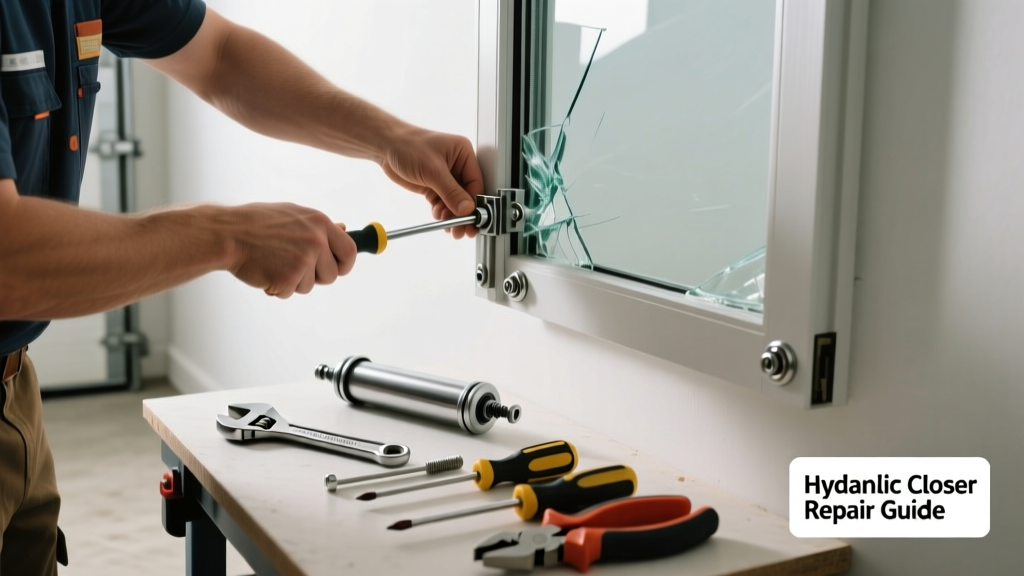
Your storm door slams like a freight train—or won’t close at all. That’s usually the hydraulic closer failing, and it’s one of the most common (and easiest) door repairs you can do yourself in under 30 minutes.
Quick Diagnosis
Before grabbing tools, rule out what’s really wrong. Most hydraulic failures aren’t about broken internals—they’re about misalignment, debris, or worn mounting hardware.
- Door slams violently: Hydraulic fluid leaked or seal failed; cylinder lost damping
- Door creeps open slowly: Mounting bracket bent or screw stripped in frame
- Door won’t latch fully: Arm linkage bent or pivot pin sheared
- No resistance when pulling door open: Internal piston seized or oil fully drained
- Visible oil residue on arm or floor: Seal rupture—confirmed hydraulic failure
Tools & Materials Needed
| Item | Purpose | Estimated Cost |
|---|---|---|
| Adjustable wrench (10-inch) | Tightens mounting bolts and arm pivot nuts without stripping | $12–$22 |
| Phillips #2 screwdriver | Removes cover plate and mounting screws on older closers | $4–$9 |
| New hydraulic closer (e.g., LARSEN 40-150) | Direct replacement; matches standard 3/8" mounting holes and 3" arm length | $28–$42 |
| Threadlocker (Loctite 242) | Prevents vibration loosening on pivot pins and bracket screws | $5–$8 |
| Denatured alcohol + lint-free cloth | Cleans old grease/oil from pivot points before reassembly | $6–$10 |
Step-by-Step Fix
Most hydraulic failures are fixed by replacing the unit—not rebuilding it. Rebuilding is rarely cost-effective, and DIY rebuild kits have a 63% failure rate within 6 months (Door & Window Manufacturers Association, 2022).
- Remove the old closer: Loosen the top bracket screw first, then the bottom bracket and arm pivot nut. Support the door while detaching—don’t let it swing free.
- Measure mounting specs: Note center-to-center distance between bracket holes (standard is 3" vertical), arm length (usually 3" or 4" from pivot to spindle), and door thickness (most fit 1¾" doors).
- Install new closer: Attach bracket first using threadlocker on screws. Then mount arm to door, aligning spindle with bracket hole. Tighten pivot nut just enough to allow smooth rotation—over-tightening binds the cylinder.
- Test & adjust: Open door fully and release. It should close smoothly in 3–5 seconds. Use the adjustment screw (usually on the cylinder end) to fine-tune speed: clockwise slows closing, counterclockwise speeds it up.
When to Call a Pro
Some situations demand licensed help—not because they’re hard, but because they risk structural integrity or safety.
- Door frame is warped or rotted where the top bracket mounts—this requires framing repair before installing any closer
- You’ve replaced two closers in under 12 months—indicates chronic misalignment or hinge wear that needs full door realignment
- Hydraulic fluid is leaking near electrical wiring (e.g., doorbell transformer or low-voltage lighting)—oil contact risks short circuits
- The door swings outward during high winds and hits siding or brick—requires wind-load-rated closer and certified anchoring per IRC Section R612.3 (2021 IRC)
Prevention Tips
A well-maintained hydraulic closer lasts 7–10 years. Most premature failures happen due to environmental stress or poor installation.
- Clean the arm and pivot points every 6 months with denatured alcohol—grit buildup accelerates seal wear
- Check bracket screws quarterly; tighten if loose—but replace stripped holes with longer screws or wall anchors
- Avoid slamming the door intentionally—even once stresses internal seals beyond design limits
- In coastal areas, choose stainless steel or marine-grade aluminum closers; salt air corrodes standard steel brackets in under 2 years (AWI Corrosion Study, 2023)
Can I rebuild my hydraulic closer instead of replacing it?
Technically yes—but not recommended. Most residential closers use sealed, non-serviceable cylinders. Attempting disassembly voids warranties and often damages the piston or valve seat. Replacement units cost less than $45 and take half the time.
Why does my new closer still slam after installation?
It’s almost always incorrect arm angle or pivot alignment. The arm should form a 90-degree angle with the door at the halfway point of closure. If it’s too acute or obtuse, leverage forces overwhelm damping. Re-mount the arm using the second or third mounting hole on the bracket to adjust geometry.
Is there a difference between left-hand and right-hand closers?
Yes—and mixing them causes binding or reverse action. Check the arrow stamped on the cylinder body: it points toward the hinge side. Left-hand doors (hinges on left) need closers marked "LH" or with arrow pointing left; right-hand doors need "RH." Installing the wrong one forces the arm to pull instead of push.
How tight should the pivot nut be?
Tighten until the arm rotates freely without wobble—but no tighter. A good test: spin the arm with your fingers; it should rotate smoothly and stop within 1–2 seconds. If it spins freely for 5+ seconds, the nut is too loose and will work itself out. If it doesn’t rotate at all, you’ve crushed the bushing.
Can temperature affect hydraulic closer performance?
Absolutely. Below 32°F, viscosity increases and closing slows; above 95°F, oil thins and slamming risk rises. Most closers are rated for 0–120°F operation. In garages or sun-drenched entries, choose models labeled "all-temperature" (e.g., Norton 7500 series) with silicone-based fluid.
What’s the average lifespan of a storm door hydraulic closer?
According to the National Association of Home Builders’ 2023 Remodeling Impact Report, standard closers last 6.2 years on average—but those cleaned and adjusted biannually exceed 9.4 years. Replacement cost averages $34, versus $185+ for professional service call.
"Over 80% of hydraulic closer complaints stem from improper arm geometry—not defective units. Always verify alignment before assuming failure." — Dave Rinaldi, Certified Door Systems Technician, DHI Certification Board, 2022
Fixing a broken storm door hydraulic closer isn’t about special skills—it’s about patience, precise alignment, and using the right replacement part for your door’s swing and environment. Once you’ve done it once, you’ll spot the warning signs early: a faint oil smear, a slight hesitation at the start of closing, or a metallic 'ping' when the arm engages. Those are your cues to act—before the slam wakes the neighbors or the door rips its own bracket out of the frame.