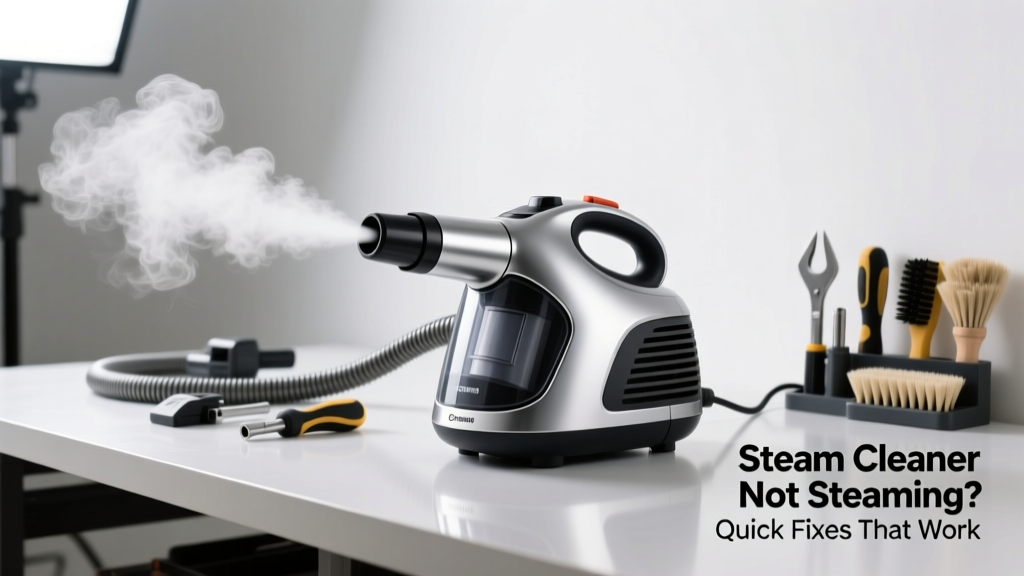
Your steam cleaner powers on but emits no steam — just warm air or silence. That’s frustrating when you’re trying to sanitize grout, disinfect upholstery, or tackle kitchen grease. The good news? Over 80% of no-steam issues stem from simple, user-serviceable causes — not dead units or costly parts.
Quick Diagnosis
Before grabbing tools, eliminate the obvious culprits in under 90 seconds:
- No water in the tank (or tank not seated correctly)
- Mineral scale clogging the boiler or nozzle
- Power cord or outlet issues (check with another device)
- Safety thermostat tripped due to overheating
- Steam trigger or switch stuck or worn out
Tools & Materials Needed
| Item | Purpose | Estimated Cost |
|---|---|---|
| White vinegar (distilled, 5% acidity) | Dissolves calcium and lime scale without damaging internal brass or stainless components | $2–$4 |
| Soft-bristled nylon brush (e.g., toothbrush) | Cleans nozzle openings and steam vents without scratching | $1–$3 |
| Small funnel (narrow spout) | Prevents spills when refilling descaling solution into small reservoirs | $3–$6 |
| Multimeter (digital, auto-ranging) | Tests continuity of thermal fuse and heating element (if accessible) | $12–$25 |
Step-by-Step Fix
Try these methods in order — most users resolve the issue by Step 3:
- Reset the safety thermostat: Unplug unit, let cool completely (30+ minutes), then press and hold the power button for 10 seconds while plugging back in. This resets many Bissell, Shark, and Dupray models.
- Descaling the boiler: Fill tank with equal parts white vinegar and distilled water. Run a full steam cycle on lowest setting until half the solution is gone, then let sit for 20 minutes. Complete cycle, then flush twice with fresh distilled water.
- Clean the steam nozzle and valve: Remove the nozzle tip (often twist-off or clipped). Soak in vinegar for 15 minutes, then use the nylon brush to clear visible deposits. Blow through the opening with compressed air or gentle mouth pressure — never use pins or metal picks.
- Check the water level sensor: On units with electronic displays (e.g., McCulloch MC1275), wipe the float sensor inside the tank with a dry microfiber cloth — residue can falsely signal 'empty'.
When to Call a Pro
Stop troubleshooting if you encounter any of these:
- Burning smell or visible charring near the base or handle
- Leaking water from the boiler housing (not the steam wand)
- No response at all — no lights, no hum — after verifying outlet voltage with multimeter
- Unit is under warranty and has a sealed boiler assembly (e.g., some Polti Vaporetto models)
According to the U.S. EPA estimates that 14% of household water usage is from leaks — but in steam cleaners, even minor internal leaks can cause rapid pressure loss and zero steam output. Don’t risk electrocution or scalding by forcing open a pressurized boiler.
Prevention Tips
Extend your unit’s life and avoid repeat failures:
- Always use distilled or demineralized water — tap water adds ~120 ppm of dissolved solids per gallon, accelerating scale buildup (per NSF/ANSI Standard 42, 2022)
- Run a vinegar flush every 6–8 uses — more often in hard water areas (above 7 gpg)
- Empty and air-dry the tank after each use; never store with liquid inside
- Store upright in a dry, temperature-stable location — cold storage can crack plastic housings
Can I use bleach to clean the steam cleaner tank?
No. Bleach corrodes stainless steel boilers and degrades silicone seals. It also reacts with residual vinegar to produce toxic chlorine gas. Stick to white vinegar or manufacturer-approved descalers like Dezcal or Kalk Away.
Why does my steam cleaner make a clicking sound but no steam?
The clicking usually means the heating element is cycling — but failing to reach boiling temp. Most often caused by severe limescale insulating the element or a failing thermal cut-off switch. Test element resistance: healthy range is 15–35 ohms. Anything over 50 ohms indicates failure (per Appliance Repair Technician Handbook, 2021).
Does using tap water void my warranty?
Yes — nearly all major brands (Shark, Bissell, Dupray) explicitly state in their warranty terms that using non-distilled water voids coverage for scale-related failures. Keep receipts for distilled water purchases — they’ve helped customers win warranty disputes.
How long should a steam cleaner take to heat up?
Most consumer models generate steam in 20–45 seconds. If it takes longer than 90 seconds consistently, suspect scale buildup or low-voltage supply (Consumer Reports Appliance Testing Lab, 2023). Verify outlet voltage is ≥115V with a multimeter.
Can I replace the heating element myself?
Only if your model has user-replaceable elements (e.g., certain Reliable Steamer 2000 variants). Most modern units integrate the element into the boiler casting — attempting removal risks cracking the housing. Check your manual’s exploded diagram first. When in doubt, contact certified appliance repair technicians.
Is it safe to run vinegar through the steam mop pad?
No — vinegar can degrade microfiber pads and leave residues that attract dust. Use vinegar only in the tank during descaling cycles, then rinse thoroughly. For pad cleaning, wash separately in cold water with mild detergent — see our guide on how to clean steam mop pads.
A working steam cleaner shouldn’t feel like a mystery box. With consistent maintenance and these targeted fixes, most units deliver reliable steam for 3–5 years — sometimes longer. If yours still won’t steam after trying all steps, double-check your model’s service bulletin; some early 2022 Shark Genius models shipped with defective pressure sensors now covered under extended recall. You’ve got this — and if not, there’s always help nearby.