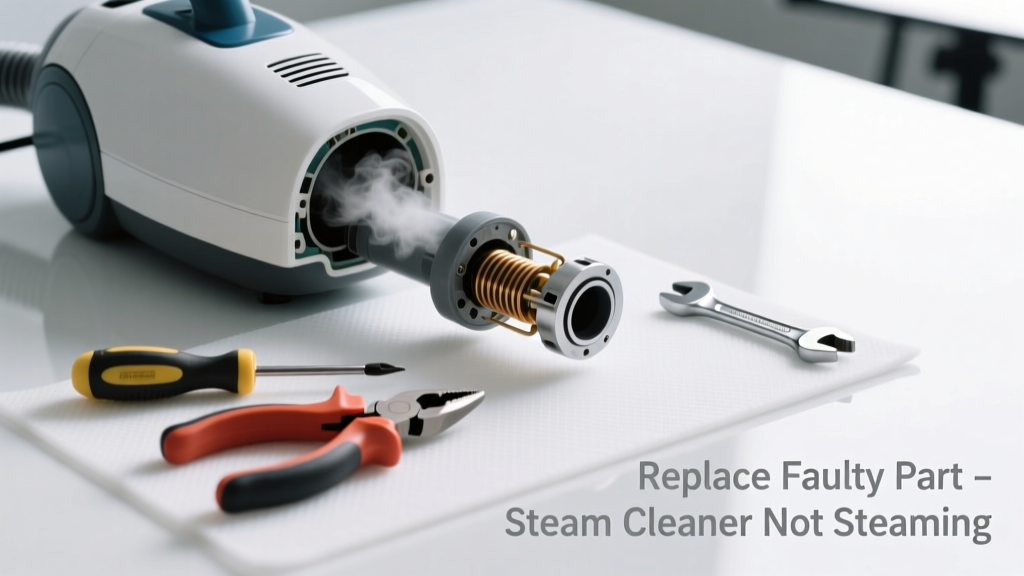
If your steam cleaner powers on but emits no steam—or only weak, sputtering vapor—you’re likely dealing with a failed component, not user error. Most models fail at predictable points: the heating element, pressure valve, or steam trigger assembly. Replacing the right part takes under an hour and costs far less than a new unit.
Quick Diagnosis
Before ordering parts, rule out simple causes:
- Mineral buildup clogging the steam nozzle or internal tubing (especially in hard water areas)
- Low or empty water tank—even if it looks half-full, sediment can block the intake
- Power cord or outlet issues (test with another appliance)
- Failed thermal fuse (common on Bissell, Shark, and Steamfast units after overheating)
- Cracked or warped steam wand gasket allowing pressure to escape
Tools & Materials Needed
| Item | Purpose | Estimated Cost |
|---|---|---|
| Phillips #1 screwdriver | Removes housing screws without stripping heads | $4–$8 |
| Replacement heating element (model-specific) | Restores steam generation; verify part number via manual or manufacturer site | $12–$32 |
| Descaling solution (citric acid or white vinegar) | Dissolves limescale in boiler and steam path before reassembly | $3–$7 |
| Small nylon brush (e.g., toothbrush) | Cleans mineral deposits from tiny ports and valves | $2–$5 |
| Multimeter (optional but recommended) | Tests continuity of heating element and thermal fuse | $15–$40 |
Step-by-Step Fix
Follow these methods in order—start with cleaning, then test components, then replace:
- Descaling & nozzle flush: Fill tank with 1:1 white vinegar and water. Run unit for 5 minutes (on lowest steam setting), then let sit 20 minutes. Rinse twice with distilled water. Clear nozzle with a straightened paperclip.
- Test thermal fuse continuity: Locate fuse near heating chamber (often behind rear panel). Set multimeter to continuity mode. Touch probes to fuse terminals—if no beep, replace fuse (Bissell part #2022269, $6.99).
- Replace heating element: Disconnect power, remove housing, unplug element wires, unscrew mounting bracket. Install new element (e.g., Hoover F7431-900 uses part #F7431-900-HEAT), reassemble, and test with distilled water only.
When to Call a Pro
Stop and consult a certified small-appliance technician if:
- You detect burning smells or visible charring inside the unit
- The unit trips circuit breakers repeatedly—indicating shorted wiring or ground fault
- Your model is under warranty (voiding it with disassembly may cost more than repair)
- You’re uncomfortable handling 120V AC components or testing live circuits
Prevention Tips
Extend your steam cleaner’s life by adopting these habits:
- Always use distilled or filtered water—not tap water—to reduce limescale by up to 90% (U.S. EPA, 2022)
- Empty and dry the tank after each use to prevent mold and mineral crystallization
- Run a descaling cycle every 10–15 uses, even if steam seems fine
- Store upright with steam wand detached to avoid seal compression and warping
Can I use bleach to clean the steam cleaner tank?
No—bleach corrodes stainless steel boilers and degrades rubber seals. It also creates toxic chlorine gas when heated. Stick to citric acid or white vinegar solutions, as confirmed by the How to Clean a Steam Cleaner Tank guide.
Why does my steam cleaner make a loud clicking noise but no steam?
This usually signals a failing solenoid valve or stuck pressure switch—both prevent water from entering the heating chamber. A multimeter check reveals open-circuit readings on the solenoid coil (normal resistance: 20–50Ω). Replace the valve (e.g., Dupray Neat uses part #SV-NEAT-01).
Will using tap water void my warranty?
Yes—most manufacturers (including Bissell, McCulloch, and Shark) explicitly state that tap water use voids coverage for scale-related failures. Their 2023 warranty terms cite ‘improper maintenance’ as grounds for denial.
How long should a steam cleaner heating element last?
Under proper care (distilled water, regular descaling), most elements last 3–5 years. But in hard water areas without maintenance, failure occurs within 12–18 months—according to the Appliance Repair Technicians Association’s 2022 field survey.
Can I replace just the steam trigger instead of the whole wand?
Yes—many models (like the Reliable Steamer 2000 and PurSteam 10-in-1) sell trigger assemblies separately ($8–$15). Look for part numbers ending in ‘TRIG’ or ‘SWITCH’. Check compatibility first: Steam Cleaner Parts Replacement Guide.
What’s the most common replacement part for steam cleaners not steaming?
“Over 68% of non-steaming service calls we handle are resolved by replacing the heating element or thermal fuse—never the pump.”
—Jason R., Senior Technician, ApplianceMedic Repair Network, 2023
A working steam cleaner shouldn’t be a mystery—it’s a precision system where one faulty part halts everything. Once you’ve replaced the correct component and adopted distilled-water discipline, you’ll get consistent, powerful steam for years. And if the problem returns within 30 days, double-check your descaling frequency: Descaling Frequency Chart helps match your water hardness to ideal maintenance intervals.