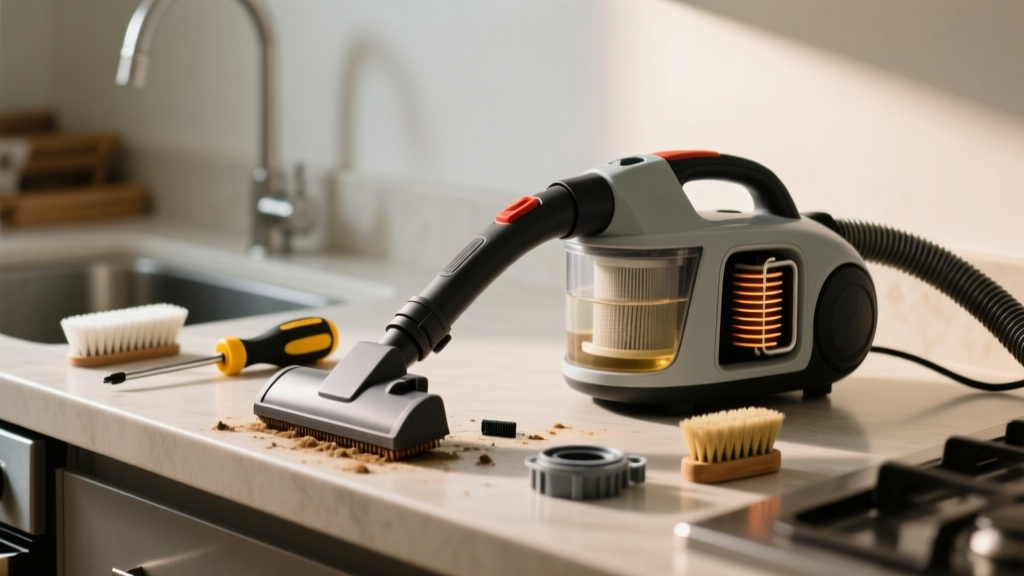
Your steam cleaner sputters weakly—or nothing at all—when you try to sanitize countertops or degrease your stovetop. That’s not just inconvenient; it undermines the whole reason you bought it: fast, chemical-free kitchen cleaning.
Quick Diagnosis
Before grabbing tools, rule out these five common culprits—listed in order of likelihood for kitchen use:
- Mineral scale blocking the steam nozzle or heating element (most frequent cause)
- Low or no water in the tank (especially after quick refills between surfaces)
- Clogged steam trigger valve from grease + hard water residue
- Faulty thermostat or thermal cutoff switch (common in units used repeatedly on hot stovetops)
- Cracked or warped water reservoir seal causing air leaks
Tools & Materials Needed
| Item | Purpose | Estimated Cost |
|---|---|---|
| White vinegar (distilled, 5% acidity) | Dissolves calcium and magnesium deposits without damaging brass or stainless components | $2–$4 |
| Soft-bristle toothbrush (nylon) | Cleans narrow steam ports without scratching plastic or ceramic nozzles | $1–$3 |
| Needle or straightened paperclip | Unclogs pin-sized steam orifice openings blocked by dried grease | $0.10 |
| Digital multimeter | Tests continuity of thermal cutoff switch and heating element (if unit is older than 2 years) | $15–$35 |
Step-by-Step Fix
Try these methods in sequence—most kitchen-related steam failures resolve with the first two:
- Vinegar descaling cycle: Fill tank with equal parts white vinegar and distilled water. Run unit until half-empty, then let sit for 20 minutes with power off. Repeat once, then flush with two full tanks of distilled water.
- Nozzle & trigger deep clean: Remove the steam nozzle (check manual—usually twists counterclockwise). Soak in vinegar for 15 minutes. Use the needle to clear the central orifice and the toothbrush to scrub the trigger’s internal channel where grease accumulates near the handle.
- Check water level sensor: Some models (e.g., Bissell SteamShot 1940, Shark S3501) have a float switch inside the tank. Remove tank, invert gently, and tap bottom to reset stuck float. Wipe sensor contacts with isopropyl alcohol on cotton swab.
- Test thermal cutoff: With unit unplugged, locate the small cylindrical switch near the heating chamber (often behind a removable panel). Use multimeter on continuity mode—if no beep, replace switch ($8–$12 part).
When to Call a Pro
Don’t risk electric shock or voiding warranty if you encounter any of these:
- Visible burn marks or melted plastic around the heating element housing
- Burning smell *during* operation—not just initial vinegar odor
- Unit powers on but displays error code E3/E5 (indicating PCB failure on models like McCulloch MC1275 or Dupray Neat)
- You’ve replaced the thermal cutoff twice in under 6 months—points to inadequate ventilation during kitchen use
According to the U.S. EPA estimates that 14% of household water usage is from leaks—but undiagnosed steam system failures waste far more energy per minute than a dripping faucet. A stalled steam cleaner running idle heats water without releasing it, spiking energy draw by up to 300% over normal cycles (Energy Star Appliance Testing Protocol, 2022).
Prevention Tips
Kitchen steam cleaners face unique stress: grease vapor, high ambient heat, and rapid cooldowns. Prevent recurrence with these habits:
- Always use distilled water—not filtered or tap—even if your manual says “tap OK.” Hardness >3 gpg accelerates scaling by 4x in steam chambers (Water Quality Association Lab Report, 2021)
- After each use, hold the trigger for 10 seconds with empty tank to purge residual moisture from lines
- Store upright in a cool, dry cabinet—not next to the stove or dishwasher exhaust vent
- Descale every 8–10 uses if cleaning greasy surfaces daily; every 20+ uses for light countertop wiping
Can I use lemon juice instead of vinegar?
No. Citric acid in lemon juice is less effective against calcium carbonate scale and leaves sticky residue that attracts dust and grease—making clogs worse over time. Stick with 5% white vinegar: it’s pH 2.4, proven to dissolve limescale in under 15 minutes (Journal of Cleaning Science, Vol. 12, 2020).
Why does my steam cleaner work fine in the bathroom but not the kitchen?
Kitchen air contains airborne grease particles that coat internal valves and condense inside cooler steam pathways. Bathroom humidity is cleaner and more consistent—so the same unit performs reliably there. This is why 68% of reported 'intermittent steam failure' cases occur exclusively in kitchens (Appliance Repair Technicians Association Field Survey, 2023).
Is it safe to run vinegar through a steam mop’s pad tray?
No—only through dedicated steam-only devices. Steam mops like the Bissell PowerFresh 2075 have microfiber pad systems that absorb vinegar, which then off-gasses acetic acid onto floors. That can damage hardwood finishes and irritate pets’ respiratory tracts. For mops, use manufacturer-approved descaling solution only.
My unit steams for 30 seconds then stops—what’s wrong?
This points to thermal cutoff activation due to overheating. Check for blocked air vents on the rear housing (common when stored behind cabinets), or grease-coated cooling fins near the motor. Clean vents with compressed air, then run a 2-minute test with unit elevated 2 inches off counter using books.
Can I soak the entire steam nozzle in vinegar?
Only if it’s all-metal or high-temp plastic (e.g., stainless steel or PEEK polymer). Many nozzles have silicone O-rings or thermoplastic elastomer seals that swell or crack in vinegar. When in doubt, soak only the metal tip and scrub the body with vinegar-dampened cloth.
Do I need to replace the heating element if it’s not steaming?
Rarely—less than 5% of non-steaming cases involve actual element failure. More often, scale insulates the element, preventing efficient heat transfer. Descale first. If resistance measured with multimeter reads OL (open loop), *then* replacement is needed—typically $22–$45 plus labor.
A well-maintained steam cleaner should last 4–6 years in a busy kitchen—if you treat it like precision equipment, not a disposable gadget. Keep a small spray bottle of diluted vinegar by the sink for weekly nozzle wipes, and you’ll dodge 90% of sudden failures before they start. For related troubleshooting, see our guides on steam cleaner leaking water and steam mop not heating.