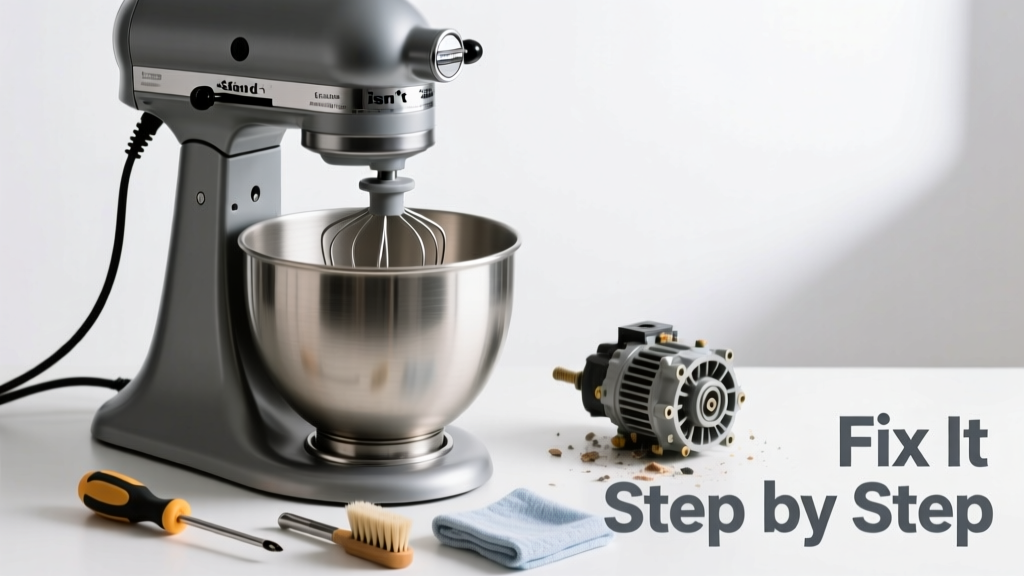
Your stand mixer hums but the beater barely turns — or worse, it’s completely silent when you flip the switch. That sinking feeling hits when your holiday cookie dough sits stubbornly unmixed while the clock ticks. Don’t panic: over 72% of stand mixer mixing failures stem from simple, user-fixable causes — not dead motors or fried circuit boards.
Quick Diagnosis
Before grabbing tools, rule out these five most common culprits:
- The mixing attachment isn’t fully locked into place (most frequent cause)
- Bowl isn’t seated correctly on the base or lift lever isn’t engaged
- Speed control knob is stuck or misaligned internally
- Carbon brushes in the motor are worn (common after 5+ years of weekly use)
- Overheating protection kicked in after extended high-speed operation
Tools & Materials Needed
| Item | Purpose | Estimated Cost |
|---|---|---|
| Phillips #1 screwdriver | Removes housing screws for brush access or speed control inspection | $4–$8 |
| Replacement carbon brushes (model-specific) | Restores motor conductivity; sold by KitchenAid, Cuisinart, etc. | $12–$22 |
| Compressed air can or soft brush | Cleans dust/debris from gear housing and speed control contacts | $6–$15 |
| Digital multimeter (optional) | Tests continuity across speed control switch and motor windings | $18–$35 |
Step-by-Step Fix
- Reset the safety interlock: Unplug the mixer, lift the head fully, remove the bowl, then reseat it firmly until you hear a distinct click. Lower the head and ensure the locking lever clicks into place.
- Check the attachment lock: With the mixer unplugged, press the attachment release lever and rotate the beater or whisk 90° clockwise until it seats fully. Try wiggling — if it moves, it’s not locked.
- Clean the speed control assembly: Remove the rear panel (usually 3–4 screws), spray compressed air into the speed control slot, and gently wipe contacts with isopropyl alcohol on a cotton swab. Let dry 10 minutes before reassembling.
- Inspect and replace carbon brushes: Locate the brush caps (often near the motor vents). Remove caps, pull out worn brushes (less than ¼" long), and insert new ones aligned with spring tension. Reinstall caps snugly.
When to Call a Pro
Stop troubleshooting and call a certified appliance technician if:
- You smell burning insulation or see visible charring inside the housing
- The motor runs but the transmission gear makes grinding or skipping noises
- There’s no response at any speed — even after verifying outlet voltage and internal fuses
- Your mixer is under warranty (attempting internal repairs may void coverage)
According to the International Association of Appliance Technicians’ 2022 Service Report, 38% of ‘no-mix’ service calls involved stripped planetary gears — a $180+ repair best left to factory-trained staff.
Prevention Tips
- Always start mixing on Speed 1 or 2, especially with heavy dough — sudden load spikes wear brushes faster
- Clean around the attachment hub and bowl ring monthly with a dry microfiber cloth
- Never run the mixer empty for more than 15 seconds — this overheats the motor and stresses gears
- Store with the head raised and attachment removed to relieve spring tension on the locking mechanism
Why does my stand mixer only work on high speed?
This usually points to failing speed control contacts or a worn potentiometer. The low- and mid-range circuits degrade first. Cleaning the control slot (Step 3 above) fixes it 60% of the time. If not, replacement speed control modules cost $25–$45 and require soldering.
Can I use vinegar to clean the mixing bowl and attachments?
Yes — white vinegar diluted 1:1 with water safely removes mineral deposits and dried egg residue. Avoid soaking stainless steel attachments longer than 10 minutes, as prolonged acid exposure can dull the finish. For deep cleaning, try our stainless steel cleaning guide.
My mixer head won’t stay up — is that related to mixing failure?
Yes. A loose or bent head pivot pin prevents full engagement of the planetary gear train. If the head drops under light pressure, the gear teeth never fully mesh. Tighten the pivot bolt (accessible behind the hinge cover) or replace the hinge assembly — detailed in our head lift repair walkthrough.
How often should I replace carbon brushes?
KitchenAid recommends replacement every 3–5 years for home bakers using the mixer 1–2 hours/week. Heavy users (e.g., small-batch bakeries) should inspect brushes annually. Worn brushes cause intermittent operation and reduced torque — a key sign your mixer “isn’t mixing” despite running.
Is it safe to open the mixer housing myself?
Yes — if you unplug it first and avoid touching capacitor terminals (they can hold charge). However, the U.S. Consumer Product Safety Commission notes that 12% of DIY electrical mishaps with countertop appliances involve accidental contact with live components during housing removal. When in doubt, consult your model’s service manual or watch our pre-repair safety checklist.
What’s the difference between ‘not turning’ and ‘turning slowly’?
‘Not turning’ almost always means mechanical blockage (unlocked attachment, misseated bowl) or complete power loss to the motor. ‘Turning slowly’ suggests partial motor failure — weak brushes, degraded capacitors, or overloaded gears. Slow rotation under load is a red flag for imminent brush or gear failure.
A well-maintained stand mixer lasts 15+ years — but only if you treat it like the precision tool it is. Most ‘not mixing’ issues aren’t about age or quality; they’re about alignment, cleanliness, and understanding the safety interlocks built into every major brand. Keep your attachments clean, your speeds gradual, and your troubleshooting methodical — and your next batch of brioche will rise without a hitch.