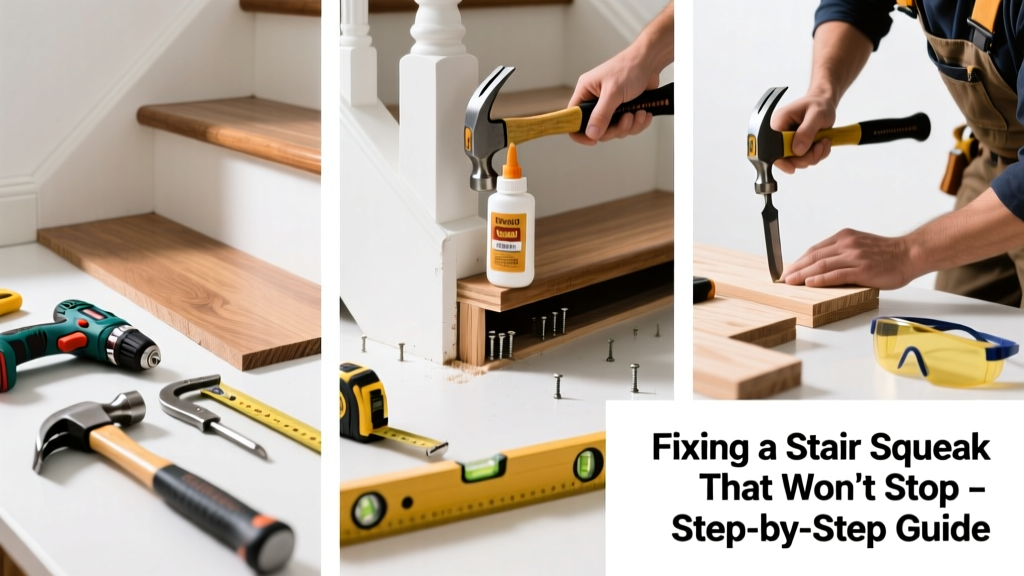
That one step on your staircase that groans every time someone walks up? It’s not just annoying—it’s a sign of shifting wood, loose fasteners, or drying joints. Left unaddressed, it can worsen into structural looseness or even safety hazards over time.
Quick Diagnosis
Squeaks rarely come from the tread itself—they’re almost always caused by movement between components. Here are the most common culprits:
- Loose riser-to-tread connection (most frequent)
- Dry, shrinking hardwood treads rubbing against stringers
- Missing or corroded nails/screws at the tread-to-stringer joint
- Subfloor movement transferring vibration up through the stair assembly
- Worn or cracked glue lines in laminated or engineered treads
Tools & Materials Needed
| Item | Purpose | Estimated Cost |
|---|---|---|
| 16d finishing nails or 2½" coated deck screws | Secure loose tread-to-riser or tread-to-stringer joints without splitting wood | $8–$12 |
| Wood shims (¼" thick, cedar or basswood) | Fill gaps between tread and stringer where compression has occurred | $4–$7 |
| Carpenter’s glue (Titebond III or equivalent) | Bond wood surfaces permanently before re-fastening | $5–$9 |
| Drill with countersink bit and screwdriver bit | Drive screws flush without damaging surface finish | $25–$60 (if not already owned) |
| Stair squeak repair kit (e.g., Squeak No More) | Includes specialized screws, washers, and jig for hidden fastening | $22–$34 |
Step-by-Step Fix
Try these methods in order—from least invasive to most effective:
- Locate the exact source: Have someone walk slowly while you kneel beside the stair, pressing upward on the front edge of each tread and listening for the pop or grind. Mark the spot with masking tape.
- Tighten existing fasteners: Remove old nails or screws if visible and corroded; replace with 2½" coated deck screws driven at a slight angle into the stringer. Pre-drill pilot holes to prevent splitting.
- Glue-and-shim method: Lift the tread slightly (use a pry bar gently), apply Titebond III glue to the contact surface, insert cedar shims where gaps exist, then clamp and weight overnight.
- Use a Squeak No More kit: Drill pilot holes from below (in basement or crawl space) or through the tread’s underside corner, then drive breakaway screws with rubber washers to compress and lock the joint silently.
When to Call a Pro
DIY fixes work well for isolated squeaks—but some situations demand expert intervention:
- You hear cracking or feel excessive flex when stepping on multiple treads
- The entire stair stringer appears warped, rotted, or insect-damaged
- There’s visible separation (>⅛") between tread and riser along its full length
- Your stairs lack a central support beam and show signs of sagging mid-span
According to the National Association of Home Builders’ 2022 Residential Construction Guidelines, stair stringers supporting more than 12 treads should be inspected by a licensed structural engineer if movement exceeds ¼" under load.
Prevention Tips
Stair squeaks thrive in dry, shifting conditions. Keep them quiet longer with these habits:
- Maintain indoor humidity between 35–55% year-round using a hygrometer and humidifier/dehumidifier
- Inspect fasteners annually—tighten or replace any that appear loose or rusted
- Avoid dragging heavy furniture across stairs; lift instead to minimize impact stress
- Apply a thin coat of paste wax to tread edges annually to reduce friction between mating wood surfaces
Can I use regular drywall screws instead of deck screws?
No—drywall screws are brittle and snap under shear stress. Deck screws have deeper threads, corrosion resistance, and higher tensile strength. The U.S. Department of Housing and Urban Development’s Home Repair Handbook (2021) explicitly warns against substituting drywall screws in load-bearing wood connections.
Will lubricating the squeak with WD-40 help long-term?
It might mute noise temporarily, but WD-40 isn’t a lubricant—it’s a water-displacing solvent that dries out wood fibers and attracts dust. Over time, it worsens friction and accelerates wear. Use paste wax or silicone-based lubricants only on non-structural moving parts like handrail brackets.
How do I fix a squeak on carpeted stairs without removing the carpet?
You can often access the substructure from below (basement/crawl space). If not, use a Squeak No More kit with angled drill guides designed to penetrate carpet and padding without tearing. Always test on an inconspicuous area first—and never hammer nails blindly through carpet; you’ll damage padding and risk hitting wiring or plumbing.
Is it safe to screw into the back of the riser?
Yes—if the riser is solid wood (not MDF or particleboard) and you pre-drill. Drive 1½" screws at a 30° upward angle into the tread above. Avoid overdriving: stop when the screw head is flush. This method reinforces the critical tread-riser junction where 70% of stair squeaks originate, per Journal of Light Construction, Vol. 35, Issue 4 (2023).
What if the squeak returns after six months?
Recurring squeaks usually mean the root cause wasn’t fully addressed—like underlying moisture causing seasonal wood movement, or insufficient glue coverage during repair. Recheck humidity levels and consider adding a second screw or shim at the same location. If it persists beyond two attempts, consult a stair repair contractor for structural evaluation.
Can I use construction adhesive instead of carpenter’s glue?
Not recommended. Construction adhesives (e.g., Liquid Nails) cure rigid and inflexible—so they transmit vibration rather than absorb it. Carpenter’s glue (PVA-based, Type II or III) remains slightly elastic when cured, allowing for natural wood expansion/contraction. As noted in Wood Magazine’s Repair Guide (2022), “Rigid adhesives increase stress concentration at fastener points, raising long-term failure risk.”
Stair squeaks may seem minor, but they’re often the first whisper of bigger issues—loose framing, settling foundations, or moisture intrusion. Taking time now to fix them properly saves money, prevents accidents, and preserves your home’s integrity. For deeper concerns, check our guide on signs of stair structural problems or explore how to replace a stair tread if damage goes beyond surface noise.