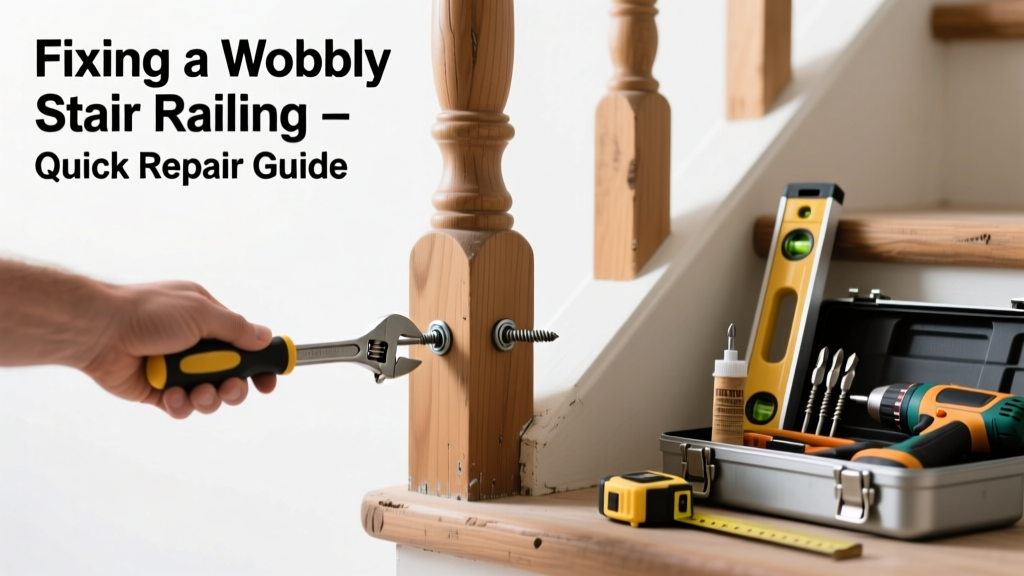
A wobbly stair railing isn’t just annoying—it’s a safety hazard. According to the National Safety Council, over 1 million stair-related injuries occur annually in U.S. homes, and loose railings contribute significantly to fall risk. Don’t wait until it fails under weight; tackle it now with targeted fixes.
Quick Diagnosis
Before grabbing tools, identify the source of movement. Most wobbles stem from one or more of these issues:
- Loose mounting screws at wall or newel post connections
- Rotted or cracked wood where brackets attach (especially outdoors or in damp basements)
- Stripped screw holes in drywall, plaster, or softwood
- Failed adhesive or epoxy in modern metal or glass railings
- Missing or broken internal fasteners inside hollow balusters or posts
Tools & Materials Needed
| Item | Purpose | Estimated Cost |
|---|---|---|
| Power drill with Phillips and square-drive bits | Drives screws securely and avoids cam-out on older fasteners | $45–$120 |
| 3/16" and 1/4" masonry bit (if anchoring into concrete or brick) | Creates clean pilot holes for anchors in non-wood substrates | $8–$15 |
| Heavy-duty toggle bolts or sleeve anchors (for hollow walls) | Provides deep, load-rated hold where studs aren’t accessible | $6–$12 per pack |
| Wood filler or epoxy resin (e.g., Abatron WoodEpox) | Fills stripped screw holes and restores structural integrity in wood | $18–$28 |
| Level and 4' straightedge | Verifies plumb alignment before and after tightening—critical for code compliance | $12–$35 |
Step-by-Step Fix
Apply these methods in order—start simple, escalate only as needed:
- Tighten all visible fasteners: Use a torque-appropriate driver (not an impact setting) to snug—not overtighten—every screw at wall brackets, newel post bases, and baluster connections.
- Reinforce stripped wood holes: Drill out damaged holes to 3/8", inject slow-cure epoxy, insert hardwood dowels coated in glue, let cure 24 hrs, then redrill pilot holes and reinstall screws.
- Anchor into framing, not just drywall: Use a stud finder to locate wall studs or joists; relocate brackets or add blocking behind drywall if original mounts missed framing entirely.
- Add hidden support brackets: Install L-brackets (3" x 3") between newel post base and floor framing—screw into both post and subfloor, concealed by carpet or trim.
When to Call a Pro
DIY stops where structural integrity and building code compliance begin. Call a licensed contractor if:
- The entire newel post rocks side-to-side more than 1/2 inch—even after tightening
- You find rot, insect damage, or crumbling masonry behind the mounting surface
- Your railing serves a commercial property or multi-family dwelling (IRC requires 200-lb concentrated load testing)
- The staircase lacks continuous handrail continuity or violates local height requirements (typically 34"–38" above stair nosings)
"A railing that deflects more than 1/4 inch under 200 pounds of force fails the International Residential Code test—and should be deemed unsafe immediately." — ICC Evaluation Service Report ESR-3947, 2022
Prevention Tips
Maintain stability year after year with these habits:
- Inspect all railing connections twice yearly—especially after seasonal humidity swings or home settling
- Replace standard drywall screws with #10 or #12 structural screws (e.g., GRK RSS) when reattaching to wood framing
- Seal exterior wood railings annually with penetrating oil to prevent moisture-driven rot at mounting points
- Label your circuit breaker panel and shut off power before drilling near wiring—many stairwell walls contain hidden cables
How tight should a stair railing feel after repair?
It should show no perceptible lateral movement when pushed firmly with one hand at waist height. A slight vertical flex (under 1/8") is acceptable in long runs—but any horizontal wiggle indicates insufficient anchorage or compromised material.
Can I use construction adhesive instead of screws?
No—adhesive alone doesn’t meet IRC load requirements. It can supplement mechanical fasteners (e.g., applied behind a bracket), but never replace them. The U.S. Department of Housing and Urban Development explicitly prohibits reliance on glue-only attachment for life-safety components like railings.
Why does my metal stair railing wobble even with tight screws?
Metal railings often wobble due to flex in thin-walled tubing or undersized mounting plates. Check for bent brackets or inadequate gusseting at joints. Reinforce with welded steel plates or switch to thicker-walled 1.5" schedule 40 pipe—don’t rely on clamping systems meant for temporary setups.
Do I need a permit to repair my stair railing?
Most jurisdictions don’t require permits for like-for-like repairs, but replacing an entire railing system, changing materials, or altering height/spacing does. When in doubt, check with your local building department—especially if your home was built before 2000, as older railings often predate current 200-lb load standards.
What’s the safest way to test my repair?
Apply steady, increasing pressure—not jerking—with your full body weight while holding a second person’s hand or a stable doorframe. If you hear creaking, see gaps open at joints, or feel movement beyond 1/8", stop and reassess anchorage. For peace of mind, use a digital deflection gauge (like the Bosch GLM50C) to measure movement precisely.
How do I fix a wobbly railing on stairs with carpeted landings?
Lift the carpet edge carefully near the newel post base. You’ll likely find missing blocking or rotted subfloor beneath. Cut a 6" x 6" access panel in the carpet backing, install 2x6 blocking between floor joists, anchor the post base through carpet and padding into solid wood—not just the carpet pad—and re-tack the carpet seamlessly.
A secure stair railing shouldn’t sway, squeak, or inspire hesitation every time someone uses the stairs. With methodical diagnosis and the right reinforcements, most wobbles resolve in under two hours—and restore confidence in one of your home’s most critical safety features. Keep your tools handy and inspect seasonally—you’ll catch small issues before they become hazards.