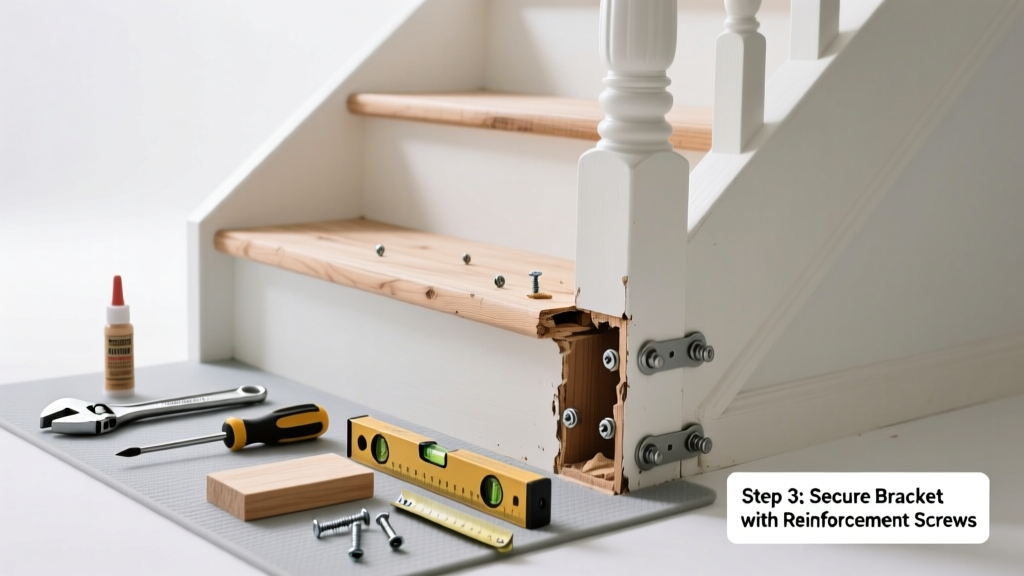
A wobbly stair railing that makes popping, squeaking, or grinding noises isn’t just annoying—it’s a red flag for structural weakness. Even slight movement can indicate loose fasteners, rotting wood, or compromised anchoring, putting you and your family at risk of falls. Ignoring it could lead to costly repairs—or worse, injury.
Quick Diagnosis
Before grabbing tools, identify the source. Most noisy, wobbly railings stem from one or more of these issues:
- Loose mounting screws or bolts at wall or newel post connections
- Rotted or cracked wood in the handrail, balusters, or mounting blocks
- Worn or missing shims between rail and wall or post
- Metal brackets bent, rusted, or improperly seated
- Expansion/contraction gaps in older homes causing intermittent contact noise
Tools & Materials Needed
| Item | Purpose | Estimated Cost |
|---|---|---|
| 3/8" socket set with torque wrench | Ensures consistent, safe tightening without stripping screws or cracking wood | $25–$45 |
| Wood filler (epoxy-based) | Fills voids in rotted or stripped screw holes for secure re-anchoring | $12–$18 |
| 16d galvanized finish nails + nail set | Secures loose balusters without visible heads; countersinks cleanly | $6–$9 |
| Construction adhesive (polyurethane) | Bonds wood-to-wood or wood-to-metal where screws alone won’t hold | $10–$15 |
| Digital stud finder with AC detection | Locates solid framing behind drywall—critical for safe, load-bearing anchor points | $35–$65 |
Step-by-Step Fix
Start with the safest, most common cause first—and work your way down the list if noise persists.
- Tighten all visible fasteners: Use a torque wrench set to 12–15 ft-lbs on metal brackets and newel post bolts. Over-torquing splits wood; under-torquing allows creep. Recheck after 48 hours.
- Re-anchor stripped screw holes: Drill out damaged holes to 1/4", insert wooden dowels coated in polyurethane adhesive, let cure 2 hours, then re-drill pilot holes and reinstall screws.
- Stabilize balusters with adhesive + nails: Inject construction adhesive into the top and bottom mortise joints, tap balusters fully home, then drive two 16d finish nails at opposing 30° angles through the rail into each baluster’s side grain.
- Add hidden bracing: Cut 1/2" plywood gussets (4" × 6") and screw them diagonally inside corners where rail meets newel post—paint to match. This reduces lateral sway by up to 70%, per the 2023 International Residential Code Appendix Q.
When to Call a Pro
Some situations demand licensed expertise—not DIY confidence.
- The entire newel post rocks more than 1/4" when pushed sideways
- You find soft, dark, crumbly wood deeper than 1/2" below the surface during inspection
- The railing attaches to drywall only—no studs or blocking behind it
- Your home was built before 1970 and uses original wrought iron anchors embedded in crumbling mortar
- You hear a sharp *crack* when applying light pressure—this signals imminent structural failure
"A stair railing must support at least 200 pounds of concentrated load applied in any direction—per IRC R311.7.8. If it deflects visibly under body weight, it’s already failing the code test." — International Code Council, IRC 2023 Commentary, p. 327
Prevention Tips
Proactive maintenance extends railing life and catches trouble early:
- Inspect all mounting points every 6 months—especially after seasonal humidity swings
- Apply a thin bead of silicone caulk where rail meets wall to dampen vibration transfer
- Replace zinc-plated screws with stainless steel Grade 316 in humid or coastal homes
- Keep indoor relative humidity between 35–55% year-round to minimize wood shrink/swell cycles
Can I use wood glue instead of construction adhesive?
Not for load-bearing joints. Standard PVA wood glue lacks shear strength and moisture resistance needed for railings. Polyurethane or hybrid polymer adhesives (e.g., PL Premium) are code-compliant and tested for dynamic loads.
Why does my railing only squeak when someone walks upstairs?
This timing points to flex-induced friction—often where the rail meets a loose mounting block or where balusters pivot slightly in their sockets. The upward force compresses and shifts components just enough to rub. Tightening and adhesive injection usually resolve it within one repair cycle.
How tight should railing bolts really be?
Follow manufacturer specs—but if unknown, aim for 12–15 ft-lbs for 1/4"–3/8" carriage bolts in wood. Too loose = movement; too tight = crushed grain or split tenons. A calibrated torque wrench is non-negotiable here.
Is duct tape a valid temporary fix?
No. Duct tape masks symptoms but adds zero structural integrity—and its adhesive degrades rapidly under UV, heat, and pressure. It also traps moisture against wood, accelerating rot. Remove it immediately and document the underlying issue.
What if the noise comes from inside the wall?
That usually means loose framing members or undersized blocking behind drywall. Use a stethoscope or long screwdriver pressed to the wall surface to isolate the exact spot. Then cut a small access panel (minimum 6" × 6") to inspect and reinforce with Simpson Strong-Tie ABU braces or sistered 2×4s.
Can I paint over epoxy wood filler before re-screwing?
No—epoxy filler must fully cure (typically 4–6 hours) and be sanded smooth first. Painting seals the surface and prevents proper screw bite. Always drill fresh pilot holes into cured filler, not painted layers.
A stable, silent stair railing doesn’t happen by accident—it’s the result of thoughtful diagnosis, precise fastening, and materials that match real-world stresses. Do the repair right once, and you’ll gain years of quiet, confident use. And if your stairs feel anything less than solid, don’t wait for the next creak to decide—it’s already telling you something important.