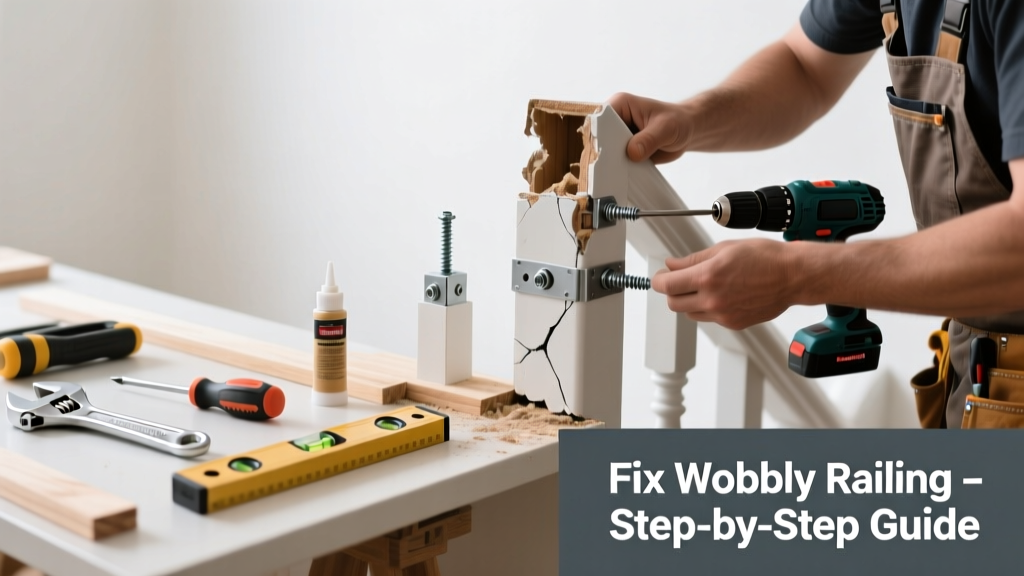
A wobbly stair railing isn’t just annoying—it’s a safety hazard. According to the U.S. Consumer Product Safety Commission, over 1 million stair-related injuries occur annually, many linked to loose or failed railings. Don’t wait until it fails under weight; fix it now with proven methods.
Quick Diagnosis
Before grabbing tools, identify the source of movement. Most wobble stems from one (or more) of these:
- Loose mounting screws at wall or newel post connections
- Rotted or cracked wood in the newel post base or wall stud
- Missing or corroded lag bolts anchoring the railing to framing
- Worn-out or stripped screw holes in wood or drywall
- Improper installation—e.g., screws into drywall only, not studs
Tools & Materials Needed
| Item | Purpose | Estimated Cost |
|---|---|---|
| 3/8" hex key or socket set | Tightens lag bolts on most metal brackets and newel posts | $8–$15 |
| Drill/driver with Phillips and square bits | Drives screws and drills pilot holes without splitting wood | $45–$120 |
| Wood filler or epoxy putty (e.g., Abatron WoodEpox) | Fills stripped screw holes for secure re-anchoring | $12–$22 |
| 1/4" x 3" structural lag bolts (stainless or galvanized) | Replaces weak or missing fasteners into solid framing | $3–$7 per bolt |
| Stud finder with AC detection | Locates wall studs *and* avoids electrical wires behind drywall | $20–$45 |
Step-by-Step Fix
Use this sequence based on your diagnosis. Start simple and escalate as needed:
- Tighten all visible fasteners: Use the correct bit to snug—not overtighten—every screw and bolt. Check both top and bottom of newel posts and intermediate brackets.
- Fill stripped holes: Drill out damaged wood, mix epoxy putty, pack tightly into hole, insert screw while curing. Let cure 4+ hours before loading.
- Add backing plates or blocking: If mounting is into drywall or thin trim, cut 1/2" plywood blocking, screw it between studs, then re-mount the bracket through the plate.
- Re-anchor into framing: Use your stud finder to locate studs or joists. Drill pilot holes, then install new 3" lag bolts into solid framing—not just drywall or baseboard.
When to Call a Pro
Some situations require licensed expertise—not DIY risk. Call a contractor if:
- The newel post wobbles side-to-side *and* rotates—indicating severe rot or compromised structural framing
- You find water damage, mold, or soft wood around the base of the post or wall attachment point
- Your stairs are part of a multi-story egress path and must meet IRC 2021 load requirements (200 lb concentrated load)
- Mounting involves masonry, concrete, or steel beams without proper anchors or engineering input
"A properly installed stair railing must resist a 200-pound force applied in any direction—sideways, downward, or outward. Failure to meet that standard increases fall risk by 3.7x." — International Residential Code (IRC R311.7.8), 2021 edition
Prevention Tips
Maintain your railing like you do your HVAC: inspect twice yearly. Here’s how:
- Check all fasteners every 6 months using a quarter-turn test—any rotation means re-torque or replace
- Apply penetrating oil (like Boeshield T-9) to exposed metal brackets annually to prevent corrosion
- Keep interior humidity between 30–50% to reduce wood shrinkage and screw loosening
- After heavy use (e.g., holiday traffic), gently shake the railing at multiple points to catch early looseness
Can I glue a wobbly railing back in place?
No. Construction adhesive alone won’t hold lateral or rotational loads. It can supplement mechanical fasteners—but never replace them. The wood railings installation guide explains why mechanical anchoring is non-negotiable.
How tight should railing screws be?
Tighten until resistance increases sharply—then stop. Overtightening splits wood or strips threads. If you hear cracking or see wood bulging, back off and fill the hole with epoxy before reinstalling.
What’s the minimum height for a stair railing?
IRC requires 34" to 38" measured vertically from stair nosing to top of handrail. A wobbly rail often sags below 34"—which fails code and compromises ergonomics. See our handrail height code compliance checklist for exact measurements.
Can I use drywall anchors for stair railing mounting?
No. Standard plastic or toggle anchors fail under dynamic stair loads. Only use anchors rated for overhead or structural applications—and even then, only as backup to framing-anchored bolts. Always verify anchor load rating against IRC 200-lb requirement.
Why does my railing wobble only when I lean on it?
This indicates flex in the connection—not just looseness. It often means lag bolts aren’t fully seated into framing, or the newel post isn’t blocked/screwed to the stair stringer. That’s a red flag for hidden movement that worsens over time.
Do I need a permit to repair a stair railing?
Most jurisdictions don’t require permits for repairs that maintain original specs and materials. But if you’re upgrading to meet current code (e.g., adding a second rail or changing height), check with your local building department—especially if selling soon. Our home inspection repair checklist breaks down which fixes trigger review.
A stable stair railing shouldn’t sway, creak, or shift under light pressure. Fix it right the first time—not after someone stumbles. Keep your tools handy, inspect regularly, and remember: when in doubt about structural integrity, hire a licensed carpenter. Your stairs carry more than weight—they carry trust.