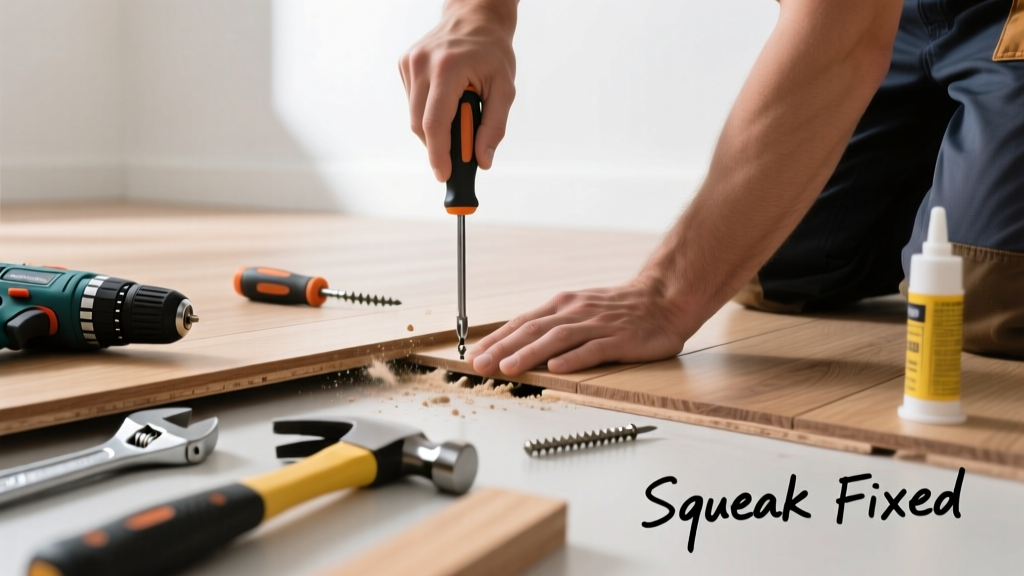
That sudden pop when you step near the hallway closet—or the low groan under the dining table—doesn’t just annoy. It often signals shifting subfloor, loose fasteners, or even moisture damage beneath the surface. Ignoring unusual floor noise can lead to bigger problems, like compromised joist integrity or mold growth in hidden cavities.
Quick Diagnosis
Unusual noises differ from standard creaks—and each points to a specific issue:
- Hollow drumming: Subfloor not glued or screwed to joists (common in older homes with nail-only attachment)
- Sharp metallic 'ping': A loose nail head vibrating against wood or metal ductwork below
- Wet-sounding squish or gurgle: Indicates trapped moisture or condensation under flooring—especially near bathrooms or basements
- Rhythmic thumping during HVAC cycles: Duct expansion/contraction rubbing against floor framing
- Crackling like Rice Krispies: Dry, shrinking hardwood planks or deteriorating particleboard underlayment
Tools & Materials Needed
| Item | Purpose | Estimated Cost |
|---|---|---|
| Stud finder with deep-scan mode | Locates joists through finished flooring without guesswork—critical for targeting fixes | $35–$65 |
| 18-gauge finish nails + pneumatic nailer | Drives nails at precise angles to secure subfloor without surface damage | $120–$220 (rental: $25/day) |
| Construction adhesive (PL Premium) | Bonds subfloor to joists permanently—stops vibration better than nails alone | $12–$18/tube |
| Shims (cedar or composite) | Fills gaps between joist and subfloor where sagging has occurred | $4–$9/pkg |
| Drill with countersink bit & 2" deck screws | Secures squeaky areas from below (if accessible) or top-down with plug cover | $45–$85 |
Step-by-Step Fix
Match your noise type to the method below. Most homeowners resolve >80% of unusual floor noises using one of these approaches:
- Top-down subfloor re-attachment: Use a stud finder to locate joists, then drive 2" coated deck screws every 6" along the joist line—countersink and fill holes with wood putty. Works best for hollow drumming and rhythmic thumps.
- Subfloor glue-down: Drill 1/4" pilot holes every 8" along joists, inject PL Premium adhesive via caulk gun, then clamp or weight area for 24 hours. Ideal for crackling or widespread looseness.
- Shim-and-screw from below: Accessible only from basement/crawlspace. Slide cedar shims into gaps between joist and subfloor, then secure with 3" structural screws. Best for wet-sounding or localized sagging.
- Nail-set + lubricant for metallic pings: Tap loose nail heads flush with a nail set, then apply powdered graphite or beeswax into the hole before covering with matching wood filler.
When to Call a Pro
Don’t risk injury or structural compromise if you observe any of these:
- Floors flex or dip more than 1/8" when stepped on (sign of joist deflection or rot)
- Moldy odor or visible water staining near the noisy area (may indicate active leak or decay)
- Multiple rooms affected simultaneously—suggests whole-house framing movement or foundation settlement
- Noise coincides with electrical buzzing or flickering lights (possible wiring contact with framing)
According to the Insurance Institute for Business & Home Safety's 2023 report, 22% of floor-related insurance claims involve undiagnosed moisture damage that began as 'just a squeak.'
Prevention Tips
Long-term quiet starts with climate control and smart maintenance:
- Maintain indoor humidity between 35–55% year-round—use a hygrometer and dehumidifier in basements
- Install transition strips at room thresholds to isolate movement between dissimilar flooring materials
- Re-torque subfloor screws every 5 years in high-traffic zones (e.g., kitchen entry, stair landings)
- Avoid dragging heavy furniture—lift or use felt pads to prevent micro-shifts in fastener alignment
Can I use WD-40 on a squeaky floor?
No—WD-40 is a solvent-based lubricant that dries out wood fibers over time and attracts dust. It may silence a nail temporarily but accelerates joint wear. Use powdered graphite or paraffin wax instead.
Will carpet padding stop unusual floor noise?
Not reliably. While thick padding muffles surface creaks, it does nothing for structural movement causing pops or thuds. Padding can even mask worsening conditions until failure occurs.
How do I know if my joists are rotten?
Probe suspect areas with an awl—if wood crumbles or penetrates deeper than 1/4", it’s compromised. Look for dark discoloration, fungal growth, or a musty smell near support beams. When in doubt, hire a licensed home inspector—wood rot inspection costs $150–$300 and prevents costly repairs.
Can I fix this without removing flooring?
Yes—in most cases. Top-down screwing, adhesive injection, and shim installation (from below) preserve finished surfaces. Only severe subfloor delamination requires partial floor removal—see our guide on hardwood floor repair for those scenarios.
Why does my floor squeak more in winter?
Low indoor humidity shrinks wood, increasing gaps between subfloor and joists. The U.S. EPA estimates that 14% of household water usage is from leaks—but dry air accounts for nearly 30% of seasonal floor noise complaints.
Do I need to replace the entire subfloor?
Rarely. Less than 5% of squeaky floor cases require full subfloor replacement. Most issues stem from fastener fatigue or minor settling—not material failure. Focus first on re-securing and gluing existing layers.
Once you’ve silenced that odd pop or thud, walk the room barefoot at night—you’ll notice the difference immediately. Quiet floors aren’t just comfortable; they’re evidence your home’s structure is stable and well-maintained. Keep a small jar of cedar shims and a tube of PL Premium in your garage—it’ll pay for itself the next time a new noise starts up.