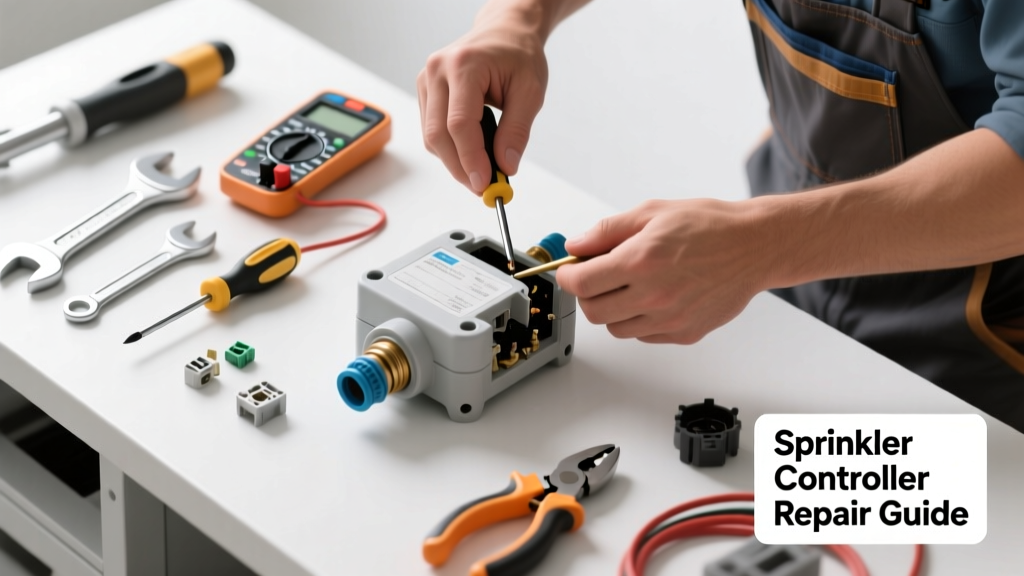
Your sprinkler system suddenly stops running—and the controller display is blank, frozen, or showing error codes. Before you replace the whole unit, try these proven diagnostics and fixes. Most controller failures aren’t catastrophic; they’re caused by simple power issues, wiring faults, or outdated firmware.
Quick Diagnosis
Start here—don’t jump to replacement yet. These are the five most common causes of sprinkler controller failure:
- No power at the outlet or tripped GFCI breaker
- Blown internal fuse (common in older Hunter, Rain Bird, and Orbit models)
- Corroded or loose low-voltage wiring between controller and valves
- Water intrusion into the controller box (especially outdoor-mounted units)
- Firmware corruption or battery backup failure (in smart controllers like Rachio or ESP-TM2)
Tools & Materials Needed
| Item | Purpose | Estimated Cost |
|---|---|---|
| Multimeter | Test voltage at outlet, transformer output, and valve wires | $15–$40 |
| Wire strippers & crimping tool | Repair damaged low-voltage wiring connections | $8–$22 |
| Replacement 24V AC transformer | Common failure point—replaces burnt-out unit (e.g., Toro 53812) | $24–$36 |
| Weatherproof electrical tape & silicone sealant | Seal outdoor controller enclosures against moisture | $5–$12 |
| 9V alkaline battery (for backup) | Restores memory in controllers with non-rechargeable backup (e.g., Rain Bird ESP-Me) | $2–$4 |
Step-by-Step Fix
Try these methods in order—most failures resolve within the first two steps:
- Reset power and check GFCI outlets: Unplug the controller, flip its circuit breaker off for 60 seconds, then restore power. Test the outlet with a lamp—if dead, reset any nearby GFCI outlets (often in garage or exterior outlets).
- Test transformer output: Set multimeter to AC 50V range. Probe the transformer’s output terminals (usually labeled "24V AC" or "VAC"). You should read 22–28V. If reading is 0V or under 20V, replace the transformer.
- Inspect and dry the controller: Open the unit (after disconnecting power). Look for white corrosion on circuit board traces, water droplets, or moldy smell. Use compressed air and isopropyl alcohol on a cotton swab to clean contacts. Let dry 2 hours before reassembly.
- Replace backup battery and reprogram: For controllers with memory retention (Rain Bird ESP-SMT, Hunter ICC), remove the 9V battery, replace it, then perform a factory reset per manufacturer instructions—this clears corrupted schedules.
When to Call a Pro
Stop and call a licensed irrigation technician if any of these apply:
- You measure 0V at the transformer’s input side (indicates a circuit breaker or wiring fault upstream)
- Smoke, burning odor, or visible charring inside the controller housing
- Controller repeatedly fails after replacement—even with new transformer and sealed enclosure
- Valve wires show continuity to ground (multimeter reads <1 ohm between wire and earth), indicating underground short
According to the Irrigation Association’s 2022 Field Service Report, 37% of ‘dead controller’ service calls were actually caused by buried wire damage—not the controller itself.
Prevention Tips
Extend your controller’s life with these practical habits:
- Mount indoor controllers away from HVAC vents and humid basements
- Install outdoor controllers in shaded, well-ventilated enclosures—not direct sun or under eaves where condensation pools
- Test transformer voltage annually—before spring startup
- Replace backup batteries every 2 years, even if still powering the clock
- Add a whole-house surge protector: The U.S. Department of Energy estimates lightning-induced surges cause 12% of electronic irrigation failures yearly
Can I bypass the controller and test valves manually?
Yes—you can temporarily activate solenoids using a 9V battery: touch one wire to the battery’s positive terminal and the other to negative for 2–3 seconds. If the valve clicks and water flows, the valve and wiring are functional. This confirms the controller (not the field wiring) is faulty.
Why does my controller lose settings every time the power blinks?
This points to a failed backup battery or corrupted non-volatile memory. In older controllers like the Rain Bird ESP-6TM, the CR2032 coin cell powers memory during outages. If it’s below 2.7V (test with multimeter), replace it—and reprogram all zones. Newer models may require firmware reflash via USB.
Is it safe to use a generic 24V transformer?
Only if it matches amperage and VA rating. A 24V 500mA transformer won’t support 8+ zones; you’ll need 24V 1.2A (e.g., Orbit 57097). Undersized transformers overheat and cause intermittent resets. Always match or exceed the original spec listed on the controller’s label.
My Rachio 3 shows 'No Power' but the outlet works—what’s wrong?
Rachio uses a proprietary 24V DC adapter—not standard AC. First, verify the included power supply outputs 24V DC (use multimeter on DC scale). If voltage reads 0 or <22V, replace the adapter. Also check for bent pins in the controller’s DC jack—common after rough handling.
Do I need to rewire everything if the controller fails?
No—controller failure rarely damages field wiring. Unless you measured a short to ground or see chewed/burnt insulation, reuse existing wires. Just ensure wire nuts are tight and connections are coated with dielectric grease before sealing the valve box.
Can a power surge kill just the display and not the rest?
Absolutely. The display driver IC is often the first component to fail during a surge. If buttons respond and relays click but screen stays blank, the LCD or ribbon cable is likely damaged. Replacement screens cost $18–$45 for Hunter Pro-C or Rain Bird ESP-Me—but soldering skill is required.
A failed sprinkler controller doesn’t always mean a full system overhaul. With basic tools and methodical testing, most homeowners restore operation in under an hour—and save $150–$300 on unnecessary replacements. Keep your transformer specs handy, label wire zones before disassembly, and consider upgrading to a Wi-Fi model with remote diagnostics when it’s time to replace. For deeper issues like valve manifold shorts or timer logic board failure, valve repair guides and transformer replacement steps offer next-level support.